Lifetime Citizen Portal Access — AI Briefings, Alerts & Unlimited Follows
United Nations marks 80th anniversary of Auschwitz liberation; leaders warn of rising antisemitism
Loading...
Summary
Leaders at the United Nations commemorated the 80th anniversary of Auschwitz-Birkenau's liberation, recalled victims and survivors, and urged renewed efforts to combat antisemitism, Holocaust denial and distortion.
The United Nations held an observance on Jan. 27, 2025, marking 80 years since the liberation of Auschwitz-Birkenau, with the secretary-general, the president of the General Assembly, ambassadors and Holocaust survivors calling for intensified education and action against antisemitism, denial and historical distortion.
The ceremony, opened by Under-Secretary-General for Global Communications Melissa Fleming, brought survivors, heads of state and permanent representatives to the General Assembly Hall to remember the victims and to press for renewed efforts to guard against hate. Secretary-General Antonio Guterres said the world must “condemn antisemitism wherever and whenever it appears” and called for education to “combat lies, and speak the truth.”
Why it matters: speakers framed the commemoration as a test of international memory and institutions. Across remarks, officials warned that the same forces of hate and dehumanization that fueled the Holocaust are resurfacing in new forms — from denial and distortion to rising antisemitic attitudes — and urged states and institutions to take concrete steps to counter them.
Guterres told the assembly that the Holocaust’s history “is to understand how the Nazis were able to commit their heinous crimes with the complicity of others,” and said the United Nations must “promote education, combat lies, and speak the truth.” He recalled the postwar creation of international legal and human-rights frameworks and invoked the Universal Declaration of Human Rights and the Convention on the Prevention and Punishment of the Crime of Genocide as foundations of those efforts.
Philemon Young, president of the 79th session of the General Assembly, said the commemoration “marks 80 years since the liberation of Auschwitz Birkenau” and urged vigilance against “holocaust denial” and “the resurgence of hate speech, antisemitism, xenophobia, and discrimination.”
The U.S. representative, identified in the program as Ambassador Dorothy Shea, cited recent survey data from the Anti-Defamation League’s Global 100, saying it found “46% of adults harbor elevated levels of anti Semitic sentiment,” and noting the ADL’s estimate of roughly 2,200,000,000 people worldwide with elevated antisemitic attitudes. Shea urged member states to implement existing international guidelines and to adopt the International Holocaust Remembrance Alliance working definition of antisemitism.
Survivors and family witnesses framed remembrance as both personal testimony and a public warning. Survivor Marianne Muller described scenes from Budapest in 1944 and implored listeners: “This thing should never never happen again.” Dimitru Miklescu, a Roma survivor who said he was deported to camps in Transnistria, urged countries to include Roma history in national museums and curricula.
Representatives of regional blocs and member states also spoke. The European Union delegation reflected on European postwar unity as a response to the Holocaust and said remembrance must spur action “to keep fighting antisemitism and all other types of insidious discrimination.” The Russian Federation delegation emphasized the role of the Red Army in liberating Auschwitz and submitted a letter to the secretary-general documenting recent examples of “glorification of Nazis and their accomplices,” saying preservation of truth about the Holocaust is a shared duty.
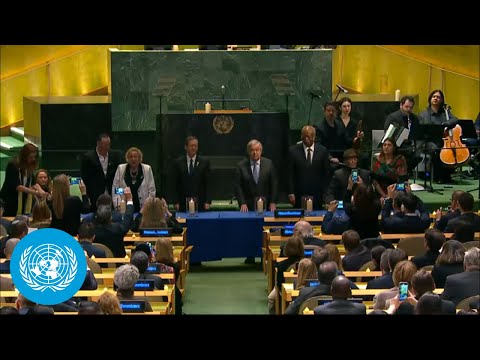
Speakers repeatedly emphasized education, remembrance, and institutional action as countermeasures. The ceremony included musical and liturgical presentations and concluded with the lighting of memorial candles led by dignitaries and survivors.
The observance did not include formal votes or decisions; it was a commemorative session combining testimony, statements by officials, and cultural presentations.