Get Full Government Meeting Transcripts, Videos, & Alerts Forever!
Get email alerts on the State Finance Investments topic
No spam. Unsubscribe anytime.
Committee rejects proposal to let state invest up to 3% of permanent funds in Bitcoin
Summary
After testimony from the state treasurer's office and cryptocurrency advocates, the committee voted 1–7 (one aye, seven nos, one excused) against a bill that would have allowed up to a 3% allocation of specified permanent funds into Bitcoin or Bitcoin ETFs; members cited existing investment processes and volatility concerns.
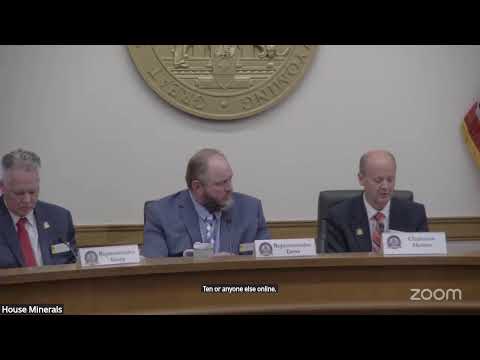
The Minerals, Business & Economic Development Committee voted down a bill that would have permitted the state treasurer to invest up to 3% of the Permanent Wyoming Mineral Trust Fund and the Permanent Land Fund in Bitcoin or Bitcoin-linked exchange-traded funds.
Sponsor Representative Jacob Wasserburger said the bill was intended to give the treasurer the option — not a mandate — to allocate up to 3% of the two permanent funds to Bitcoin to preserve purchasing power against inflation. Wasserburger cited a study that found a modest allocation to Bitcoin would have outperformed a treasury-only allocation from 2018–2024.
State Treasurer Curt Meier and deputy staff provided written and oral testimony explaining the office’s perspective. Treasurer Meier said the treasurer’s office did not solicit the bill and emphasized that any new asset allocation must pass through the office’s existing governance processes — the investment-funds committee, consultants and the State Loan and Investment Board — and comply with the prudent-investor rule. Deputy Treasurer Don Williams and CEO Patrick Fleming added operational concerns; Fleming said the bill as written could be read as a mandate in one clause and noted Bitcoin’s historic volatility and concentration of holdings among early miners as risk factors.
Treasury staff said the office can, under current rules, invest in Bitcoin exposure via an SEC‑registered ETF without statutory change, and cautioned that the bill’s proposed rulemaking directives were unnecessary because the treasurer already works under an Investment Policy Statement and State Loan and Investment Board oversight.
Proponents, including the Satoshi Action Fund, argued a small allocation could protect purchasing power and pointed to safeguards in the bill: a 3% cap, options to hold exposure through SEC‑regulated ETFs or geographically diversified custodial solutions, and limits on how holdings would be secured.
After discussion the committee voted on the bill; the roll call was: Representative Campbell — Aye; Representative Knapp — No; Representative Larson — No; Representative Lalley — No; Representative Riggins — Excused; Representative Schmidt — No; Representative Tarver — No; Representative Weber — No; Chairman Heiner — No. The clerk reported one aye, seven no, one excused; the measure failed to advance.
Ending: Committee members said the treasurer’s existing investment governance and the ability to gain Bitcoin exposure through ETFs made the statutory change unnecessary; concerns about volatility and the state’s risk tolerance were central to the vote.