Get Full Government Meeting Transcripts, Videos, & Alerts Forever!
Get email alerts on the Education topic
No spam. Unsubscribe anytime.
Corning Community College cites top graduation rate, expanding short-term workforce programs
Summary
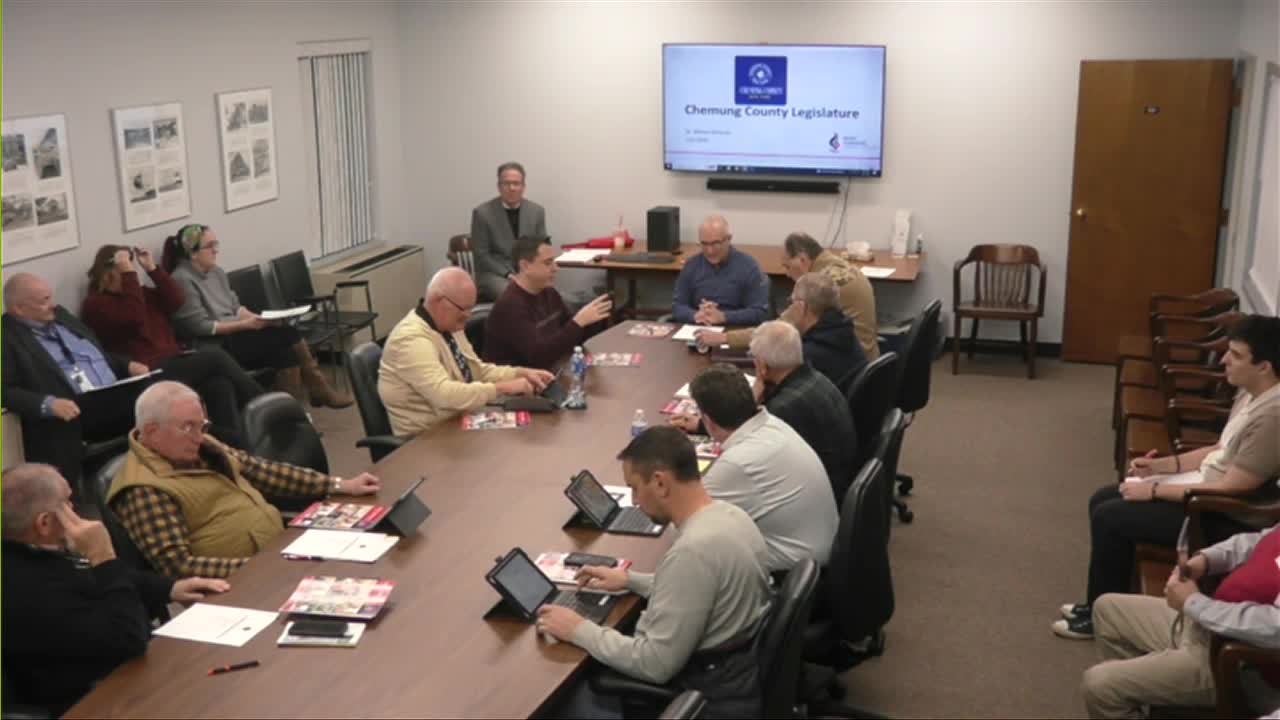
Dr. Malaney, president of Corning Community College, told the Chemung County Legislature committees on Jan. 27 that the college achieved the highest graduation rate among New York community colleges and is shifting toward shorter workforce programs and grant-driven student supports.
Dr. Malaney, president of Corning Community College, told the Chemung County Legislature committees on Jan. 27 that the college achieved the highest graduation rate among New York community colleges and is shifting toward shorter workforce programs and grant-driven student supports.
"Among all 30, we hit a 40% graduation rate," Malaney said, adding the figure was about 5 percentage points above the second-ranked college and well above SUNY and national averages. He said the college also completed its accrediting review with full reaccreditation and 16 best-practice findings.
That statistic, Malaney said, reflects recruiting, retention and completion efforts. He described a return to positive enrollment after a decade-long decline — a 2.2% increase last year — and said the college expects to finish the academic year roughly flat against ambitious demographic headwinds.
Why it matters: community college graduations and short-term credential programs are a major local workforce pipeline. Malaney framed recent program changes as a response to employer needs and state policy attention.
The college has refocused some programs to meet local employer demands. Malaney said the auto technology credential shifted from a two-year degree to a one-year certificate after manufacturers asked for shorter, skills-based training. He also described a battery-technology program developed with Binghamton University, funded through a federal grant in the university’s Build Back Better–style award, that the college runs as a short-term (about one-month) training with high job placement rates.
"We converted from a 2 year degree program to a 1 year certificate program," Malaney said, adding that the battery program places graduates quickly into jobs.
Malaney highlighted workforce outcomes such as the largest recent graduating class from the Southern Tier law-enforcement cadet program (36 graduates) and a student success example: a former student who returned after an initial dropout and later earned internships at NASA and a scholarship to Yale.
Financial and grant picture: the college has created a grants office and reported a cluster of new awards, including a National Science Foundation grant and other state and federal awards that Malaney said support student tuition and program development. He said the college has benefited from SUNY internship funding that paid 36 student internships last year and praised Governor proposals he described as positive for adult nontraditional student recruitment.
Questions from county legislators focused on graduate destinations and local retention. Malaney said he did not have full placement statistics at the meeting but said many graduates — particularly nursing and machining students — stay in the region, taking jobs at local hospitals and manufacturers.
The presentation closed with upcoming campus events and a note that the college is emphasizing ‘‘microcredentials’’ and short-term industry-recognized certificates as a growth area.
Looking forward: Malaney asked the legislature to continue supporting the college’s annual appropriation and flagged the New York State Opportunity Promise proposal as potentially aiding adult enrollment if funding and details are finalized.