Get Full Government Meeting Transcripts, Videos, & Alerts Forever!
Get email alerts on the Utilities Regulation topic
No spam. Unsubscribe anytime.
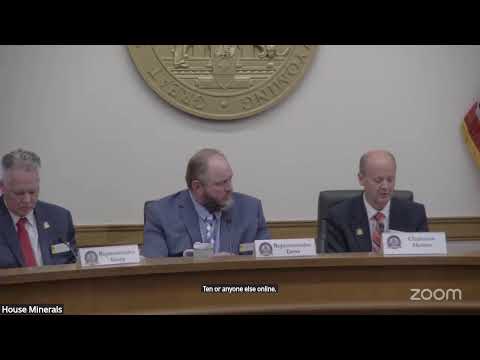
Committee tables bill on utility allocation agreements after lengthy testimony from co-ops and oil-and-gas interests
Summary
The Minerals, Business & Economic Development Committee tabled House Bill 184 after extended testimony about whether statutory changes are needed to enforce customer allocation agreements and how the Public Service Commission should resolve disputes when utilities or third parties serve customers inside another utility’s certificated territory.
The Minerals, Business & Economic Development Committee tabled House Bill 184 after extended testimony from rural electric cooperatives, the Public Service Commission, and oil and gas industry representatives about how customer allocation agreements are enforced and whether statutory changes are necessary.
Sponsor Representative J.D. Williams said the measure would amend Public Service Commission law to bar a person or entity from "sell[ing] electricity for use by a customer in another public utility certificated service territory" without a customer allocation agreement among the seller, the customer and the utility in whose territory the customer is located. Williams said the intent is to protect not-for-profit member-owned rural electric cooperatives from loss of load and revenue when neighboring utilities or third parties serve customers inside a coop’s certificated area.
Wyoming Public Service Commission Chair Mary Throne told the committee the PSC already has complaint and enforcement processes and said the commission is preparing a rule that would require utilities to notify the PSC when they become aware of service across territory lines; she said the PSC’s planned rulemaking could address the main dispute-resolution issue raised in testimony. Commissioner Throne warned that litigation among utilities could shift costs to ratepayers.
Representatives of rural electric cooperatives described two long, costly disputes in which oil-and-gas companies or outside lines provided service inside a cooperative’s territory. Northeast Electric Association (NEA) said resolving a past incursion required a multi-year legal process and cost the coop hundreds of thousands in legal fees; that dispute has been resolved by a customer allocation agreement and a meter at the boundary. Cooperatives urged a statutory backstop so that future incursions can be resolved more quickly.
Industry groups, including the Petroleum Association of Wyoming, opposed the bill and urged a path that would preserve oil-and-gas development while ensuring utilities can reach agreement. The Petroleum Association and other industry speakers said prior disputes had been resolved privately and that the commission’s pending rulemaking could provide a path forward without imposing a statutory veto on development.
Other evidence offered to the committee included examples of contributions-in-aid-for-construction and project costs: witnesses described a 22‑mile NEA project costing roughly $2.8 million and an oil company contribution of about $12 million on a transmission upgrade; witnesses said typical line-extension costs can run $100,000 per mile for a 69 kV line and that industrial connections sometimes require substantial developer funding.
After testimony, Representative Lawley moved to table the bill indefinitely to allow parties and the PSC rulemaking to develop a dispute-resolution pathway; the committee approved the motion to table by voice vote.
Ending: The committee tabled House Bill 184 and asked parties to pursue a PSC-led rulemaking and negotiated solutions during the interim before bringing statutory changes back to the Legislature.