
Committee approves amendment requiring potential water testing near limited mining operations
Get AI-powered insights, summaries, and transcripts
Sign Up Free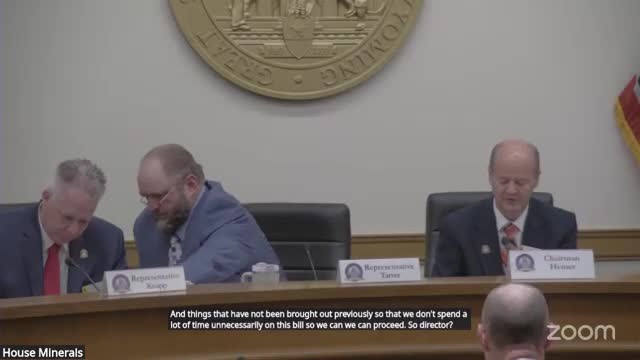
Summary
The Minerals, Business & Economic Development Committee approved an amendment to a bill that would allow the Department of Environmental Quality to require water quality sampling of domestic wells within 300 feet of proposed limited mining operations; the bill advanced from committee 7–1 with one excused member.
A committee amendment that would allow the Wyoming Department of Environmental Quality to require water-quality testing of domestic wells near proposed limited mining operations passed the Minerals, Business & Economic Development Committee, which voted 7–1 with one member excused to advance House Bill 59.
The DEQ-proposed amendment would allow the department to require testing of "any drinking water well or domestic well within 300 feet of the proposed limited mining operation," and instructs that operators need not sample wells where the well owner does not grant access, Director Todd Parfit told the committee.
Supporters said the change narrows the scope of the original bill and provides homeowners with a baseline sample if problems arise. The Wyoming Mining Association and the Associated General Contractors said they would back the bill if the 300-foot limitation were adopted, citing the amendment’s tighter focus. Opponents urged caution about creating new regulatory burdens for operators.
The amendment and bill prompted discussion over two related questions: whether the department should be required to test ("shall") or given discretion ("may"), and whether the buffer around operations should be larger. Several environmental and landowner groups urged a mandatory requirement or a larger radius; the Greater Yellowstone Coalition recommended 500 feet and suggested changing language that allows the department discretion. Advocates for industry and for Americans for Prosperity argued that DEQ already has authority to investigate complaints and that a statutory mandate could create unnecessary delay.
Representative Jeff Larson successfully offered an amendment to the DEQ language changing the provision from a mandatory "shall require" to a discretionary "may require." The committee passed Larson’s change on voice vote before taking the final roll call on the bill.
Representative-elect roll call recorded the committee vote on House Bill 59 as: Representative Campbell — Aye; Representative Knapp — Aye; Representative Larson — Aye; Representative Lalley — Aye; Representative Riggins — Excused; Representative Schmidt — No; Representative Tarver — Aye; Representative Weber — Aye; Chairman Heiner — Aye. Committee staff announced the tally as seven ayes, one no, one excused.
Stakeholders who testified in favor included the Powder River Basin Resource Council, Wyoming Outdoor Council and Rocky Mountain Farmers Union; they emphasized the value of baseline testing to protect private water supplies. Industry witnesses, including the Wyoming Mining Association and Associated General Contractors, said they would accept a targeted testing requirement but warned a broader mandate could chill some operations and raise aggregate construction costs.
The DEQ director said test results would be submitted to the land quality division and retained in limited mining operation files to form a baseline "if there were ever any questions about water quality changes in those domestic wells." Several witnesses and members pressed for clarity about which minerals and operations would be covered, noting House Bill 10’s simultaneous changes to the LMO definition could affect scope.
The committee advanced the bill to the floor; members discussed possible statutory cleanup if related bills that alter the LMO definition move through the Legislature.
Ending: The bill now goes to the full House for consideration; committee members signaled the need to reconcile the LMO definition and testing language if other bills changing mineral definitions also pass.