Get Full Government Meeting Transcripts, Videos, & Alerts Forever!
Get email alerts on the Haiti Security Humanitarian topic
No spam. Unsubscribe anytime.
Speaker tells council gang attacks and airport closure left Port-au-Prince isolated and worsened humanitarian crisis
Summary
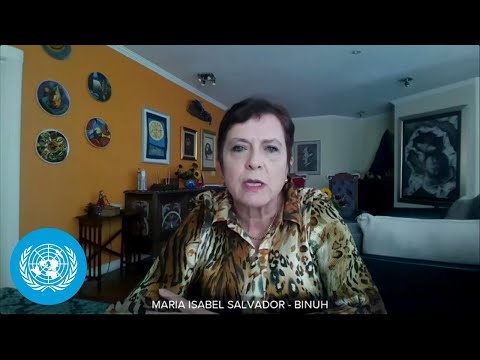
Maria Isabel Salvador (role not specified) told the council that armed gangs attacked commercial aircraft near Port-au-Prince’s international airport on Nov. 11, forcing the airport’s closure and contributing to hundreds of deaths and mass displacement.
Maria Isabel Salvador (role not specified) told the council that armed gangs attacked commercial aircraft near Port-au-Prince’s international airport on Nov. 11, forcing the airport’s closure and suspension of flights and leaving the capital increasingly isolated.
“She has the floor” — Salvador opened by saying she was “hopeful for the signs of progress in the political front despite serious setbacks in the security way.” She told members that at least three aircraft were struck and that one flight attendant was injured in a reported attack.
The speech said the U.S. Federal Aviation Administration’s ban on U.S.-registered aircraft increased the capital’s isolation and that at least one major airline has said it will not return to Haiti for the foreseeable future. Salvador reported that, in the weeks following, coordinated gang attacks across the capital provoked violent responses from armed self-defense groups and contributed to what she described as a surge in killings and displacement.
Salvador gave consolidated casualty and displacement figures: at least 220 deaths and nearly 41,000 people displaced from the November wave of violence; separate mass killings in what the transcript names as “Guarve Jeremie in the commune of Cite Soleil” resulting in 207 fatalities “mostly among the elderly”; and an escalation in another department with 114 fatalities from retaliatory violence. On Dec. 24, she said, the hospital of the State University in Port-au-Prince was attacked before a reopening ceremony, resulting in the deaths of a police officer and two journalists.
She reported international security contributions arriving in January: 217 Kenyan police officers including an advanced team of five women deployed on Jan. 18; 150 Guatemalan personnel and an advance team of eight Salvadoran troops also arrived, according to her remarks. Salvador said the Haitian National Police, supported by the multinational security support mission (MSS) and in some cases by Haiti’s armed forces, has improved coordination and anti-gang planning and operations.
Salvador noted a security milestone on Jan. 10 when 739 new recruits — including 213 women — graduated from the National Police Academy, and called recent appointment of a Secretary of State for Public Security “a positive step.” She also told the council that challenges remain, citing high attrition, insufficient specialized training and a lack of equipment for the Haitian National Police and saying enhanced international assistance and additional trust-fund contributions for the MSS are critical.
On political processes, Salvador said the United Nations deployed an electoral needs assessment in November and that recommendations for constitutional and electoral support were approved by the UN focal point for electoral assistance. She said the National Conference on Constitutional Reform continued its work, noted that broader consultations including the Haitian diaspora were beginning, and said a constitutional referendum and general elections remain targeted for the year but “require security increasing measures, sustained commitment, and timely progress.”
Salvador described corruption allegations involving three members of the transitional presidential council and said some political actors have sought help from the CARICOM Eminent Persons Group to facilitate national dialogue; she said a letter that referenced a gang coalition drew strong criticism and “showed that any attempt to legitimize armed gangs is rejected by the majority of Haitian actors and the public.”
Turning to humanitarian needs, Salvador said more than 6,000,000 people — nearly half the population — require humanitarian assistance, with 3,900,000 targeted for aid. She said the number of internally displaced persons has tripled to over 1,000,000, with more than half children, and that displacement sites lack clean water, sanitation and education. Salvador reported acute food insecurity affecting 48% of the population, with nearly 2,000,000 people in IPC Phase 4 (emergency) and 6,000 in IPC Phase 5 (catastrophic).
She said humanitarian partners carried out 700 UN missions in the fourth quarter, including 500 directly related to lifesaving assistance, and that the 2025 humanitarian response plan requires $908,000,000. Salvador urged member states to contribute to that plan and to trust-fund support for the MSS so the multinational effort can continue and scale up when security conditions permit. She told the council the UN had temporarily reduced its footprint in Port-au-Prince while maintaining a skeleton team to continue lifesaving assistance remotely.
The speaker closed by urging full operationalization of a newly established National Security Council and calling for sustained international and domestic efforts to stabilize security and protect political and humanitarian processes.