Get Full Government Meeting Transcripts, Videos, & Alerts Forever!
Get email alerts on the Ballot Drop Boxes topic
No spam. Unsubscribe anytime.
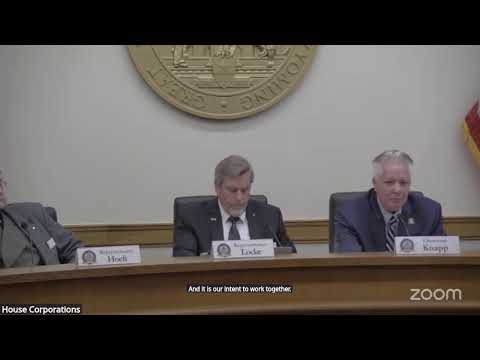
Committee approves ban on unattended ballot drop boxes after debate over security and rural access
Summary
The Corporations, Elections & Political Subdivisions Committee approved House Bill 131, a prohibition on unattended ballot drop boxes, after hearing testimony about chain-of-custody risks and rural voter access.
The Corporations, Elections & Political Subdivisions Committee approved House Bill 131, a prohibition on unattended ballot drop boxes, after hearing testimony about chain-of-custody risks and rural voter access.
The bill, approved by an 8-1 roll call, would require that a completed absentee ballot be mailed via the United States Postal Service or hand-delivered to a clerk (or another clerk within the county, per an amendment adopted in committee). Committee members moved the bill to the floor for further consideration.
The bill’s sponsor and committee chair, Chairman Knapp, opened the discussion by framing the measure as part of a three-part approach to election integrity: preserving the ability to vote, maintaining chain of custody, and ensuring post-election auditability. Knapp said the bill is “short” and is intended to make clear that returning a ballot must be either mailed or hand-delivered to election officials.
Wyoming Secretary of State Chuck Gray testified in support of the bill, saying he believes existing statutes (including Wyoming Statutes 22-9-113 and 22-2-103) do not authorize unattended drop boxes and asserting that his office rescinded a prior directive that had allowed them during the COVID-19 response. Gray cited examples from other states — including tampering incidents and arson attacks reported elsewhere — as reasons he considers unattended drop boxes an unacceptable security risk. He told the committee his office rescinded prior guidance and would not issue new guidance authorizing drop boxes because, he said, doing so would violate his oath if the practice is not authorized by statute.
County clerks from across Wyoming testified in opposition to an outright ban, or sought clarifications, describing the procedures they use when they operate drop boxes. Malcolm Urban, speaking for the County Clerk’s Association and identified as Platte County Clerk, said many counties have used receptacles for decades and that in 2024 roughly “almost 5,000” voters statewide used some form of drop box. Joe Rubino, policy director in the secretary of state’s office, told the committee seven counties used drop boxes in the 2024 cycle (Albany, Carbon, Converse, Fremont, Laramie, Sweetwater and Teton) and that two additional counties had used them in 2022 (Hart and Sheridan).
Several county clerks described security steps they said they use. Carbon County Clerk Lisa Smith said her office alone received 2,100 absentee ballots in the 2024 general election and that 151 of those were returned through her office’s drop box; she described dual-staff retrieval, a signed chain-of-custody log, motion-activated cameras with daily review, and backups to county IT and sheriff systems. Fremont County Clerk Julie Friess described grant-funded, hardened boxes, alarm and speaker systems that warn loiterers, reduced slot sizes to accept one ballot at a time and procedures to photograph or log vehicles and plates when appropriate. Laramie County Clerk Deborah Lee said 2,077 absentee ballots were delivered via drop box in the 2024 general election (36% of absentee returns in that cycle for Laramie County). Sweetwater County Clerk Cindy Lane reported 1,134 constituents used her county’s drop box since 2022. Natrona County Clerk Tracy Goode said the county has accepted ballots in a locked receptacle inside the clerk’s office since 1992 and that in the most recent general election more than 13,000 absentee ballots were received, about 32% of which were dropped in that receptacle.
Clerks asked the committee for six clarifications they said were necessary if the ban is enacted: (1) confirmation that authorized election officials or sworn election judges deputized by the clerk may receive hand-delivered ballots; (2) whether an in-office receptacle intended only for ballots is permissible; (3) whether counties may contact a voter if a ballot is discovered in a prohibited drop box and offer a cure or replacement; (4) whether commercial courier services such as FedEx or UPS count as “mailed”; (5) whether ballots delivered to another county office (treasurer, assessor) but subsequently transferred to the clerk would be accepted; and (6) whether the prohibition would apply to special-district mail-ballot elections. County clerks said they would comply with the legislature’s policy choice but asked for those details to avoid recurring disputes.
Members of the public and advocacy groups also testified on both sides. Several speakers urged preserving drop boxes as an access measure for rural, shift-working and elderly voters; others urged the ban on security grounds. One public speaker proposed an amendment to allow municipal clerks and other sworn municipal officials to accept ballots on the clerk’s behalf to increase local access.
The committee adopted two amendments before the final vote. Representative Lucas successfully offered an amendment, based on a public proposal, to change the hand-delivery requirement so the ballot may be delivered to “any clerk within the county the ballot was issued” as provided in Wyoming Statute 22-3-104(h)(ii). A second amendment amended the mail option to specify the United States Postal Service as an authorized mailing method. Both amendments were approved by the committee prior to the final roll call.
On the roll call, the committee recorded eight aye votes and one no vote (Representative Yin). The committee chair said the committee would consider the County Clerk Association’s recommendations when the bill moves to the full floor.
What the committee decided and what remains: The committee approved House Bill 131 with amendments and sent it to the floor. The committee did not create a cure or notification procedure in the bill text during the committee markup; clerks asked the legislature to clarify whether voters whose ballots are placed into prohibited receptacles would receive notice or an opportunity to cure. The secretary of state said he would not issue guidance authorizing drop boxes because he does not believe state law authorizes them; county clerks said their legal advice and local practices differ and asked for legislative clarity. The bill’s final language and floor debate will determine whether the statutory change applies to special-district mail-ballot elections or to courier-delivered ballots.
Votes at a glance: House Bill 131 (Ballot drop boxes prohibition) — Committee outcome: approved 8–1; mover to work the bill: Representative Brown (moved), Representative Weber (seconded); key amendments: (1) allow delivery to “any clerk within the county the ballot was issued” (adopted); (2) specify United States Postal Service for mailed ballots (adopted). The measure was reported out of committee for floor consideration.
Ending note: Committee members and county clerks said they intend to continue dialogue as the bill moves to the floor to resolve operational questions raised by counties about notification, courier deliveries and whether county-run in-office receptacles remain lawful under any final language.