Get Full Government Meeting Transcripts, Videos, & Alerts Forever!
Get email alerts on the Procedural Bill Files topic
No spam. Unsubscribe anytime.
Committee opens three bill files to address multiple procedural clarifications ahead of session
Summary
The Legislative Process Committee voted to open three bill files to draft rule changes covering consent calendar timing, bill numbering, sponsor changes after numbering and other procedural clarifications discussed at the meeting.
The Legislative Process Committee voted to open three bill files to capture a package of drafting and procedural clarifications discussed during the meeting. The motion to open the files passed by voice vote.
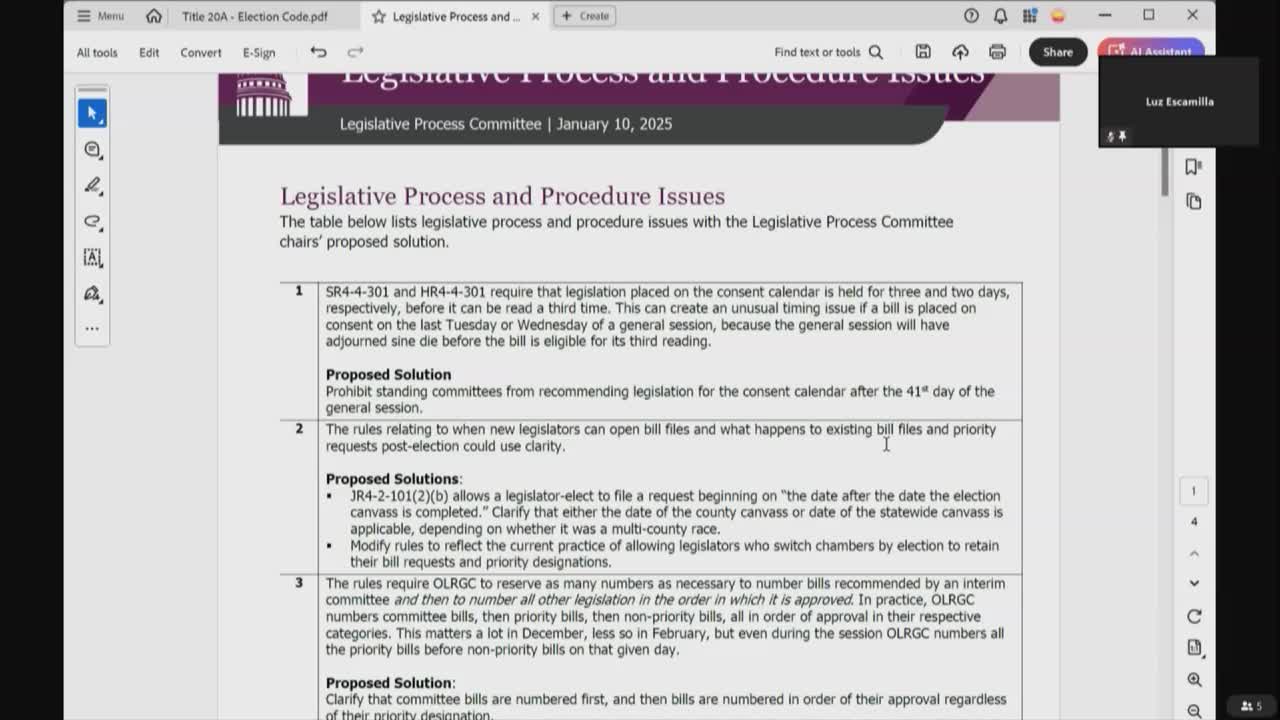
Staff described a long list of proposed clarifications and fixes that chairs had discussed with counsel, many of which staff said resulted from limitations in the legislature’s new drafting system or from statutory ambiguities encountered during the last election cycle. Topics the chairs asked staff to prepare language for include:
- Prohibiting standing committees from recommending legislation for the consent calendar after the 41st day of the general session, to avoid placing bills on consent when the requisite hold period would extend past adjournment. Committee members discussed how consent items must remain on the calendar for multiple days (three days in the Senate, two in the House) and how late placement can prevent consideration before adjournment.
- Clarifying what happens to bill requests, priorities and numbered bills when a legislator changes chambers, resigns or is replaced. Staff said current practice treats those requests as transferable in some cases but the rule language does not make the practice explicit.
- Standardizing numbering so committee bills are numbered first and all other bills are numbered in order of approval (first in, first out), rather than maintaining separate numbering lines for priority and nonpriority bills.
- Clarifying that technical corrections to legislation (for example, long‑title edits) will be implemented by LRGC at the secretary/clerk’s request because the new drafting system does not allow clerks to make those changes directly.
- Defining censure in House rule to match the Senate rule language (an official reprimand/condemnation that, if approved by the majority, is printed in the journal).
- Limiting sponsor changes after a bill is numbered: staff proposed allowing sponsorship to change only once after numbering; committee discussion considered whether that limit should be applied per bill or per legislator and left the matter for drafting.
- Clarifying that an interim committee’s unanimous recommendation allows a bill to skip only the standing committee in its chamber of origin (consistent with current practice but not explicit in rule).
- Giving the committee rules for resolving conflicts between enacted bills that lack coordination clauses: staff proposed treating the last enacted bill (defined by latest legislative action) as controlling for the conflicting provisions.
Committee members debated several of these items during the meeting. Some members objected to the “last enacted” rule as a final resolution method and said other remedies could be appropriate, while staff and other members said some resolution method is needed for rare conflicts missed during drafting. Members also discussed concerns about chairs’ ability to open committee bill files during the interim and how that can affect drafting prioritization; that topic will be handled in a separate bill file and was debated at length during the meeting.
The committee directed staff to draft bill language for the items discussed and to return the draft for further committee consideration during the interim.