Get Full Government Meeting Transcripts, Videos, & Alerts Forever!
Get email alerts on the Department General Order 6 14 topic
No spam. Unsubscribe anytime.
Police Commission Approves Revised DGO to Emphasize Mental‑health‑first response and CIT coordination
Summary
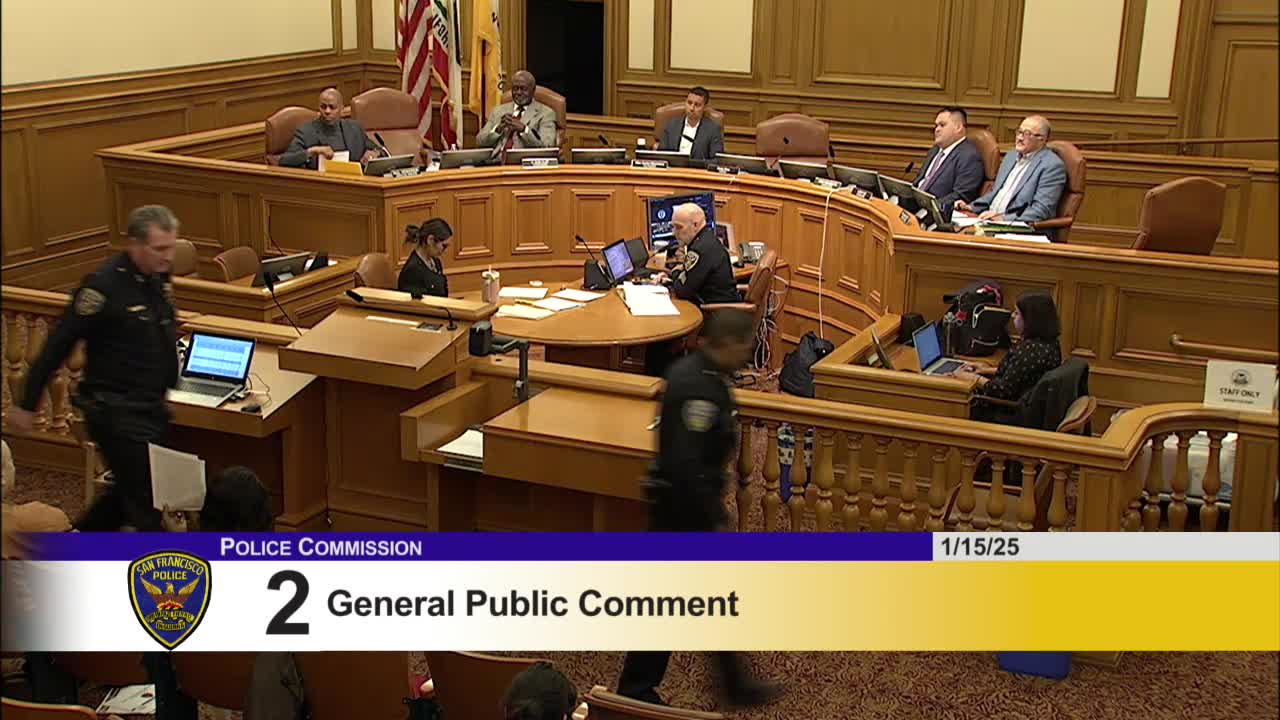
The San Francisco Police Commission on Jan. 15 approved a revised Department General Order 6.14 directing officers to prioritize de‑escalation, diversion and collaboration with behavioral‑health partners when responding to adults in crisis, and accepted a friendly amendment changing the phrase “psychiatric evaluation” to “mental health assessment.”
The San Francisco Police Commission on Jan. 15 approved a revised Department General Order 6.14 that directs officers to prioritize de‑escalation, diversion and collaboration with non‑law‑enforcement mental‑health resources when responding to adults in crisis.
The move, approved unanimously by the six commissioners present, advances changes tied to state law updates and labor bargaining; the commission also accepted a friendly amendment replacing the phrase “psychiatric evaluation” with “mental health assessment.”
The new DGO, presented by Lieutenant Anderson of the San Francisco Police Department, “centers on a humane, compassionate approach, emphasizes de‑escalation, diversion and reduces stigma around mental‑health issues,” and directs officers to involve specialized behavioral‑health resources unless an individual is violent or otherwise poses a public‑safety risk. Lieutenant Anderson said the revisions incorporate changes from SB 43 and expand the definition of “gravely disabled” to account for severe substance‑use disorder.
Commissioners debated the language used to describe officer actions when a third party requests an evaluation. Commissioner Juan Yanez suggested — and Lieutenant Anderson accepted — replacing the phrase “psychiatric evaluation” with “mental health assessment” to avoid implying that officers are conducting clinical diagnoses in the field. Commissioner Rafael Benedicto made the motion to approve the order, which Commissioner Clay seconded; the vote was 6–0 to approve the DGO with the amendment.
Public commenters and stakeholders who spoke during the hearing praised the role of the Crisis Intervention Team (CIT) and related training. David Elliott Lewis, a longtime member of the CIT working group and board president of the Mental Health Association of San Francisco, described the CIT program’s training and field support as life‑saving and urged continued support for diversion alternatives and for better cross‑agency coordination.
Director Paul Henderson of the Department of Police Accountability and Assistant Deputy Chief April Sloan (Community Paramedic Division) also spoke in support of the revisions and the collaborative process that produced them. The policy director at DPA and members of the CIT working group were acknowledged during the presentation as contributors to the draft policy.
Votes at a glance
- Revised Department General Order 6.14 (psychological evaluations/mental‑health assessments): Approved 6–0. Motion by Commissioner Rafael Benedicto; second by Commissioner Clay. Friendly amendment adopted to replace “psychiatric evaluation” with “mental health assessment.”
- Department General Order 8.03 (crowd control): Adopted 6–0 with a 45‑business‑day delay to implementation, motioned by Commissioner Clay and seconded (recorded separately on the agenda).
- Consent calendar (receive and file a bundle of reports and donations): Approved 6–0.
What the order does and why it matters
Lieutenant Anderson and department staff described DGO 6.14 as an effort to reduce confrontations with people experiencing mental‑health or co‑occurring substance‑use crises, promote diversion to care and limit law‑enforcement involvement in noncriminal situations when appropriate. The order preserves existing legal thresholds for involuntary holds (danger to self, danger to others, gravely disabled) but updates procedures and guidance to reflect SB 43 and to add guidance about obtaining search warrants and gun‑violence restraining orders when appropriate.
Commissioners and public commenters emphasized training and interagency coordination. Commissioner Benedicto noted the role of the CIT working group and asked that the department continue to collaborate with the Department of Public Health, fire/paramedics and other partners to operationalize the diversion goals in the policy. Commissioner Yanez pressed for precise language so that officers and the public understand the limits of what law enforcement can and should do in medical or clinical contexts.
Implementation and follow‑up
Commissioners directed staff to use the DGO in bargaining with affected units pursuant to the commission’s labor relations resolution, and the item will be used in meet‑and‑confer processes as required by law. The commission’s vote authorizes the department to use the revised DGO for bargaining; it does not by itself create a change in contractual terms beyond that process.
Public comment and related context
Speakers during public comment included current and former members of the CIT working group, advocates from mental‑health organizations and an assistant deputy chief of the Community Paramedic Division, who described an implementation work group tied to SB 43 and praised the department’s collaboration in developing the order. Several commenters urged additional alternatives to arrest and requested continued city investment in non‑police crisis response options.
What did not change
The commission did not adopt any additional funding or operational directives as part of the vote. The DGO approves updated operational guidance for officers; specific program expansions, new facilities or funding allocations were not part of the motion and would require separate action by the mayor’s office or Board of Supervisors.
Next steps
The department will proceed to use DGO 6.14 in bargaining with affected labor units and begin department training and roll‑out consistent with that process. Commissioners asked for continued updates on interagency coordination, CIT training outcomes and how the department will measure diversion and outcomes under the revised order.
(Reporting note: Quotations and attributions in this story are taken from the Jan. 15, 2025 San Francisco Police Commission meeting transcript.)