Get Full Government Meeting Transcripts, Videos, & Alerts Forever!
Get email alerts on the Long Term Homeowner Exemption topic
No spam. Unsubscribe anytime.
Revenue Committee reviews changes to long-term homeowner tax exemption in Senate File 67
Summary
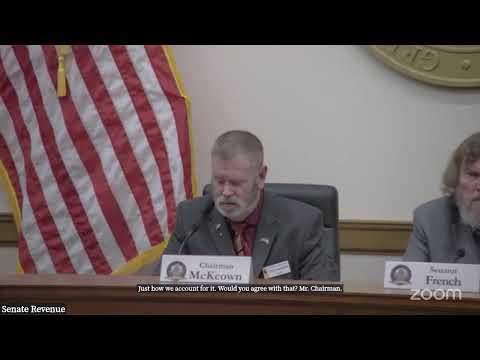
CHEYENNE — The Revenue Committee of the 68th Legislature heard testimony on Senate File 67 on reforms to the long-term homeowner property tax exemption, including a change reducing the required months of occupancy from eight to six and removing the statute's sunset provision.
CHEYENNE — The Revenue Committee of the 68th Legislature heard testimony on Senate File 67 on reforms to the long-term homeowner property tax exemption, including a change reducing the required months of occupancy from eight to six and removing the statute's sunset provision.
Department of Revenue Director Brenda Henson told the committee the amendment would implement two substantive changes: shorten the occupancy requirement to six months and repeal the statute's sunset so the exemption would continue beyond the original expiration date. "As of today, we're looking at approximately 18,000 applications statewide," Henson said, and she noted the amendment would take effect Jan. 1, 2026.
The nut graph: committee members, county assessors and Department of Revenue staff concentrated on how the new exemption would be calculated alongside existing residential caps and how the law should treat properties owned by corporations, partnerships or trusts. Those technical and administrative issues will determine how many taxpayers qualify and how local offices must process claims.
Henson summarized the program rollout from last year, saying the original statute (enrolled act no. 44 from the 2024 session) required applicants to be at least 65 and to have paid Wyoming property tax on a residential property for 25 years. Rules and application forms were provided to county assessors in September, she said, and county treasurers mailed notices with tax bills. The application is two pages and applicants must provide proof of age; they need only list where they paid property tax, Henson said.
Henson warned of a calculation ambiguity: SF 67 requires a 50% exemption on fair-market value for qualifying structures and land, but Wyoming law also includes a 4% cap on residential structure value implemented in 2025. "The language does not include a calculation clarification," Henson said, explaining the Department and Legislative Service Office staff have discussed statutory language to establish the order and method for applying multiple exemptions so that exemptions are applied uniformly across counties.
Converse County Assessor Dixie Huxtable, speaking for participating county assessors, said assessors took no formal statewide position but want clarification if the exemption becomes permanent. "We did not take a position on the bill as it's drafted, but we want to voice some concerns should it pass as far as the repeal," Huxtable said. She described administration problems that will arise where a single legal owner (for example, a corporation) holds multiple houses on a parcel and different elderly residents in those units appear to qualify individually under the statute.
Huxtable and other assessors said the bill's definition of "owner" in last year's law included shareholders, partners, contract vendees and trusts. That breadth has produced scenarios in which multiple residents living in separate structures on one property might each claim the exemption even though the deeded owner is a single entity.
Senators asked practical questions about tax bills and payment. Senator Kent Case and Senator French pressed assessors on whether tax notices go to the owner of record and how counties track which resident occupies which improvement on a multi-improvement parcel. Huxtable said counties send a single tax bill to the owner of record and, in many cases, would have to rely on the applicant's sworn statement to identify which structure qualifies. She also told the committee the counties' current systems would likely require manual work to calculate multiple-per-structure exemptions rather than handle them automatically.
Committee members did not record a formal vote on SF 67 during the transcript excerpt. Henson said the Department is prepared to implement changes affecting applicants in 2026 if the amendment passes, but recommended statutory clarification on the order of applying percentage exemptions and existing caps.
Next steps discussed in the hearing included drafting clarifying language (LSO staff and a Josh Anderson were referenced as having prepared possible amendment text) to define calculation order and to resolve whether multiple exemptions are allowable on a single owner account with multiple residences. The committee did not take action on the amendment in the portion of the hearing covered by the transcript.