Get Full Government Meeting Transcripts, Videos, & Alerts Forever!
Get email alerts on the Community Reinvestment Project topic
No spam. Unsubscribe anytime.
Tacoma to deploy $4 million in state CRP funds for loans, rent and asset grants to locally based businesses
Summary
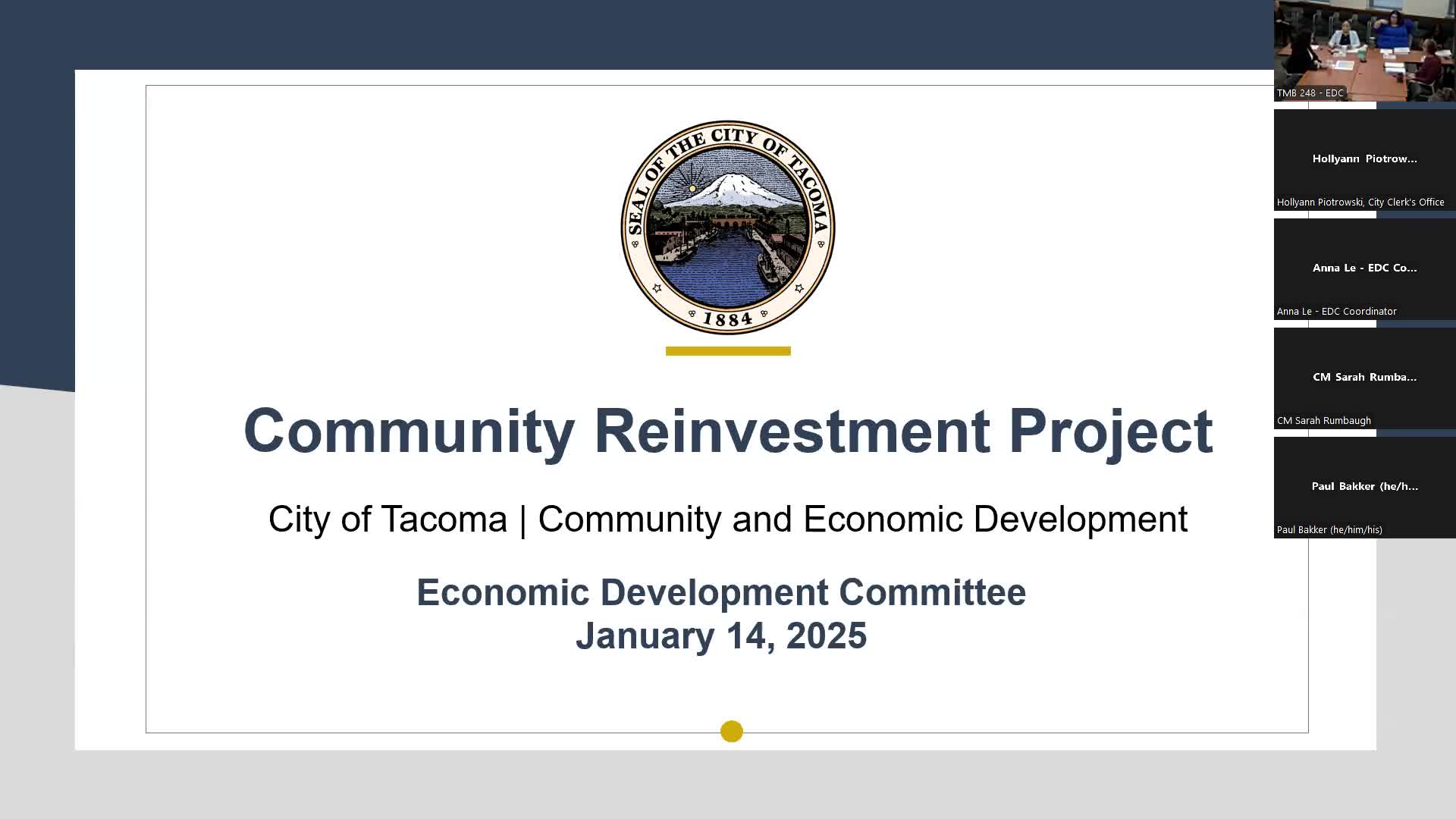
City staff told the Economic Development Committee Jan. 14 that Tacoma will administer a $4 million Washington State Community Reinvestment Project (CRP) allocation through two loan products and two grant programs, with applications opening Jan. 21 and a hard spending deadline of June 2025.
Tacoma’s Economic Development Committee heard a briefing Jan. 14 on a $4 million Community Reinvestment Project allocation from the Washington State Department of Commerce that city staff plan to deploy as loans and grants for Tacoma-based businesses and nonprofits. City staff said the package is intended to benefit communities harmed by the historical enforcement of drug laws and must be spent under a Commerce timetable that staff characterized as “aggressive.”
The CRP funding comes through the Department of Commerce’s Blended Capital Enhancements Program. “The CRP is a program of the Washington State Department of Commerce. This community design plan is intended to uplift communities that were harmed by the historical design and enforcement of state and federal criminal laws and penalties for the war on drugs,” Business and Economic Development Analyst Georgia Patterson told the committee.
City staff described the $4 million allocation as split into two loan products totaling $2.6 million and two grant streams totaling $1 million. The loan programs include an Uplift loan (collateral-free loans up to $100,000 intended for existing businesses or nonprofits with at least three years of operation) and an Accelerator loan (larger loans up to $1,000,000 aimed at longer‑standing businesses for property acquisition or major investments). The grant programs are a commercial rent grant (50% rent match for one year, up to $25,000) and a commercial assets grant (up to $25,000 for equipment, inventory or infrastructure).
Patterson said the city will use flexible, “risk-embracing” underwriting that adjusts standard banking ratios and adds nonfinancial indicators tied to the CRP mission, including questions about how a business was impacted by the war on drugs. She added that the Tacoma Community Redevelopment Authority (TCRA) will administer the loan funds through the city’s revolving loan fund (RLF). “With successful repayment, the $2,600,000 that we are investing into loan programs will be retained in a new revolving loan fund, which represents the first nonfederal investment into our RLF since 1979,” Patterson said.
Staff described program goals, target populations and outreach. The target audience includes businesses owned by Black, Latino and Indigenous entrepreneurs, legacy businesses, social enterprises, businesses in low-opportunity areas (as identified through the City of Tacoma Equity Index), and graduates of local accelerators and incubators. Staff said they will also use historical police-mapping tools—referred to in the presentation as SOAP and SODA maps—to prioritize locations historically overpoliced and harmed, but with the aim of directing benefits to those communities.
Patterson outlined an expedited timeline supplied by Commerce: the city signed its contract with Commerce the day before the briefing; the application was scheduled to be released Jan. 21; applications will close March 14; underwriting and scoring will occur in late March and early April; notifications are expected in early April; disbursements are planned for April–May; and the grant closeout must be complete by June 2025. “We essentially have 6 months to spend $4,000,000,” Patterson said.
Staff discussed technical assistance and outreach. The city has budgeted $100,000 to contract culturally competent small‑business technical assistance (TA) providers and said it had already selected two TA contractors: REVV (an out‑of‑state firm that will deliver in‑person services) and Golden Gift Consulting (a local Lakewood firm). Patterson said the city will host information sessions and application clinics and has shared a program matrix so businesses and partners across Pierce County can stack or coordinate funding. She noted other CRP grantees working in Pierce County, including the Urban League (reported in the briefing as a $5,000,000 award), Making a Difference Foundation (about $1,000,000) and Workforce Central.
Committee members pressed staff on eligibility and access. Patterson said uplift loans require a three‑year operating history, accelerator loans require five years, and the grants require one year of operation as of Jan. 1, 2024. She explained Tacoma residency rules: home‑based businesses must have the applicant’s residence within Tacoma city limits; brick‑and‑mortar businesses must have a physical location in Tacoma. Staff also described language‑access plans, translated materials, on‑site interpreter request procedures for events and use of an online application host (Submittable) with translation capability.
Council members raised implementation questions—how the city will help businesses navigate leases, the need for enrollment flexibility for loan applicants working with TA providers, and the possibility of transferring unused loan funding to grants if demand for loans falls short. Patterson said staff requested that flexibility from TCRA in their administrative approval to move funds from loans to grants if necessary and that TA providers will have discretion to finalize applicant documents when needed within the open application window.
The committee did not take a formal vote on the CRP package during the briefing. Staff said they will proceed with the published application and outreach schedule and return to the committee after the application round to report results and lessons learned.
Ending: The application release is scheduled for Jan. 21, with info sessions Jan. 29 and Feb. 6 and application clinics to follow. Staff emphasized the compressed Commerce deadline and said city partners will be mobilized to help applicants submit competitive materials.