Get Full Government Meeting Transcripts, Videos, & Alerts Forever!
Get email alerts on the Transportation Finance And Planning topic
No spam. Unsubscribe anytime.
Charlotte delegation, city staff outline $19.4 billion multimodal transportation plan and public process
Summary
City and regional leaders on a legislative briefing described a 30-year, multimodal transportation funding strategy estimated at $19.4 billion, discussed next steps for the Red Line commuter rail and Silver Line airport connection, and flagged other legislative priorities including water transfers, arcade game parlors, and court staffing.
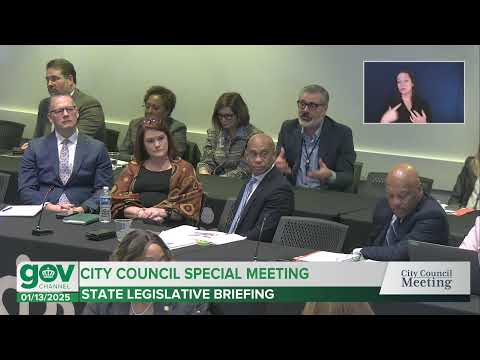
Charlotte officials and members of the Mecklenburg County legislative delegation on Jan. 22 held a legislative briefing in Charlotte to review the city’s 2025 legislative agenda and a proposed multimodal transportation funding plan that staff said could total about $19.4 billion over 30 years.
The proposal, described by Ed McKinney of the Charlotte city manager’s office, would dedicate about 60 percent of funds to roads and bus investments and about 40 percent to rail, and is structured as an annual, sales-tax-derived revenue stream intended to be distributed to local jurisdictions. "So it's really important to sort of pause on that, that number at the top, 19,400,000,000," McKinney said. He added the local revenue could help "potentially pull down another 6,000,000,000" in federal matching funds over time.
Why it matters: leaders said the package is intended to address growth-driven congestion, safety needs such as sidewalks and lighting, bus frequency and amenities, and to fund the Red Line commuter rail and other priority corridors. The proposal positions a local funding source as a local match to attract federal grants and, if put to voters, would be accompanied by a revised transit plan and a public referendum later this year.
Details of the plan and process
McKinney and city staff described the plan as multimodal and countywide in scope, with local jurisdictions empowered to use road-designated funds according to local priorities. Elements highlighted included better bus service (frequency, stop amenities and microtransit/first-last-mile service), rail investment to implement the Red Line and other corridors, and a financing model intended to unlock federal grant opportunities. The staff presentation cited recent successful multimodal sales-tax referendums in Phoenix, Nashville and Columbus as case studies.
City staff gave several schedule milestones: the Metropolitan Transit Commission (MTC) will update the transit system plan beginning in late January; the MTC — which includes elected representation from the city, county and towns — will review alternatives and station placement during a multi-month public process; and the city and partners hope to conclude planning and ask the public to weigh in, with a target of a November public vote if the MTC and local leaders approve a plan.
Red Line and Norfolk Southern corridor
Officials said a major recent development was Charlotte’s purchase negotiations with Norfolk Southern to secure corridor access. McKinney described the talks as a "20 years in the making" breakthrough that preserves the ability to run commuter rail and to extend service into Iredell County and Mooresville should those jurisdictions decide to participate.
Airport and Silver Line connection
City and airport officials said the airport’s Concourse A expansion — a roughly $231,000,000 project that added 10 gates — increases the region’s aviation capacity and strengthens the case for a rapid connection between Uptown and Charlotte Douglas International Airport. An airport official, identified in the briefing as the airport director, said the airport is "very enthusiastic about the opportunity to have the Silver Line" and that the airport and CATS are focused on "creating a connection, fast reliable service from Uptown Charlotte, the rest of the region into the airport." CATS staff said options for the Silver Line and other rapid corridors will be presented to the MTC for consideration beginning Jan. 22, with alternatives evaluated in the context of financial feasibility.
Other legislative items discussed
City staff and elected officials briefed the delegation on several additional items in the legislative agenda: the recently launched civilian crash investigation program for minor vehicle collisions; concerns about the rise of arcade "fish game" parlors and related planning and crime impacts, which city leaders said the delegation intends to support through legislation; the STOW Regional Water Resource Facility, a wastewater plant under construction with commissioning expected in 2026; and a notice of intent filed by Charlotte Water for an interbasin transfer (IBT) to move water from the Catawba River Basin to the Rocky River Basin. Staff said IBT studies and an environmental analysis are ongoing and that they are meeting with affected local officials and using state lobbying resources on the matter.
Questions and next steps
Delegation members asked about station spacing along the Red Line, alternative ways to connect the airport to Uptown (including high-frequency bus options), cost control best practices from other cities, and how the funding split was decided. Staff said detailed station placement and alternative alignments could change through the MTC process and that staff would provide additional materials summarizing other cities' models and cost-control lessons. Elected leaders asked staff to provide follow-up information on court staffing and local violence intervention programs.
Formal actions
The meeting concluded without formal votes on any legislation or funding authorizations. The only recorded formal action was a motion to adjourn that passed by voice vote.
Ending
City and delegation leaders closed by urging continued collaboration between Charlotte elected officials, municipal staff and the state delegation as the MTC process advances and the city prepares materials for the public conversation later this year. "We greatly appreciate your time," Mayor Vi Lyles said at the meeting's close.