Get Full Government Meeting Transcripts, Videos, & Alerts Forever!
Get email alerts on the Real Estate Strategy Llc topic
No spam. Unsubscribe anytime.
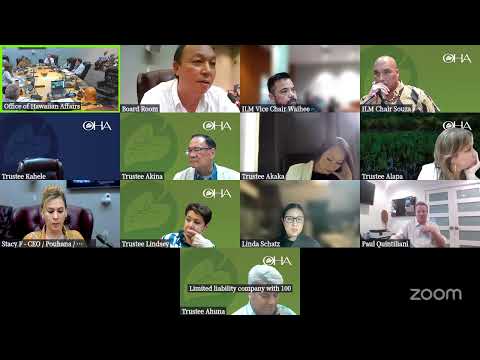
OHA trustees debate LLC and joint‑venture options for Kakaʻako Makai development; legal review and transparency urged
Summary
Trustees continued discussion Jan. 8 on options for developing Kakaʻako Makai, with consultants recommending a single‑purpose LLC but trustees demanding legal review and transparency safeguards before any governance change.
The Office of Hawaiian Affairs Committee on Investments and Land Management continued a months‑long discussion on Jan. 8 about a real‑estate strategy for OHA’s investment and legacy lands, including how to manage and develop Kakaʻako Makai. Consultants from Paragon Realty Partners described recommended tactics and identified four options to unlock embedded value: create a wholly owned single‑purpose limited liability company (LLC) with independent governance, enter a master joint venture, execute a master ground lease, or sell in bulk and reinvest proceeds.
Why it matters: trustees were told Kakaʻako Makai is an investment asset whose primary fiduciary objective is to generate a minimum real return and meet industry benchmarks; consultants said OHA currently lacks the organizational model and staffing to execute complex, time‑sensitive development in the current structure.
Consultant recommendation and deferred items: Paragon recommended an LLC structure as the preferred path to balance control with faster execution: an independent LLC board and staff would handle day‑to‑day development while OHA would retain major approval rights as sole member (for example over budgets, debt issuance, sales/leases and joint‑venture approvals). The board deliberately deferred final direction after extended questions from trustees; consultants and trustees noted two issues driving caution: (1) funding and start‑up operating costs for an LLC or an operating entity; and (2) historical concerns that LLCs can reduce transparency if governance safeguards are inadequate.
Costs and staffing: consultants presented a budget model estimating initial start‑up and annual operating costs for a single‑purpose LLC versus a joint venture vehicle. They estimated that a self‑operated LLC would require an operating budget in the low millions annually to hire development, legal, finance and project staff. The consultants said the joint venture option could secure external capital (which would dilute OHA’s equity) and reduce OHA’s need to add staff, but would cede more control to a partner.
Trustee concerns and calls for legal review: several trustees urged substantial legal review and transparency measures before any action. - Trustee Jose Aquino cited historical controversies involving private trust LLCs and urged independent legal advice: "we need very good legal review on this issue so that we will be able to see that the structure we choose... will allow us to maintain our fiduciary duties for accountability and transparency." - Trustees also asked that any structure include strict reporting, board appointment controls and approval rights for major development milestones and capital calls. Consultants responded that those controls can be written into an operating agreement and that OHA, as sole member, would retain major approval rights and the ability to dissolve the LLC.
Next steps and timing: committee leadership said it intends to return an action item to the board in the near term to finalize a chosen path and to complete remaining work required for a tactical plan, including trustee interviews and additional legal and financial due diligence. Administration encouraged trustees to review materials and consult legal advisers ahead of the forthcoming action item.
Ending: trustees did not vote on a governance model at the Jan. 8 meeting. The discussion reaffirmed that any move to an LLC or joint venture will require written governance protections, periodic reporting to the OHA board, and clarity on who funds predevelopment and capital needs.