Get Full Government Meeting Transcripts, Videos, & Alerts Forever!
Get email alerts on the Land Use topic
No spam. Unsubscribe anytime.
Applicant seeks to abandon previously approved micro-hydro project at Mill Road; public hearing set for Feb. 3
Summary
An applicant presented plans to abandon a previously approved micro-hydro installation at a Mill Road dam and restore the streambank; the planning board accepted the application and scheduled a public hearing for Feb. 3 while asking for additional engineering, planting and permitting details.
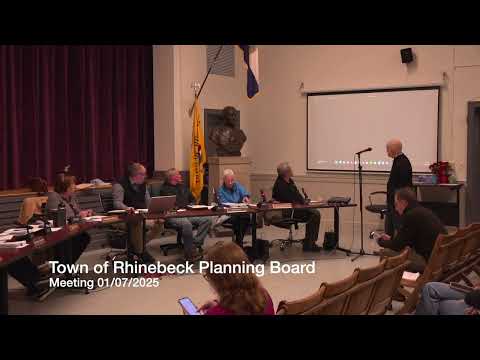
Applicant Joel Perron asked the Rhinebeck Planning Board on Jan. 7 to approve an amended site plan to abandon a previously approved micro-hydro installation at a dam on Mill Road and to restore the streambank to its original contour.
The board accepted the application for further review, classified the action as an "unlisted" action under environmental review rules and scheduled a public hearing for Feb. 3. The board also directed staff to send the application materials to the Conservation Advisory Board (CAB), the Wetlands Advisory Committee (WAC), Dutchess County planning and the National Environmental Council (NEC) for review.
Why it matters: The proposal involves reversing work already performed near a watercourse, and board members pressed for clarification on what was done, how the restoration would be engineered and whether state or federal permits are required. Restoring streambanks can affect erosion, flood risk and wetland jurisdiction, so the board sought more technical detail before final approval.
Board and staff questions focused on three topics: the extent and composition of riprap and rock currently placed along the bank; erosion and flood resilience of any backfill; and state permitting under recent DEC rule changes that took effect Jan. 1, 2025. Planning staff said photos show large rock placed on the bank that was not clearly documented on the submitted plan, and asked the applicant to mark the disturbed/rock-filled area on the site plan and to provide a planting plan showing native species for bank stabilization.
Joel Perron described the work as restoring the riverbank to its pre-construction contour and said the plan calls for returning riprap and soil and replanting native vegetation to prevent erosion. Board staff said there is a stop-work/notice-of-violation related to earlier work and that the originally approved micro-hydro site plan differed from what was installed. The applicant said an engineering consultant prepared the submitted site plan and that the project team can supply clearer digital plans and a planting plan prior to the hearing.
Planning staff and board members recommended the applicant confirm whether a DEC jurisdictional determination or Army Corps coordination is required, and to provide a stamped engineering approach for streambank restoration that anticipates flood events. Staff noted the DEC rule changes effective Jan. 1, 2025 may alter whether a state permit is required and asked the applicant to obtain written guidance and to document any consultations.
The board accepted the application materials as adequate for further review, classified the action as unlisted for environmental review and set a public hearing for Feb. 3. The board additionally asked for: a clearer site plan showing the location and depth of placed rock; a planting plan prepared by a qualified landscape professional; documentation of any stop-work orders or enforcement letters; and written confirmation from DEC or other permitting agencies about jurisdiction.
Board staff said the board may also consider rescinding prior special-use or variance approvals tied specifically to the micro-hydro installation if the project is formally abandoned, and that the board would examine that question at later procedural steps.
Looking ahead: The board will review the revised plans and agency determinations ahead of the Feb. 3 public hearing and may require a consultant review to confirm the restoration approach is stable during flood events.