Get Full Government Meeting Transcripts, Videos, & Alerts Forever!
Get email alerts on the Judiciary Bills Roundup topic
No spam. Unsubscribe anytime.
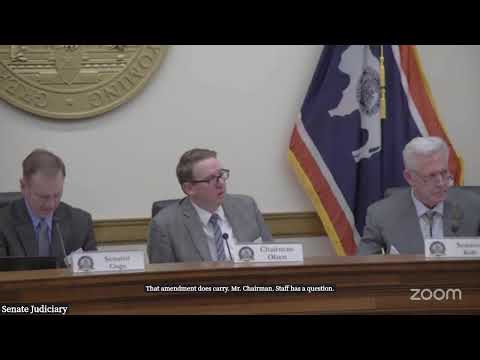
Wyoming Judiciary Committee advances three bills on squatters, fraudulent documents and protection orders
Summary
The Senate Judiciary Committee advanced three bills addressing unauthorized occupants and related fraud, and amended a proposal to change protection order hearing timelines after testimony from landlords, law enforcement and victim advocates.
The Senate Judiciary Committee on Tuesday advanced three bills: Senate File 6, a measure to allow law enforcement to remove unauthorized occupants from residential property; Senate File 11, a felony for using fraudulent documents to gain or remain in possession of property; and Senate File 7, amendments to protection-order procedures. Committee members adopted several conforming and procedural amendments and sent all three bills to the floor.
The bills were presented as responses to complaints from property owners, landlords and courts about a rise in people occupying residences without permission and about falsified documents used to assert control over property. Committee members said the proposals aim to create a faster, clearer path for law enforcement and courts to respond while preserving civil remedies where appropriate.
Senator Anderson, sponsor of Senate File 6, told the committee the measure grew out of a constituent complaint about “4 or 5 bruisers” occupying a house the constituent owned and would not leave. “She went through the process with the legal entities to try to get those guys kicked out,” Anderson said, and the bill “is trying to do is make it a criminal case.” The draft establishes a procedure for owners or authorized agents to submit a sworn affidavit to law enforcement and for officers to verify ownership quickly. It also included felony and misdemeanor provisions in the draft: a felony punishable by up to 10 years in prison or a fine up to $10,000 for knowingly occupying, damaging, or remaining in a residential dwelling after giving officers reason to remove the person.
Representatives of the Wyoming Realtors and local landlords urged the committee to pass the measure and suggested technical edits. Lori Ervokite of the Wyoming Realtors described multiple incidents across the state, including a member who arrived at a foreclosed house and found a squatter inside. “It turned out well,” she said of that case, but she told the committee that law enforcement often treats such incidents as civil matters once the occupant claims a legal right, sending property owners into a months-long forcible entry and detainer process. Julie Gleim of the Landlords Association of Cheyenne said Cheyenne alone has roughly 10,000 rentals and about 180 evictions a month; she said some eviction calendars are set six weeks out.
Law-enforcement representatives supported the measure with caution. Alan Thompson, executive director of the Wyoming Association of Sheriffs and Chiefs of Police, said language in the draft was revised during interim work to address law enforcement concerns about verification and service. Thompson warned prosecutors and police that verifying ownership and related issues may be difficult in some counties because county mapping and assessor systems vary; he urged realistic expectations about when officers can corroborate claims.
Committee amendments to SF6 included conforming the bill’s wording from “unauthorized occupant” to “unauthorized person,” removing a permissive provision that would have explicitly allowed law enforcement to charge an owner a reasonable hourly rate for a civil standby, and deleting a requirement that an owner list the date they acquired a property on an affidavit. Senator Crago argued removal of the fee language would avoid creating an “administrative nightmare” for local departments; Alan Thompson and other witnesses had said charging owners could unfairly penalize victims. After the amendments the committee moved and advanced SF6 to the floor; the committee recorded a roll-call affirmative vote and designated floor managers.
Senate File 11 creates a separate felony for intentionally using a document that a person knows, or reasonably should know, is false or fraudulent to gain or remain in possession of property. Committee members and witnesses described SF11 as complementary to SF6 but focused specifically on document fraud—examples included falsified leases or deeds posted online to induce strangers to rent or occupy property. Mark Miller, senior attorney with the Pacific Legal Foundation, told the committee the draft follows model language used in other states and is intended to separate true trespassers from holdover tenants who have some prior tenancy right. Scott Meyer of the Wyoming Bankers Association and other industry witnesses supported the bill because similar schemes have been used to falsely list or borrow against properties. The committee voted to advance SF11; a roll-call vote in the committee recorded affirmative votes from members present.
On protection orders, the Judicial Branch proposed Senate File 7 to harmonize language between Title 7 (stalking and assault protection orders) and Title 35 (domestic relations protection orders), clarify service requirements, and adjust some timelines and clerk procedures. Alisa Butler, state court administrator, said the changes were intended to reduce clerk and judge workload and to make service and venue rules consistent across protection-order types. Among other changes, the draft initially extended the statutorily required time to hold a post-filing hearing from 72 hours to up to 10 days to give courts more time to accomplish personal service in rural counties. That timeline prompted sustained public testimony from victim advocates and local providers.
Yvonne Swanson of the Advocacy and Resource Center in Sheridan County told the committee that extending the hearing interval would create safety risks and heavier demands on local victim-service budgets. “By increasing that time frame in which the judicial system must take action ... is almost as if we're telling the victims that we serve that their emotional and physical safety has dropped from the top of our priority list,” Swanson said. She and other advocates urged preserving the 72-hour hearing requirement or ensuring more robust ex parte relief for immediate safety.
After public testimony and committee discussion the committee adopted a series of amendments to SF7. Members removed the proposal to extend the hearing window back to 72 hours (i.e., they did not adopt the 10-day extension) and left the hearing-timing standard as it had been; they also adopted conforming service changes that require mailing (certified and first-class) of extension or modification notices and other procedural clarifications. The committee also narrowed, for procedural clarity, the court’s authority to appoint counsel for certain petitioners in limited circumstances during initial proceedings; committee members discussed but did not settle on age-based limits beyond the compromise language the committee considered. The amended SF7 was reported out of committee on an affirmative roll-call vote.
What the committee did not do: committee members and witnesses repeatedly emphasized that these bills are designed to provide a remedy against unauthorized occupants and fraudulent paperwork but are not meant to replace ordinary landlord–tenant eviction processes for holdover tenants. Several witnesses said civil remedies and the forcible entry and detainer statutes remain the appropriate path when there is a disputed tenancy.
The committee sent all three bills—SF6 (residential unauthorized-occupant removal, amended), SF11 (fraudulent documents to possess property), and SF7 (protection order harmonization, amended)—to the Senate floor. Floor managers were designated for the bills. Next steps are committee report filing and consideration during the Senate’s next floor calendar.