Get Full Government Meeting Transcripts, Videos, & Alerts Forever!
Get email alerts on the Alcohol Licensing topic
No spam. Unsubscribe anytime.
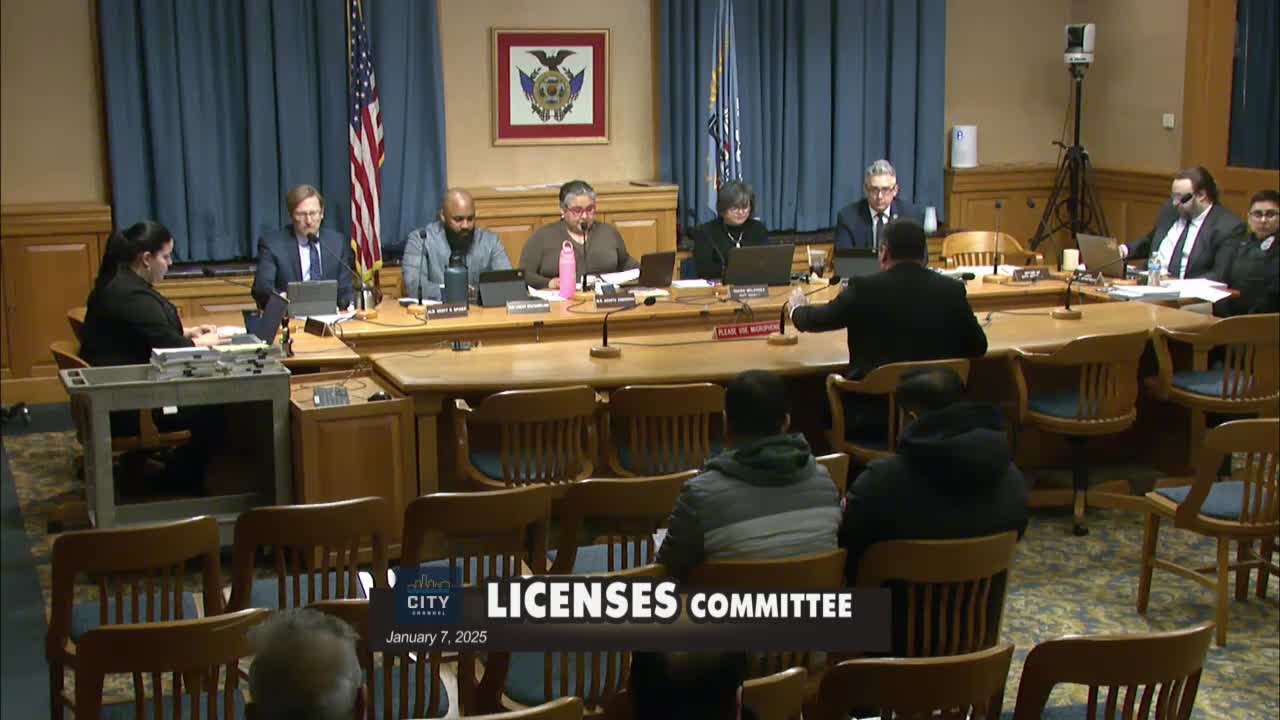
Licenses Committee advances ordinance to let City Clerk issue class D operator licenses
Summary
The Licenses Committee on Jan. 7 advanced a substitute ordinance to allow the City Clerk's office to issue class D operator (bartender) licenses administratively when applicants have a clean local background check, paid fees and completed the required responsible beverage server training.
The Licenses Committee on Jan. 7 advanced a substitute ordinance that would let the City Clerk—9s office issue class D operator (bartender) licenses when three conditions are met: a clear local background check (no items that would be bases for denial), payment of the fee and proof of completion of the responsible beverage server course. The committee chair, Licenses Division staff and the license manager presented the ordinance as a way to reduce multi-week delays that now occur while applicants wait for a council meeting.
License Division Manager Jim Cooney told the committee that under the current process applications are placed on a grant list when a police report arrives and must wait until a regular Common Council meeting for final action, which can delay issuance by two or more weeks. Cooney said the substitute ordinance would let staff issue licenses immediately when no adverse items appear on the record and the applicant has paid fees and completed training. Applicants with flags on their background checks would still be referred to the committee for deliberation.
Cooney and the committee members referred to 2023 Act 73, which created a statewide bartender license and changed the local operating environment. Committee members said the ordinance was intended to keep Milwaukee applicants from feeling compelled to rely solely on the new state process, and to allow local businesses and applicants to move faster when they otherwise meet local criteria.
Alderman Scott Speicher moved approval in committee; no member objected and the committee advanced the ordinance to the next step. The ordinance was presented as a substitute, and committee action will be forwarded to the Common Council for further consideration and any additional readings required by city rules.
Staff and the committee discussed coordination with the Wisconsin Department of Revenue (DOR). Cooney said the License Division is working with DOR to improve lines of communication so the city and state can share licensing information, and the committee asked staff to add an application question about prior state denials so committees have more information when an applicant seeks both state and local licensure.
The committee—9s action was procedural: to recommend the substitute ordinance move forward. The ordinance would not expand the city—9s grounds for denial or alter training requirements; it only delegates limited issuance authority to the City Clerk when narrow, objective conditions are met.
Ending: The committee advanced the ordinance, with staff committed to working on DOR communication lines and adding an application question about past state denials. The change is intended as an administrative streamlining step; the Common Council will take the next steps on the ordinance.