Get Full Government Meeting Transcripts, Videos, & Alerts Forever!
Get email alerts on the Agriculture topic
No spam. Unsubscribe anytime.
Planning commission backs agricultural protection area for Jacobs Briggs land with caveat to preserve eminent‑domain options
Summary
The Planning Commission voted unanimously to recommend city council approve a 53‑acre agricultural protection area petition by Jacob Briggs, adding direction that city eminent‑domain authority for potential future roadway acquisition be preserved and that staff and the applicant work on language to reflect that.
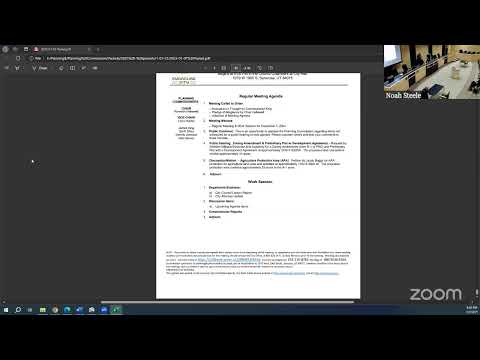
The Syracuse City Planning Commission voted unanimously to recommend that city council approve an agricultural protection area (APA) petition covering roughly 53 acres at about 1184 South / 25100 West, filed by Jacob Briggs.
Staff explained that APA designation protects farming operations from nuisance claims by new neighbors and can make rezone without owner consent more difficult; it can also complicate future right‑of‑way acquisition. "One of the powers of the city is the city can rezone property, as part of our police powers. But if it's under APA, it protects it," the planner said. He also noted the city’s transportation master plan includes two future improvements in the area — a potential roundabout at 3000 West and 700 South and an extension of 25100 West toward SR‑193 — and recommended modifications to the petition to avoid blocking future road acquisitions.
Applicant and landowner Jacob (Jake) Briggs spoke at length about the family’s long history farming the property and said he sought protections that would allow continuing agricultural use while acknowledging neighbor concerns. “I've I've never wanted to do a pig farm, but I'd also don't want to restrict what we might need to do in the future,” Briggs said, adding that his family has farmed the land for generations and currently grows alfalfa, wheat and pumpkins.
Major points and concessions - APA purpose and scope: Staff explained APA status protects property owners from nuisance claims (noise, dust, odors) and can limit rezoning without owner consent; city ordinance requires a minimum acreage (10 acres) and the petition far exceeds that threshold. - Transportation concerns and proposed carve‑outs: Staff recommended that the commission seek modifications to the APA that would reserve a strip of land (40 feet from a particular eastern edge) and a larger 250‑foot radius around a planned intersection center so that the city would not be hindered in acquiring right of way for future road improvements. Staff said the 250‑foot radius was a conservative placeholder because the precise design of a future roundabout or intersection has not been determined. - Applicant objections: Briggs said his concern with carve‑outs was practical: removing small portions of a contiguous field could leave agricultural activities unprotected in part of the same field. “...it will not be, will not benefit from this protection,” he said of a carve‑out and warned that routine nightly farming operations would not be limited to only part of a field. - Third‑party advisory input: Staff said the Davis County Agriculture Protection Advisory Board had reviewed the petition and recommended approval.
Commission response and action Commissioners discussed balancing farmland protection with the city's need to preserve future roadway alignment and eminent‑domain options. Several commissioners said they were reluctant to approve a blanket APA that would create long‑term obstacles to future right‑of‑way acquisition. The commission agreed that language could be drafted clarifying that the APA would not restrict the city's eminent‑domain authority for future roadway projects.
A commissioner moved to recommend approval of the APA petition by Jacob Briggs "with the caveat that the eminent domain be maintained for some possible future roadway" — language the commission asked staff and the applicant to refine before the item proceeds to city council. The motion was seconded and passed unanimously.
What happens next The commission’s recommendation will be forwarded to city council, which will consider the APA petition and any refined language preserving city eminent‑domain options. Staff and the applicant agreed to draft clarifying language for council review. State statutory waiting periods apply; staff noted the item would not reach council final action until the required timelines had been met.
Speakers quoted in this article are identified in the meeting record and include the city planner (staff), the applicant Jacob Briggs, the city attorney (Collin) and several planning commissioners.