Get Full Government Meeting Transcripts, Videos, & Alerts Forever!
Get email alerts on the Municipal Finance And Governance topic
No spam. Unsubscribe anytime.
Commissioners press staff for clearer rules, timelines and reporting on commission initiatives
Summary
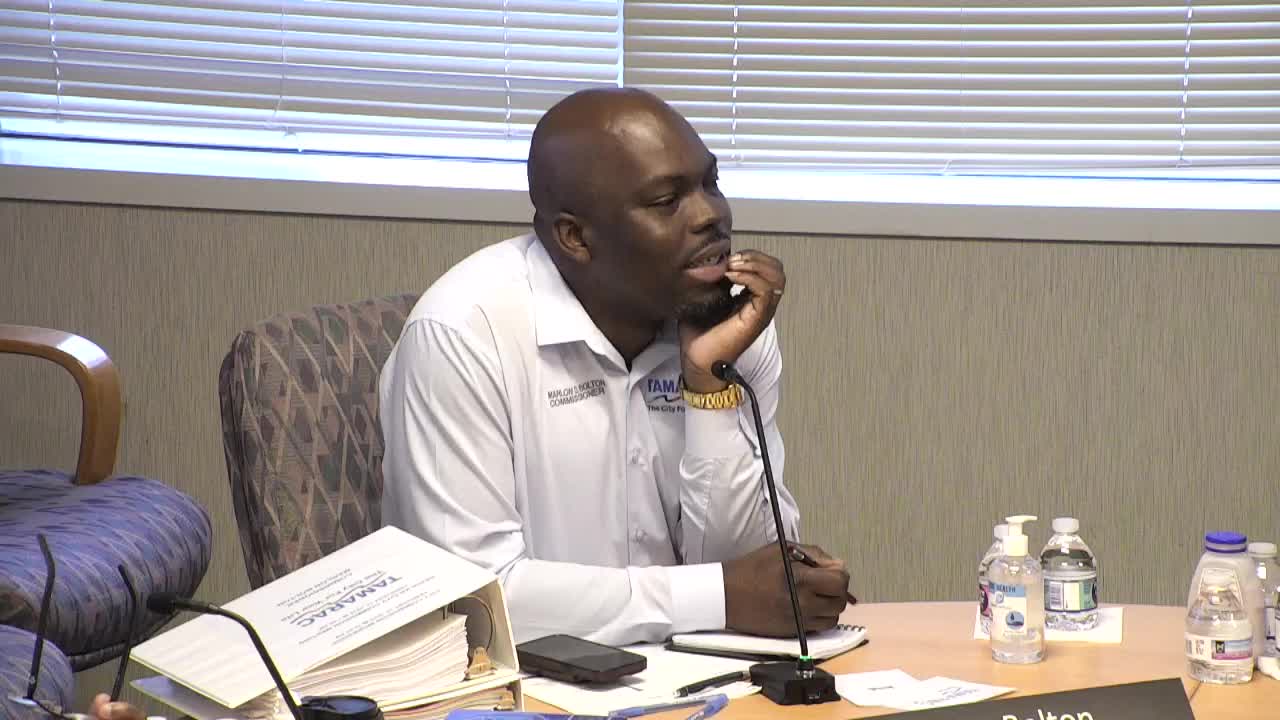
Workshop discussion focused on the city’s Commission Initiative policy (adopted 2022). Commissioners raised concerns about inconsistent communications, staff overtime and the application deadlines in the policy; several commissioners asked staff and the city attorney to return with revisions and remedies before the scheduled Feb. 12 vote.
City staff reviewed the City Commission Initiative policy, adopted by resolution in 2022, and commissioners used the Feb. 10 workshop to discuss perceived implementation problems and possible revisions.
Justin Barnaby, Special Events Supervisor, and Rudolph Galindo, Director of Parks and Recreation, summarized the policy’s purpose — to set uniform procedures for events, outreach and initiatives organized or sponsored by commissioners — and described deadlines in the policy (120 days for major events, 45 days for facility requests, 30 days for simple meetings). The policy also clarifies which costs are eligible for initiative funds, the reimbursement process and staff-hour considerations.
Many commissioners said the policy has produced uneven results in practice. Concerns included: inconsistent access to city promotional tools (banners and mailings), a perception that some initiatives receive more proactive support than others, and questions about whether commissioners should be charged for staff overtime tied to initiatives. Commissioners also said short-notice opportunities and constituent-driven events can arise inside the stated deadlines and asked how the policy could be made workable without forcing commissioners to cancel community outreach.
Staff and the city attorney explained the policy was intended to protect public funds and to ensure initiatives serve a documented public purpose; they said reimbursements and donations must meet public-purpose criteria and that the city can be asked to define eligibility on a case-by-case basis. The city’s finance director noted some initiative-related expenditures (for example, small donations or individual, one-time purchases) are already handled through existing budget lines and are not governed by the initiative procedures.
Following extended discussion, commissioners asked staff, the city attorney and finance to prepare specific edits and to return with a revised policy. The commission directed staff to: (a) prepare a rewrite or amendment reflecting the workshop feedback; (b) provide a short-term approach so initiative requests remain deliverable pending a formal change; and (c) supply cost comparisons and operational changes (including whether a month-to-month contract or alternate procurement affects event planning). Commissioners also asked for clarity about whether initiative funds can be used for assistance to individual residents and for a case-by-case legal opinion where necessary.
No vote was taken; staff will return with proposed language and a plan for applying interim changes before the next formal adoption step.