Get Full Government Meeting Transcripts, Videos, & Alerts Forever!
Get email alerts on the Transit topic
No spam. Unsubscribe anytime.
Wake Transit shifts away from large commuter rail; proposes I‑40 BRT, boosts microtransit and community funding
Summary
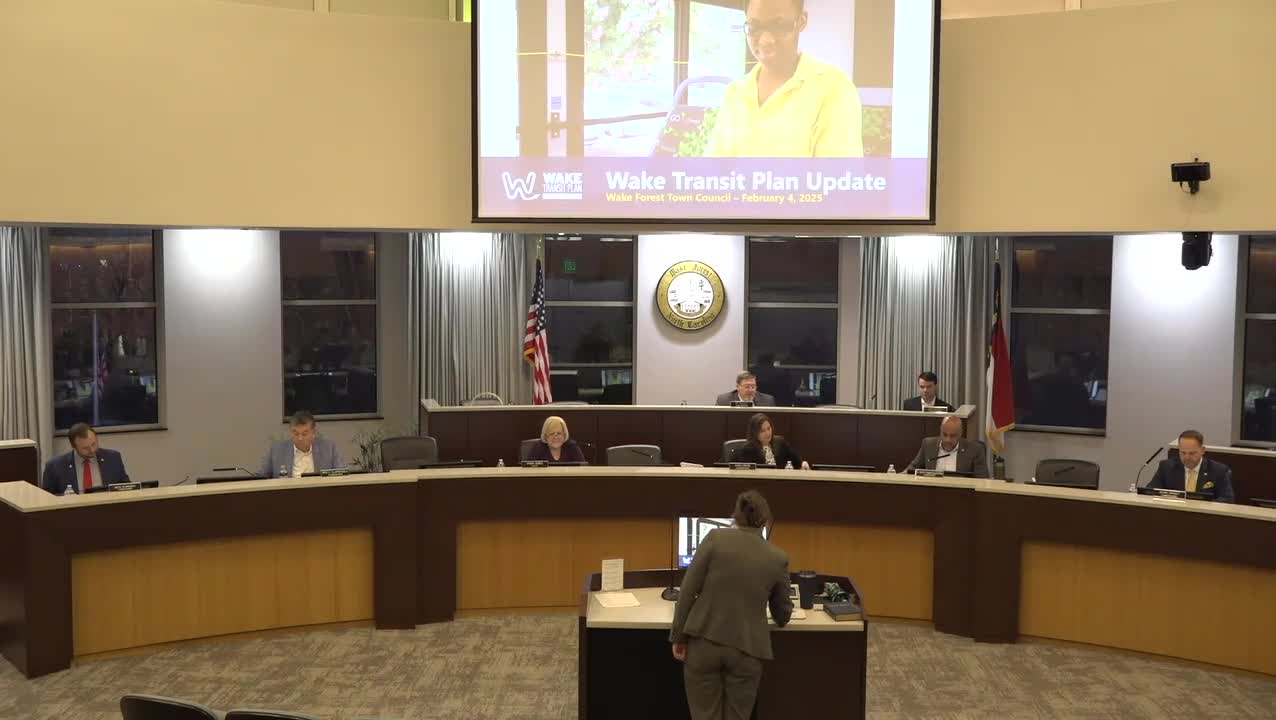
CAMPO and Wake Transit staff briefed Wake Forest council on phase 2 of the Wake Transit Plan update, outlining a shift from a single large commuter-rail project toward investments in regional rail improvements, an I‑40 bus rapid transit line, more frequent service, mobility hubs and expanded community funding for microtransit and local projects.
Ben Howe, Wake Transit program manager with the Capital Area Metropolitan Planning Organization (CAMPO), told the Wake Forest Town Council the Wake Transit Plan is being updated and that public engagement for phase 2 concluded in January.
The plan, funded by a voter‑approved sales tax, has raised nearly $750 million through 2023 and “we're expecting it to raise another $700,000,000 to $1,000,000,000 by 2035,” Howe said. He summarized four “big moves”: connect regionally, connect all Wake County communities, create frequent reliable urban mobility, and enhance access to transit.
Why it matters: the update will shape ten‑year investment choices in Wake County, including whether to continue pursuing a costly commuter rail line or reallocate funding to regional/passenger‑rail improvements, high‑frequency bus corridors and local projects in Wake Forest.
Howe said the feasibility work and cost estimates have pushed planners away from the previous large commuter‑rail concept. “Commuter rail has really just not [been] very feasible. The cost has ballooned,” he said, and estimated the Wake Transit share of that program was approaching or exceeding $2,000,000,000. Instead, staff and consultants are proposing a broader pot for rail investments — including investments in Amtrak/inner‑city passenger rail and infrastructure to increase train frequency — and a new I‑40 BRT concept to serve airport, Raleigh, RTP and connections into Durham with 15‑minute service.
The plan also emphasizes frequent bus service (defined as 15‑minute headways and roughly 17‑hour daily spans), continued work on four core BRT corridors and two planned extensions, and new “mobility hubs” to connect car‑share, bike‑share, microtransit, rideshare and rail. Howe noted Wake Forest recently secured federal funding to help build a local mobility hub that Wake Transit could potentially support.
Wake Forest specifics: CAMPO’s market analysis (done summer 2024) finds Wake Forest’s population density at about 3.29 people per acre versus a Wake County average of 2.06; population grew roughly 32% from 2016 to 2022 while employment in the town fell about 5% over that period. The analysis shows suburban demand for on‑demand/microtransit in many areas; Howe said microtransit “is really successful” in suburban developments and will continue to qualify for the Community Funding Area (CFA) program.
Public engagement and next steps: phase 2 outreach included online surveys, 20+ in‑person pop‑ups and targeted focus groups. Howe reported the engagement closed with just over 1,000 survey responses, with about 70% supporting the proposed approach to rail investments and the I‑40 BRT and roughly half of respondents split on the tradeoff between “serving more people” and “serving more places.” Wake Transit staff will use the input to draft a recommended investment strategy, release a draft plan for public review in May and seek adoption by CAMPO’s executive board and the GoTriangle Board of Trustees later this summer or early fall.
Funding and community funding area changes: the plan summary presented current and projected spending since 2017 (staff said roughly $200,000,000 invested to date on service and capital). Continued clean‑bus purchases and stop/access upgrades were highlighted; Howe said Wake Transit has used about $30,000,000 in local funds to leverage approximately $133,000,000 in federal grants. The CFA allocation model under discussion would increase Wake Forest’s community funding area share from roughly under $20,000,000 over ten years to more than $40,000,000, and staff is exploring lowering the CFA local match for operating projects from 50% toward about 35% in later fiscal years.
Questions from councilors focused on federal funding uncertainty, microtransit eligibility and standards, and local details about mobility hubs. On federal funding Howe said, “we don't know what's gonna happen with federal funding,” but added the Wake Transit program “is well funded locally” and several BR T corridors already have or are close to securing federal dollars.
What’s next: Wake Transit staff will finalize recommended scenarios, hold stakeholder meetings and present a draft plan to the public in May before finalizing the plan for governance board adoption in late summer or early fall.