Get Full Government Meeting Transcripts, Videos, & Alerts Forever!
Get email alerts on the Public Safety Emergency Response topic
No spam. Unsubscribe anytime.
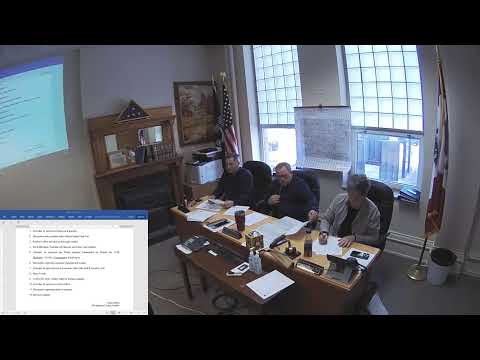
Winnebago County supervisors discuss Mount Valley peat fire costs, emergency status and closed session on potential litigation
Summary
Supervisors reviewed roughly $234,000 in county costs from the Mount Valley peat fire, agreed to schedule a closed session Feb. 25 to discuss payment and potential litigation, and discussed monitoring options including infrared drone flights.
Winnebago County supervisors reviewed costs tied to the ongoing Mount Valley peat fire and set a closed session for Feb. 25 to discuss potential litigation and payment of outstanding bills.
The board heard an itemized accounting of county and contractor charges related to firefighting and mitigation. County staff reported payments or invoices including a Swanson custom services invoice of about $165,730.26 for pumping; surfactant purchased and related handling of roughly $40,000 plus IMT transport of $4,620.05; and equipment costs from Full Circle Plows of $6,270.05. Secondary roads and excavation costs were reported as part of county work. The total reported so far was $234,342.64.
The discussion focused on whether the fire is fully extinguished, monitoring needs and eligibility for federal assistance. A county speaker said the emergency declaration had been filed to enable access to funds but that the incident "did not meet the threshold" for federal disaster assistance, citing a federal threshold of $293,000. The board discussed infrared drone surveillance as a monitoring tool; supervisors said their fire chief, Nate, had attempted infrared or visual checks but operator availability has been inconsistent.
Supervisors also raised public-safety concerns about trespassers and visitors to the burned site. A participant reported social-media posts encouraging people to search the site for artifacts; the board noted the property is private and advised it remained closed to the public because areas could still have unstable burn hollows.
On next steps, the board agreed the matter should be discussed in closed session with counsel to address potential litigation and payment options. Carla (staff) was directed to place a closed session on the Feb. 25 agenda. The board indicated any formal action would occur in open session after counsel consultation.
Todd Lewis, who advised on firefighting strategy during the response, was quoted in the meeting: "If it doesn't get put out, it will never stop." The meeting record shows supervisors asked for more monitoring evidence, including infrared drone imagery, before removing the emergency declaration.
The board did not vote on payments during the session; staff said most vendor bills had been paid and that outstanding items were primarily secondary roads charges. Supervisors asked staff to collect and bring additional documentation — drone/infrared imagery if available — to the Feb. 25 closed session so the board could consider any possible action in public session after counsel's advice.
The item moved directly into routine drainage business after the discussion, with the board scheduling the closed session and agreeing to reconvene on Feb. 25 for further consideration.