Get Full Government Meeting Transcripts, Videos, & Alerts Forever!
Get email alerts on the Property Tax Assessments topic
No spam. Unsubscribe anytime.
Caroline County officials press state assessors on timing, notice for property reclassifications including utility‑scale solar
Summary
County commissioners questioned the local office of the State Department of Assessments and Taxation on when property use changes — from agricultural to commercial — are reflected on tax rolls, how officials are notified, and how the county and towns can improve information-sharing during utility‑scale solar and surface‑mining activity.
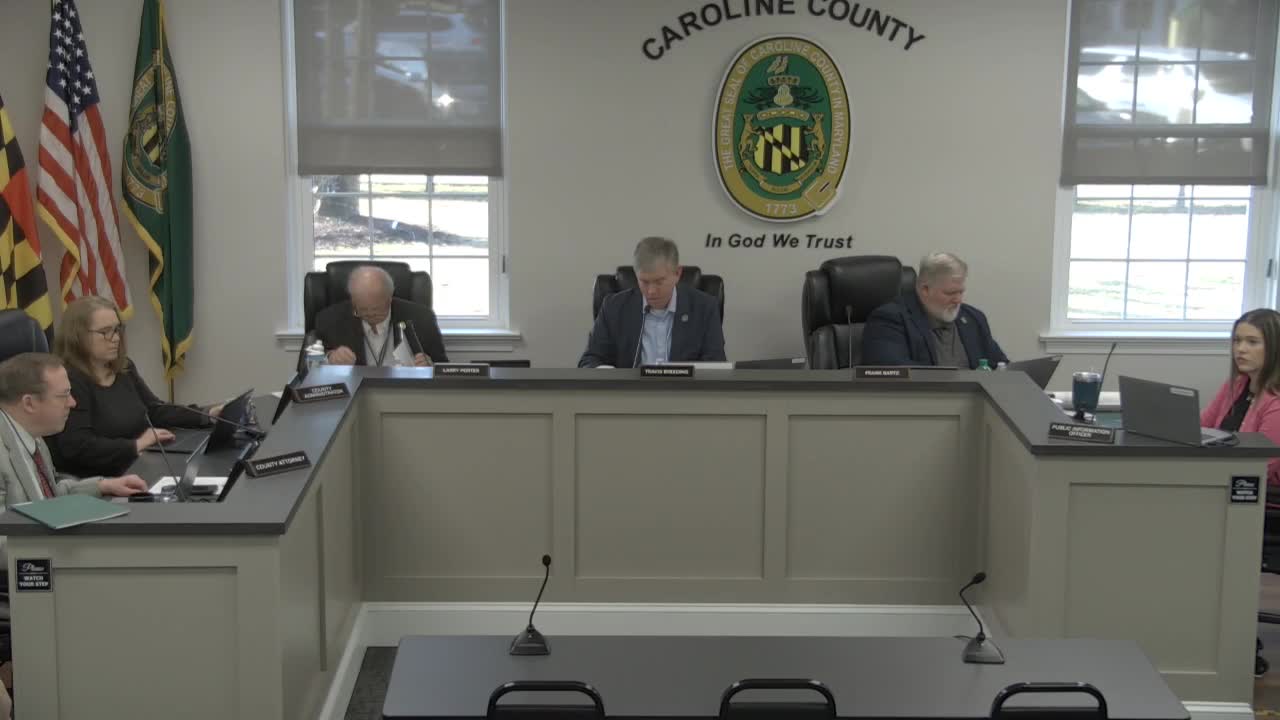
Keith Bobick, supervisor for the local office of the Maryland State Department of Assessments and Taxation (SDAT), told the Caroline County Board of Commissioners on Feb. 4 that changes in property use are reflected on the tax roll effective the fiscal year beginning July 1 following the change.
Commissioner Porter and other commissioners pressed Bobick for details about how and when the office learns that a property has changed use — for example, when agricultural land is converted to utility‑scale solar or to surface mining — and how the county's tax office and SDAT could avoid sending residents to the wrong office for help.
Bobick said SDAT typically learns about large projects through county planning and codes permits, deeds and surveys, and occasionally via news reports or direct observation. He said his local office has five employees; staff typically telework two to three days a week. SDAT performs reassessments on a rotating schedule so each property is reviewed on a multi‑year cycle; roughly one‑third of parcels are in the cycle each year, which equates to inspecting about one‑ninth to one‑tenth of parcels annually. Physical inspections are done for properties with permits or where sales data indicate a need.
On solar specifically, Bobick said a utility‑scale solar site that has changed from agricultural to another use is reassessed once the change is in effect and that reassessments are applied for the upcoming July 1 tax year; whether that occurs the day panels are first placed, when stripping/topsoil work begins, or when a permit issues depends on when the change of use actually starts. He cited a local project where erosion control measures and soil work were visible in the field and said the reassessment would be effective on the next July 1 even if the formal change has not yet been entered into SDAT records.
Commissioners raised two recurring concerns: (1) some municipalities do not consistently transmit permit information to SDAT, which can delay reassessment, and (2) a voicemail/menu message on the assessor/tax phone lines has sometimes sent residents to the county tax office when their issue was an assessment question. Bobick said some towns are “better than others” at sending permits and that planning and codes recently switched from paper copies to an electronic spreadsheet for permit information; he offered to provide commissioners a list of municipalities that are not supplying regular permit information. He also offered to work with county staff to clarify phone messaging.
The board discussed possible steps to reduce errors and delays: (a) a standing monthly or quarterly permit feed from planning and codes to SDAT, (b) a template or checklist SDAT will require from applicants that request a county letter for a CPCN or similar filing, and (c) revised voicemail/menu language to direct callers to the correct office based on the nature of their question.
The commissioners and SDAT also reviewed how certain outbuildings and business uses are taxed. Bobick said grain storage tanks are assessed as improvements regardless of whether they sit on residential or commercial parcels, and commercial properties use different valuation approaches for land than residential parcels. For personal property and certain large electrical generation equipment, Bobick said those classifications and assessments are handled in Baltimore by the central SDAT office.
Next steps recorded in the meeting: SDAT will provide the commissioners a list of towns that have not been supplying permits regularly; planning and codes and SDAT staff will explore an automated or monthly permit pull from the county permitting system; and county staff will review and propose clearer phone messaging for residents seeking assessment or tax assistance.
Ending: Commissioners requested that staff return with a proposed communications and permit‑sharing workflow that could be implemented well ahead of the July 1 reassessment deadline.