Get Full Government Meeting Transcripts, Videos, & Alerts Forever!
Get email alerts on the State Legislation Blueprint topic
No spam. Unsubscribe anytime.
Board hears state legislative and Blueprint for Maryland’s Future update; district opposes pausing collaborative time and seeks analysis of costs
Summary
Harford County Board members received a legislative update from MABE-aligned representatives and district staff on state bills and Blueprint changes, including concern about pausing collaborative time, requested studies of special-education adequacy and National Board Certification stipend impacts, and tracking of community schools funding.
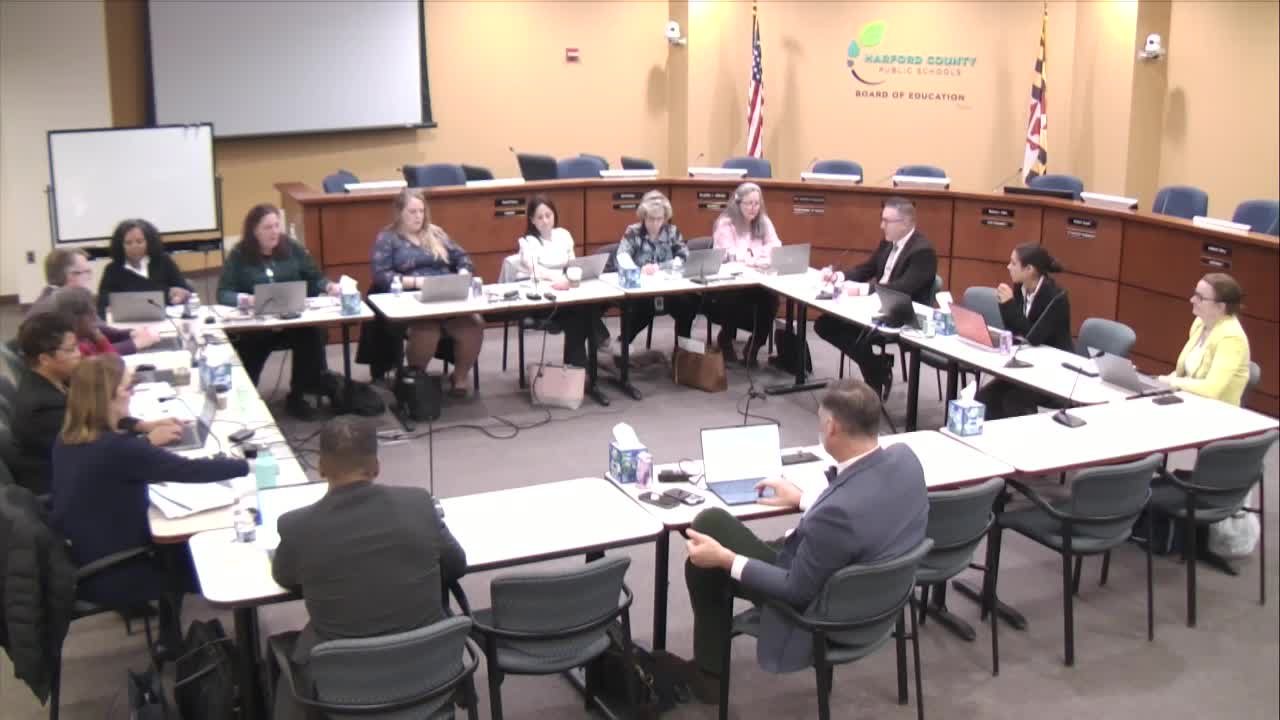
Board members received an extended update on ongoing state legislation and changes to the Blueprint for Maryland’s Future at the Feb. working session. The briefing covered bills that MABE (Maryland Association of Boards of Education) is tracking or opposing, the Accountability and Implementation Board's pause on the collaborative time requirement in the Blueprint, and district priorities for state analysis on affordability and special-education adequacy.
Dr. Carol Mueller (board member, MABE representative) guided members through the Maryland Association of Boards of Education’s online advocacy center summary of 2025 bills and MABE positions. She said MABE generally opposes legislation “that’s going to take away local control,” and cited examples including bills concerning school start times and cell-phone policy where MABE recommends local boards keep decision authority. She also reviewed specific bills on the agenda list as of Feb. 17, 2025, including measures addressing public school construction inflation-adjustment funding and proposed high-school graduation requirements that would tie completion to FAFSA submission.
District leaders described additional Blueprint-related concerns. Dr. Phil Bolsom (Superintendent; transcript uses “Doctor. Balson/Bolsom” in places) and Katie Ridgeway, chief of staff, summarized how the state’s pause of the collaborative time element — a portion of the Blueprint’s career ladder intended to reallocate teacher time over an eight-year phase-in — could reduce next year’s foundation calculation by roughly $163 per pupil. Ridgeway said that if the $163-per-pupil component were removed from the foundation, it would represent about a $5 million reduction in state revenue for the district and the equivalent of about 50 teaching positions.
Bolsom testified in Annapolis with other superintendents about concerns in the governor’s budget proposal and the potential effects of changes to the foundation formula on school staffing and services. District staff said they are asking the state for three specific analyses: an evaluation of the impact of National Board Certification (NBC) stipend program and its renewals, an adequacy study of special-education funding, and an analysis of the foundation formula used to allocate state funds.
Board members and staff also discussed NBC stipends. The district noted that NBC-related incentives can accumulate over multiple renewals; testimony cited renewal payments that add several thousand dollars and that in aggregate the lifetime stipend impact can be large. District leaders asked for evaluation to determine whether NBC stipend structure achieves anticipated retention and achievement goals and whether renewal amounts should be adjusted.
Community schools funding was another topic. Ridgeway explained the governor’s proposed legislation would pause some community-schools funding for two years after next year, while also permitting use of funds for leadership coordination. Board members heard that the pause had prompted testimony from students and community advocates in Annapolis opposing such a reduction.
The board was also briefed on student advocacy activities: a delegation of students participated in an American Youth Association advocacy day in Annapolis and raised issues such as anti-bias training, blueprint funding, cell-phone policies, legacy admissions and teacher shortages.
Ending: District staff said they will continue to monitor legislation, supply the board with written summaries and recommended actions, and press the state for the requested analyses on NBC, special-education adequacy, and the foundation formula. Board members were urged to contact state legislators about bills that affect local control and student supports.