Get Full Government Meeting Transcripts, Videos, & Alerts Forever!
Get email alerts on the District Finance topic
No spam. Unsubscribe anytime.
Harford County schools project deficit in operating categories as fund balance shrinks after one-time settlement refund
Summary
Harford County Public Schools officials forecast an operating shortfall driven by rising special-education costs and an unbudgeted textbook purchase, and plan to use one-time revenue from a county rate-stabilization refund to avoid overspending state budget categories.
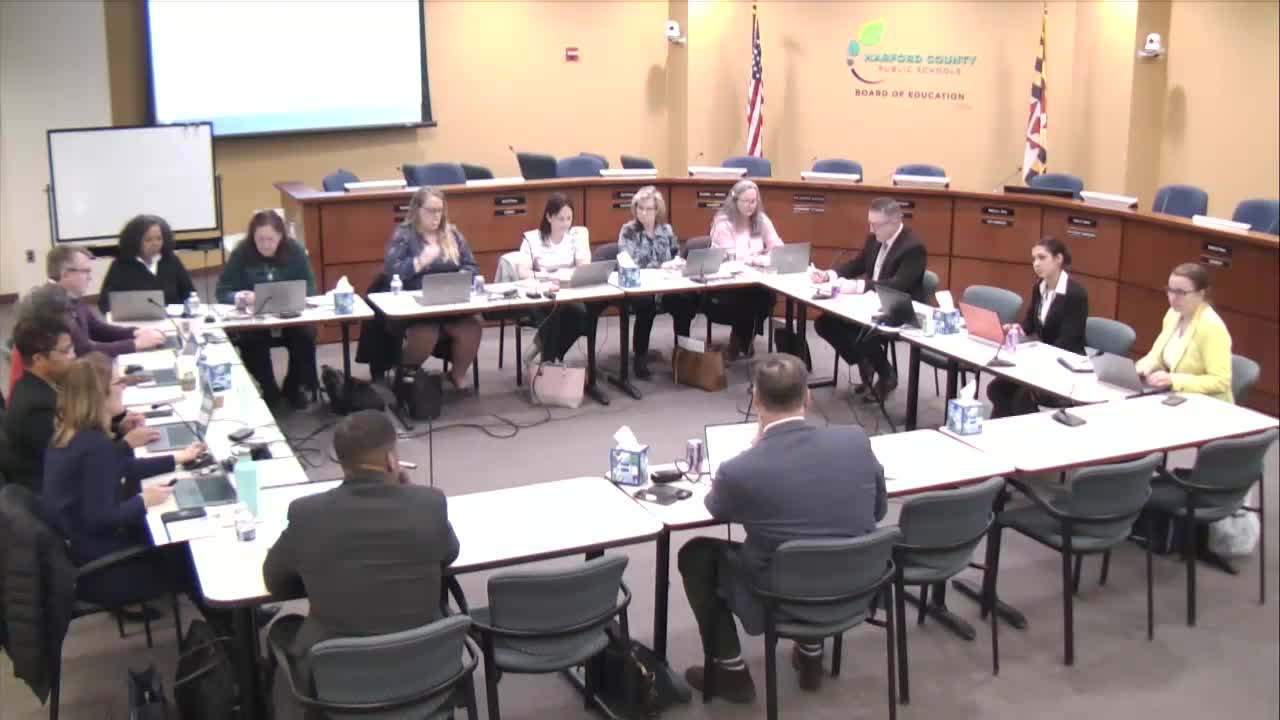
Harford County Public Schools officials told the Board of Education at its Feb. working session that the district projects operating expenditures will exceed the adopted budget for fiscal year 2025, largely because of special education costs and a recent large textbook purchase.
Deborah Judd, assistant superintendent for business services, presented the quarterly financial report for the period ending Dec. 31, 2024, and said the projection “does not include the impact of the snow that we've had since January 1” and “so it will, unfortunately, negatively affect us a little bit.”
Judd said the district currently anticipates about $4.9 million in additional revenue compared with the adopted budget — “mainly due to interest revenue and also for $3,000,000 that the county government sent from our rate stabilization fund related to our settlement with CareFirst.” At the same time, she said, expenditures are “projected to be over what we budgeted by $1,900,000,” driven primarily by special-education costs, particularly nonpublic placements, and by a recent textbook purchase.
That combination leaves the district with an estimated unassigned fund balance of roughly $29 million before accounting for a $10 million appropriation the board approved at its previous meeting; after that appropriation, Judd said, unassigned fund balance would fall to about $19 million. She noted that the district ended fiscal 2024 with roughly $26 million in fund balance.
Board members asked how Harford’s fund balance compares with standards. A board member asked, “What is a correct fund balance?” Judd answered that guidance varies, noting Government Finance Officers Association (GFOA) guidance recommending roughly two months of operating revenues (about 16.7%); she said Harford’s unassigned fund balance is currently about 4½ percent of its operating budget and that most Maryland school systems are well below the GFOA recommendation.
Board members and Judd discussed the recurring challenge of textbooks. Judd said the district historically budgets textbooks in capital rather than operating, and “we have not received capital funding in several years for that, so that's a challenge that we're going to have to address in the next several years.” She added the district cannot legally overspend any state-required accounting category and that the board may need to appropriate additional revenue or make inter-category transfers in May to cover the projected shortfall.
On special education, a board member observed that enrollment of students needing special education services has risen. Judd said higher counts and more placements — especially nonpublic placements — are major cost drivers and that if the state shifts more special-education costs to local school systems, the local budgetary pressure would increase. She said the district would need to propose increased special-education line items in future budgets when trends continue upward.
Judd also described other elements of the revenue picture, including federal funds that shielded some operating spending in prior years and a one-time rate-stabilization refund that boosted revenues. The board scheduled a return presentation in May to seek appropriation authority if necessary.
Board members asked for more detail on line items that have low year-to-date spending percentages (for example, “other instructional costs”) and whether those underspent lines could create a larger second-half-year liability. Judd explained that some categories are front-loaded (software, device leases, textbook-related contracts) while others — like instructional salaries — are paid more heavily during the school year and therefore appear behind at the quarter end. She said the office will provide additional breakdowns if requested.
Ending: The board closed the budget discussion after asking staff to return in May if the district needs to appropriate additional revenue; staff committed to provide more granular item-level detail and to quantify the expected impact of recent snow-related costs when those payroll numbers were complete.