Get Full Government Meeting Transcripts, Videos, & Alerts Forever!
Get email alerts on the Recovery Housing Regulation topic
No spam. Unsubscribe anytime.
Stakeholders urge caution as Ohio committee hears bill to add certificate‑of‑need and local inspections for recovery housing
Summary
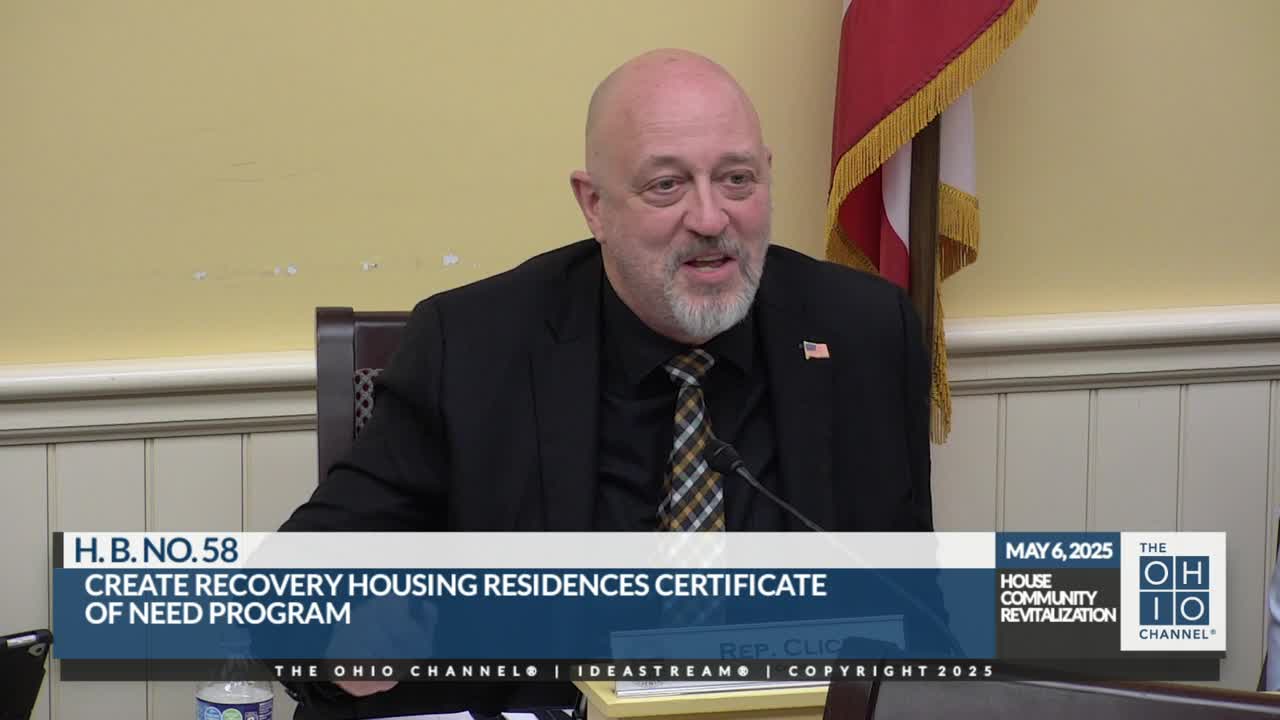
Lawmakers heard extensive testimony on House Bill 58, which would add a certificate‑of‑need process, per‑bed fees, and local inspection responsibilities for recovery housing residences, prompting broad opposition from credentialing organizations, providers and people in recovery.
Lawmakers heard extensive proponent and opponent testimony on House Bill 58, which would impose a certificate‑of‑need process, set new fees and inspection responsibilities, and transfer some complaint‑investigation duties to county alcohol, drug and mental health (ADAMH) boards for recovery housing residences.
Ohio Recovery Housing’s executive director, Danielle Gray, opened her testimony in opposition, saying, "Medicaid does not pay for recovery housing," and cautioning that the bill as drafted would create unintended consequences that could reduce access to housing for people in recovery. Gray described an existing state registry and credentialing process created after 2023’s HB 33, said the system has been certifying organizations since January, and urged the committee not to dismantle or duplicate the current oversight structure.
Why it matters: witnesses representing certified recovery‑housing operators, statewide advocacy groups and some people in long‑term recovery told the committee the state already has a functioning credentialing and complaint system, but that HB 58 would add a certificate‑of‑need requirement, annual ADAMH inspections, per‑bed application fees and potential penalties that could raise costs for residents and hamper new homes from opening.
Testimony highlights and data cited
- Ohio Recovery Housing (ORH) and other credentialing organizations said the registry and certification process established under HB 33 (effective January) is actively taking applications: testimony cited over 170 organizations already credentialed and more than 180 pending applications; ORH said it had rejected 36 applications for failing to meet standards and had received over 100 complaints since May 2024 (many forwarded to the Department of Mental Health and Addiction Services). - ORH and multiple provider groups warned that certificate‑of‑need rules traditionally used for hospitals and long‑term care would be ill‑suited for private, landlord‑style residences and would add time and cost that operators — many of whom are self‑supporting or nonprofit — cannot absorb. Several witnesses noted that recovery housing is not Medicaid‑funded room and board and that bad actors using treatment‑funding work‑arounds are a separate problem that HB 58 would not fix. - Providers and advocates (Lighthouse Behavioral Health Solutions, Oxford House, Woodrow Project, Community Health Alliance, Ohio Alliance of Recovery Providers, Ohio Citizen Advocates for Addiction Recovery) described consequences they expect from HB 58: higher resident costs, fewer new homes, duplication of statewide credentialing, inconsistent local enforcement, and diversion of limited public funds to run the proposed local inspection program. - Personal testimony came from people in recovery who credited certified recovery homes with supporting employment, family reunification, and stable housing; one resident said she regained custody of her children and sustained housing after living in a certified recovery residence.
Questions from committee members
Members asked about complaint pathways, whether local prosecutors had used criminal penalties under current law, and whether ADAMH boards have capacity to perform inspections and investigations. ORH said substantiated violations can be referred to the Ohio Attorney General but suggested adding criminal penalties to enable quicker local prosecution in egregious cases. Witnesses said local boards typically lack personnel, training and funding to take on annual inspections and the proposed administrative workload.
Alternative recommendations offered by witnesses
- Add criminal penalties for operating uncredentialed recovery housing so local prosecutors can act directly against bad actors. - Increase funding and targeted enforcement to address localized problems rather than imposing statewide certificate‑of‑need and fee regimes. - Educate communities to reduce NIMBY opposition and help distribute recovery housing more equitably across jurisdictions.
Next procedural steps
House Bill 58 was recorded as having its third hearing; no committee vote was taken. Several witnesses asked for an interested‑parties meeting and additional dialogue to revise the proposal without destabilizing the new credentialing system.