Get Full Government Meeting Transcripts, Videos, & Alerts Forever!
Get email alerts on the Education Programs Ccmr Cte topic
No spam. Unsubscribe anytime.
Alief ISD presents after‑school program growth and CCMR/CTE gains at board workshop
Summary
District staff reported expansion of the Children Interacting After School (CIA) program, $40,000 donation to the culinary program, enrollment figures, and progress and challenges on college, career and military readiness (CCMR) and industry‑based certifications (IBCs).
Alief ISD trustees heard updates on after‑school programming, post‑secondary readiness and career and technical education during the board's Feb. 4 workshop.
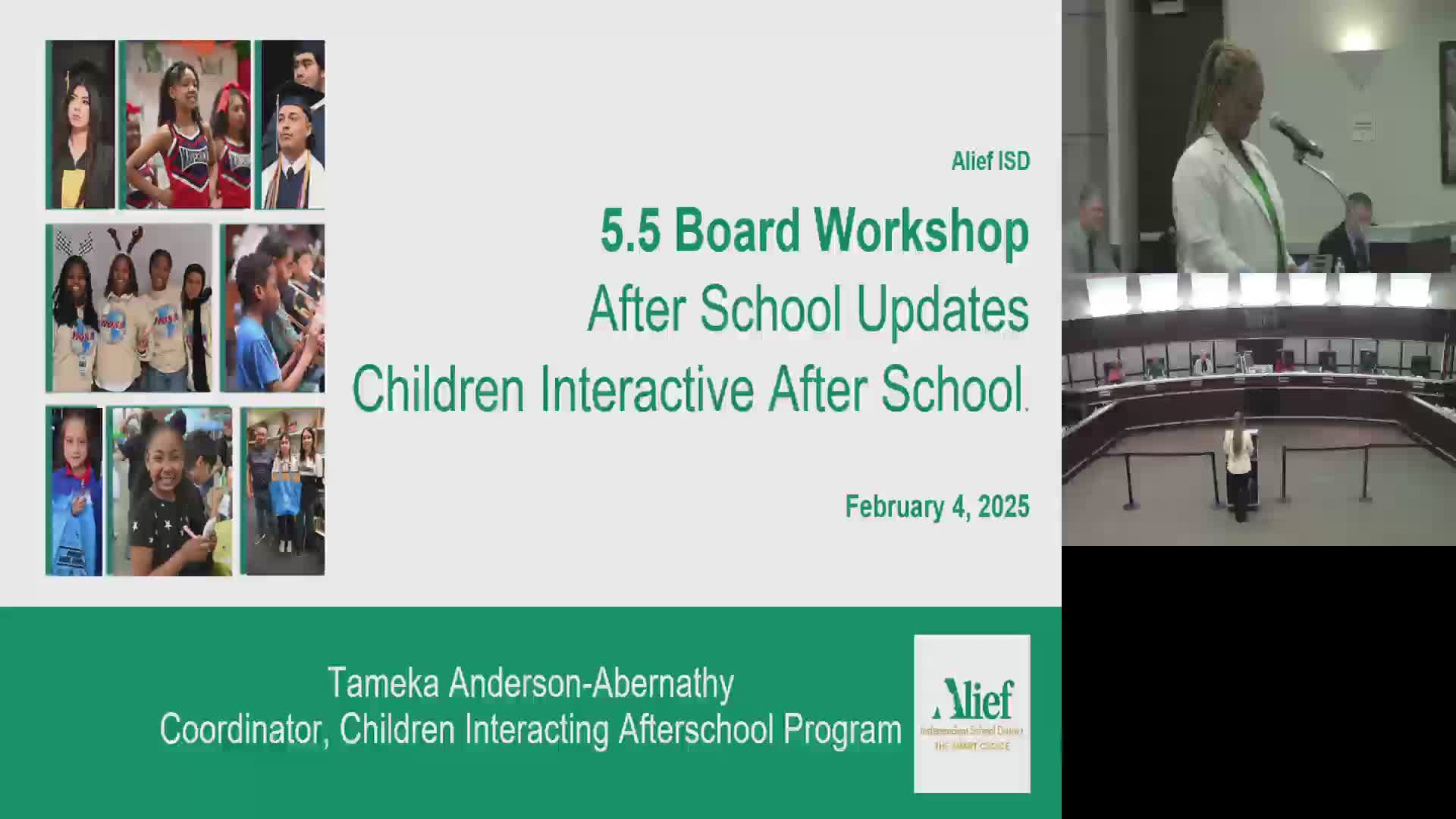
Tamika Abernathy, coordinator of the Children Interacting After School program (CIA), told trustees the program began in 2013 and has expanded its services and vendors, including a culinary program launched virtually in 2020. She said CIA has grown from 15 families in its early phases to 300 families in the culinary program and currently serves 1,260 students at 21st Century Community Learning Center sites at no cost to parents. A Hope Clinic donation of $40,000 this year was identified as supporting the culinary family‑engagement effort.
Kathy Young, deputy superintendent of curriculum and instruction, introduced a College, Career and Military Readiness (CCMR) update. Brandy Brotherton, director of advanced academics and post‑secondary outcomes, reviewed the multiple ways students can earn a CCMR point under Texas accountability rules: SAT/ACT scores, TSI, Texas College Bridge, OnRamps dual‑credit courses, AP exam scores, dual credit hours, industry‑based certifications (IBCs), or military enlistment. Brotherton cited historical and current data: a 41.9% CCMR rate for 2022–23 (as of January of that year), 56.7% the prior year, and a current OnDataSuites rate of 47.6%; she said Texas College Bridge completions would raise the district's effective percentage toward nearly 60% once integrated into state reporting.
Brotherton also noted low TSI performance in some areas — "When we look at our TSI data in ELA, 6 percent of our kids are meeting that benchmark" — and described district plans to progress‑monitor and expand earlier CCMR pathways so students reach readiness before their senior year.
Jennifer Baker presented CTE and IBC developments. She explained state rule changes that now require students to be a "concentrator" (two or more CTE courses earned) for certifications to count and that future rules will require "completer" status. Baker reported 409 current eleventh‑ and twelfth‑grade students who have earned an IBC and met concentrator status, plus 294 eleventh‑ and twelfth‑grade students who have earned an IBC but have not yet completed coursework. She listed recent successful certification exams (examples included Adobe Premiere Pro, ASE brakes, drone certification, Microsoft Office Excel/Word expert, food protection manager where 62 students passed recently, and patient care tech/EKG/phlebotomy where 55 students passed). Baker said most certification testing occurs heavily in March–May and numbers are expected to rise.
Trustees praised the CTE center and the CIA market day. Board members and presenters emphasized outreach efforts such as eighth‑grade tours of the Marshall Center for Advanced Careers, an upcoming Alief Youth Expo, and partnerships with HCC, Hope Clinic, YMCA and other community organizations.
Presenters said Texas College Bridge will remain available to seniors but, starting after the current semester, the district will not place juniors in that senior‑only pathway because TEA rules now limit crediting to senior‑year completion and the program is no longer free. Board materials with detailed numbers were to be posted in board notes.