Get Full Government Meeting Transcripts, Videos, & Alerts Forever!
Get email alerts on the Brownfields Job Training topic
No spam. Unsubscribe anytime.
Tacoma outlines EPA brownfields job-training program; early cohorts show hires
Summary
City staff updated the Economic Development Committee on a U.S. EPA Brownfields job-training grant that funds HAZWOPER and related certificates, described outreach and partner roles, and reported placement rates from the first cohorts.
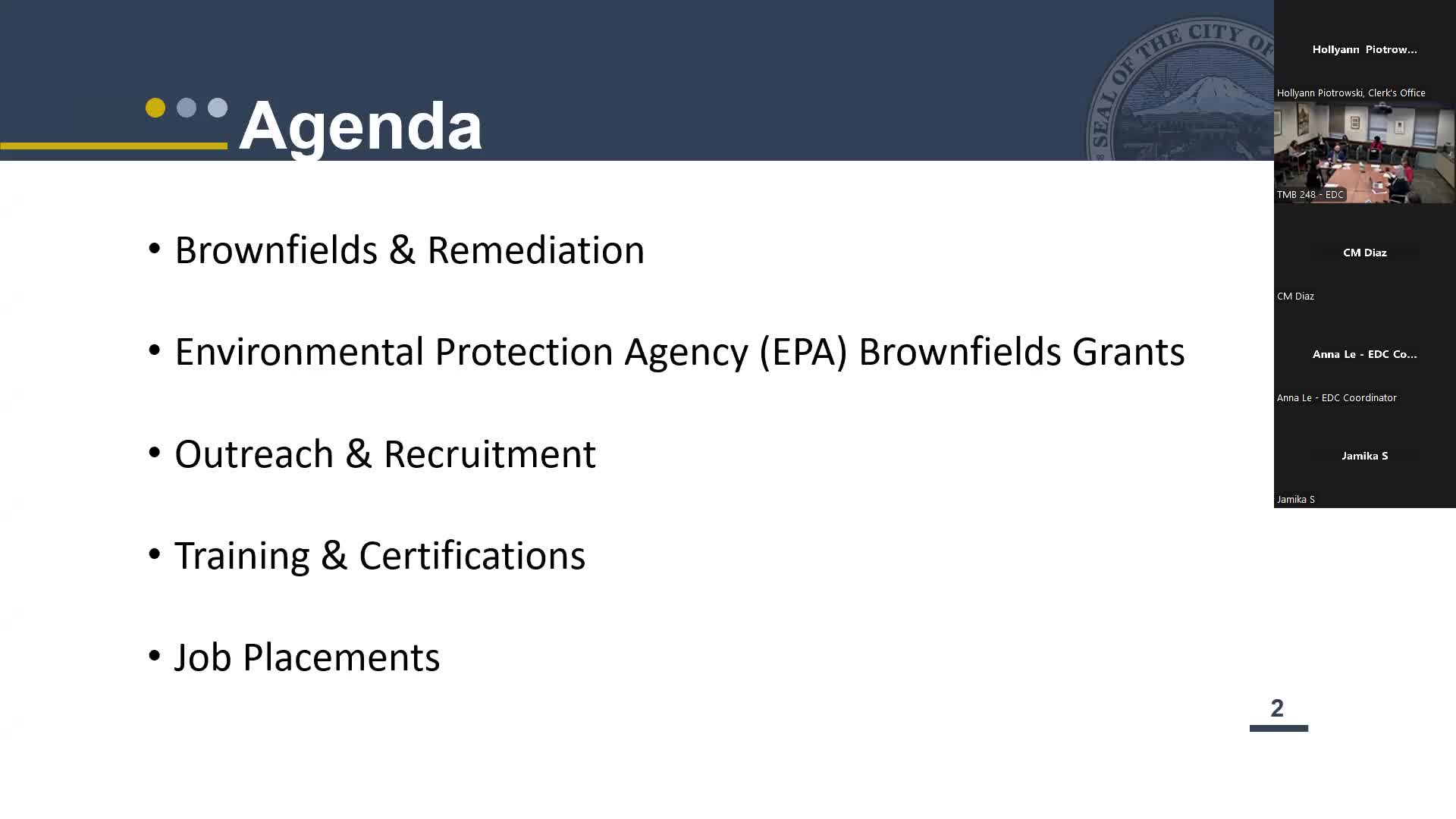
On Feb. 25, 2025, the City of Tacoma Economic Development Committee received an update on a U.S. Environmental Protection Agency brownfields job-training grant that city staff said will support remediation work and local hiring.
The program matters because Tacoma’s industrial past left contaminated properties across the city and the surrounding port, and remediation projects require trained technicians. Deborah Trevorrow, workforce grama analyst at Community and Economic Development, told the committee that the city’s EPA-funded training is intended to create a local pipeline of certified remediation workers able to support cleanup projects tied to the Port of Tacoma and other remediation efforts.
Trevorrow said Tacoma has a long industrial history, citing the Asarco copper smelter and the Tacoma Smelter Plume; she said the EPA placed Commencement Bay and the smelter site on its Superfund list in 1983. She also summarized a Department of Ecology study that the city shared with committee members, saying there are 1,024 sites in Pierce County and 908 of those are in the city of Tacoma. Trevorrow said the port has removed about 1,300,000 cubic yards of contaminated sediment from local waterways and that the port and other agencies are continuing assessment and cleanup work.
Trevorrow described the current award as a five-year, approximately $500,000 EPA-funded training program and said the city has managed multiple brownfields training grants over the years. She said the city has received about nine brownfields-related grants totaling roughly $2,400,000 and that prior three-year awards (about $200,000 each) generally exceeded placement targets.
Training partners and course content
Antoine Washington of Goodwill described outreach and recruitment for the program and the pipeline from initial interest to enrollment. Washington said online interest generated about 20-plus contacts, roughly 60 applicants completed an initial information screening, about 40 completed a CASAS screening (a basic reading and math assessment used for grant requirements), and 18 completed full enrollment for one recent cohort. He said 15 was the target class size for the cohort that began Jan. 27.
Washington emphasized employer engagement: “We gained access to at least 10-plus employers to come and talk to them,” he said, and noted employers were scheduled for the cohort’s upcoming graduation.
Michelle Barr of Clover Park Technical College described the curriculum and certification requirements. "The core of the program ... is the HAZWOPER, which is the 40-hour hazardous materials handling certificate," Barr said. She said Clover Park stretches HAZWOPER over more days than the minimum to give students more time to learn and pairs lectures with hands-on labs and exercises, including decontamination drills and practice with respirator tanks. Barr listed supplemental credentials included in recent cohorts: OSHA-10 general safety, first aid/CPR, bloodborne pathogens, asbestos worker (32-hour certificate), Lead RRP (renovation, repair and painting), flagger certification and forklift certification.
Placement outcomes and support services
Washington summarized placement efforts from the first cohort: the initial cohort, held in July/August, enrolled nine participants and eight graduated. “We were able to place 65% of those personnel in such job categories as general labor, flagger, office worker, and a paid internship with one of our Goodwill programs,” Washington said, referring to Goodwill’s WEX (work experience) placements. He described wraparound supports used during recruitment and enrollment, including background questionnaires, financial screenings and one-on-one intake conversations to assess barriers to training completion.
Trevorrow said the city tracks graduates for a year under grant requirements and that past cohorts typically exceeded placement targets; she asked committee members to refer candidates for the next cohort. Trevorrow said the next cohort on this grant is scheduled to begin in early May, and she invited council members to attend graduations or site visits.
Committee questions and context
Committee members asked about retention in Tacoma versus regional placements; Washington said most placements for the program have been local but some employers operate regionally and may place workers at sites outside Pierce County. Council members praised the program’s hands-on approach and said they hoped the city would continue applying for EPA brownfields grants to sustain the training pipeline.
The presentation linked the training program to ongoing remediation needs in Tacoma neighborhoods and the port area and positioned the training as workforce development aligned with remediation projects. Presenters and committee members repeatedly cited the EPA award, the port’s remediation activity and the Department of Ecology site inventory as the program’s policy and technical context.
Looking ahead
Trevorrow said staff plan to continue applying for EPA brownfields funding "as possible" and encouraged referrals to the May cohort. Washington said outreach will continue to focus on community organizations, churches, high schools and partner agencies that serve unemployed and underemployed people.