Get Full Government Meeting Transcripts, Videos, & Alerts Forever!
Get email alerts on the State Budget And Taxation topic
No spam. Unsubscribe anytime.
Appropriations Committee advances property-tax relief, child nutrition funding and election disclosure measures; several bills pass on party-line votes
Summary
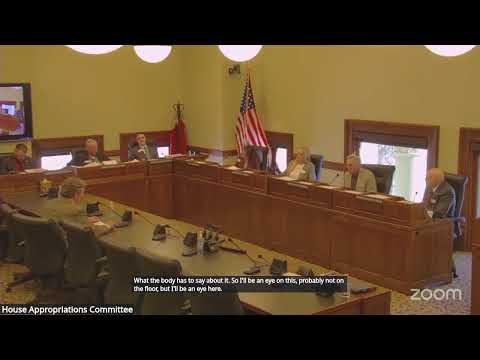
The House Appropriations Committee on May 20 recommended passage of multiple bills addressing property-tax relief, bond question wording, a summer nutrition EBT pilot and election disclosure measures, while rejecting a proposal to create a Monument to America oversight task force.
The House Appropriations Committee on May 20 recommended passage of multiple bills addressing property-tax relief, bond ballot language, a summer nutrition pilot, parental waiver acknowledgments, foreign funding disclosures for ballot measures, and a streamlined annexation building-permit rule. The committee also debated a separate measure to create a Monument to America oversight task force and associated expenditure; that proposal failed on a committee roll call.
The committee, chaired by Representative Bair, handled three re-referrals and four regular bills under expedited testimony rules and took recorded roll-call votes on each bill. Most measures were advanced to the House floor, with several passing by 6–1 or unanimously. The monument/task-force bill drew extended discussion and was defeated in committee 2–5 after amendments cut the requested appropriation.
Why it matters: The bills carry direct budgetary or procedural effects — from estimated tens of millions for the property-tax relief plan to a $2.28 million startup request for a summer nutrition electronic benefit transfer (EBT) pilot — and include new disclosure and enforcement language for ballot measures that could alter how local bond questions are worded and policed.
House Bill 130 — property-tax relief (recommended do pass) Chairman Bair presented House Bill 130 as a property-tax relief measure brought by the majority floor leader that would provide a homeowner exemption using energy matching funds identified in the fiscal note. Under the committee amendment, the exemption in the first year would apply broadly to residential homes and, in the second year, would be limited to primary residences once the Department can confirm residency status. The bill includes a $400,000 per-residence cap as presented in committee and a fiscal estimate shown in the committee materials.
Committee members discussed the bill’s fiscal note. Chairman Bair summarized the committee amendment and the fiscal impacts: “the cost of the bill is 83,000,000 per year in ’26 and ’27” and the amendment changes the first-year cost to about $110,000,000 while leaving the second-year cost at $83,000,000, the chairman said. The committee voted on a roll-call motion to recommend the bill do pass; Representative Aleman moved and Representative Smith seconded. The recorded roll call was: Aleman — Aye; Angelos — Aye; Harrelson — Aye; Pendergraft — Aye; Sherwood — No; Smith — Aye; Chairman Bair — Aye. The tally reported by the clerk was 6 aye, 1 no. The committee’s action sends the bill to the floor with a “recommend do pass” from Appropriations.
House Bill 190 — bond-question wording and Secretary of State oversight (recommended do pass) Representative Lien presented House Bill 190, which would require the Secretary of State to review bond-question language and strike wording that the sponsor and supporters consider biased or emotionally laden. Lien said the bill is intended to remove adjectives and emotionally framed language from bond questions so voters see “we want this amount of money for this much” without descriptive modifiers.
Representatives, the Secretary of State’s office and county officials discussed draft language. Jesse Neiman of the Secretary of State’s office told the committee “Secretary Grama stands in full support of this bill” and said the office could implement review without additional positions or funding. Mr. Rubino, the office’s chief policy officer, recommended keeping the statutory phrase as drafted — the bill draws from an existing election-code phrase that he described as the origin of the “true and impartial manner” language used in other statutes.
Vice Chair Pendergraft moved and Representative Smith seconded the motion to recommend the bill do pass. The roll-call vote recorded: Aleman — Aye; Angelos — Aye; Harrelson — Aye; Pendergraft — Aye; Sherwood — No; Smith — Aye; Chairman Bair — Aye. The clerk reported 6 aye, 1 no. The bill was recommended to the floor.
House Bill 341 — summer nutrition EBT pilot (recommended do pass) Representative Larson introduced House Bill 341 and was joined by the Department of Family Services director for a brief financial explanation. The department said the initial request is $2,280,000 in federal fund authority and state general-fund match; “half of that would be federal dollars, half would be general fund,” the director said. The department described those funds as primarily for IT and program startup costs, temporary staff and contracts needed to establish an EBT-based summer benefit that would provide eligible children $40 per month during summer months. The department estimated ongoing costs of roughly $1,400,000 per year, of which the state share would be about $700,000 annually if the program continues.
Committee members asked whether benefits would be delivered to children or parents; the director and sponsor said benefits would be provided so children eligible for free or reduced-price school meals could access nutrition when school is not in session. The committee adopted the motion to recommend the bill do pass; the roll call was: Aleman — Aye; Angelos — Aye; Harrelson — Aye; Pendergraft — Aye; Sherwood — Aye; Smith — No; Chairman Bair — Aye. The clerk reported 6 aye, 1 no. The committee noted the bill contains language restricting purchases (the amendment includes “shall not be used to purchase soft drinks”) and that the appropriation request is a one-time startup that could be revisited.
House Bill 336 — written acknowledgment when parents relinquish rights (recommended do pass) Representative Weber presented House Bill 336. The bill would require a written acknowledgment signed by a parent who voluntarily relinquishes parental rights, making explicit that a relinquishment does not eliminate that parent’s continuing child-support obligations unless a court order modifies or terminates those obligations or the child is adopted. Weber told members the bill “does not change the law” but requires an informed-consent signature so parents are clear about financial responsibilities.
The committee voted to recommend the bill do pass; the roll-call vote indicated unanimous committee support on the day recorded as 7 aye.
House Bill 337 — prohibition and disclosure for foreign funding of ballot measures (recommended do pass) Representative Weber also presented House Bill 337, which would require groups organized to support or oppose statewide ballot initiatives to file a certificate with the Secretary of State affirming they did not knowingly receive funds from foreign nationals and that no foreign national directly or indirectly participated in decision-making for the group. The bill as drafted cross-references a federal definition of “foreign national” and authorizes the Secretary of State to bring civil enforcement actions and assess penalties up to twice the amount of any prohibited contribution.
Deputy Secretary of State Jesse Neiman and Mr. Rubino (chief policy officer) testified in support. Rubino said the Secretary of State’s office has prioritized measures to prevent foreign influence in initiative processes and believes disclosure and penalties are appropriate. The committee voted to recommend the bill do pass; roll call was unanimous on the record reported as 7 aye.
House Bill 140 — building-permit continuity after annexation (recommended do pass) Representative Feiler presented a short bill to clarify that a building permit issued by a county remains valid if a parcel is annexed by a city during construction, so long as the original permit-holder completes the project; subsequent projects would then fall under the city’s jurisdiction. The Associated General Contractors of Wyoming testified in support. The committee moved and recommended the bill do pass; the roll-call vote recorded all present members voting aye.
House Bill 106 — Monument to America oversight task force (failed in committee) Representative Harshman brought a longer-reaching bill to create an oversight task force to recommend locations, design scope and candidate figures for a proposed Monument to America to mark the 250th anniversary of the Declaration of Independence. The bill originally included references to scale and to Mount Rushmore-style treatment but the committee adopted amendments removing Mount Rushmore wording, reducing the appropriation and narrowing scope. The proposed funding in committee materials was adjusted during amendment (committee adopted a reduction from $40,000 to $20,000 for non-legislative member expenses).
Committee debate on the monument bill was extensive and often lighthearted; members raised questions about scale, who would be honored, implications for tribal lands and private involvement, and whether the state should prioritize other uses of funds. After working the bill and adopting amendments, the committee held a roll-call vote. The recorded votes were: Aleman — No; Angelos — Aye; Harrelson — No; Pendergraft — No; Sherwood — Aye; Smith — No; Chairman Bair — No. The clerk reported the tally as 2 aye, 5 no. The bill therefore did not receive a committee recommendation to pass.
What’s next All bills that received a committee recommendation will be carried to the House floor for further debate and final votes. Fiscal details and program conditions discussed in committee — especially the multi-year cost estimates for HB130 and the one-time startup versus ongoing costs for HB341 — will be part of floor consideration.
Ending: The Appropriations Committee adjourned after completing its docket and sending several bills to the floor; members noted they had expedited testimony limits in place for the day and reserved final minutes to address re-referrals before adjournment.