Get Full Government Meeting Transcripts, Videos, & Alerts Forever!
Get email alerts on the Elections Ballot Qualification topic
No spam. Unsubscribe anytime.
Miramar commission hears public concerns as legal fight over candidate Luis Pedraza’s ballot status heads to court
Summary
A dispute over whether Luis Pedraza’s name should appear on a March 11 ballot because a state form had a 'write‑in' box checked led to public comments and a pending court hearing. Attorneys told the commission a judge will resolve the matter the next day.
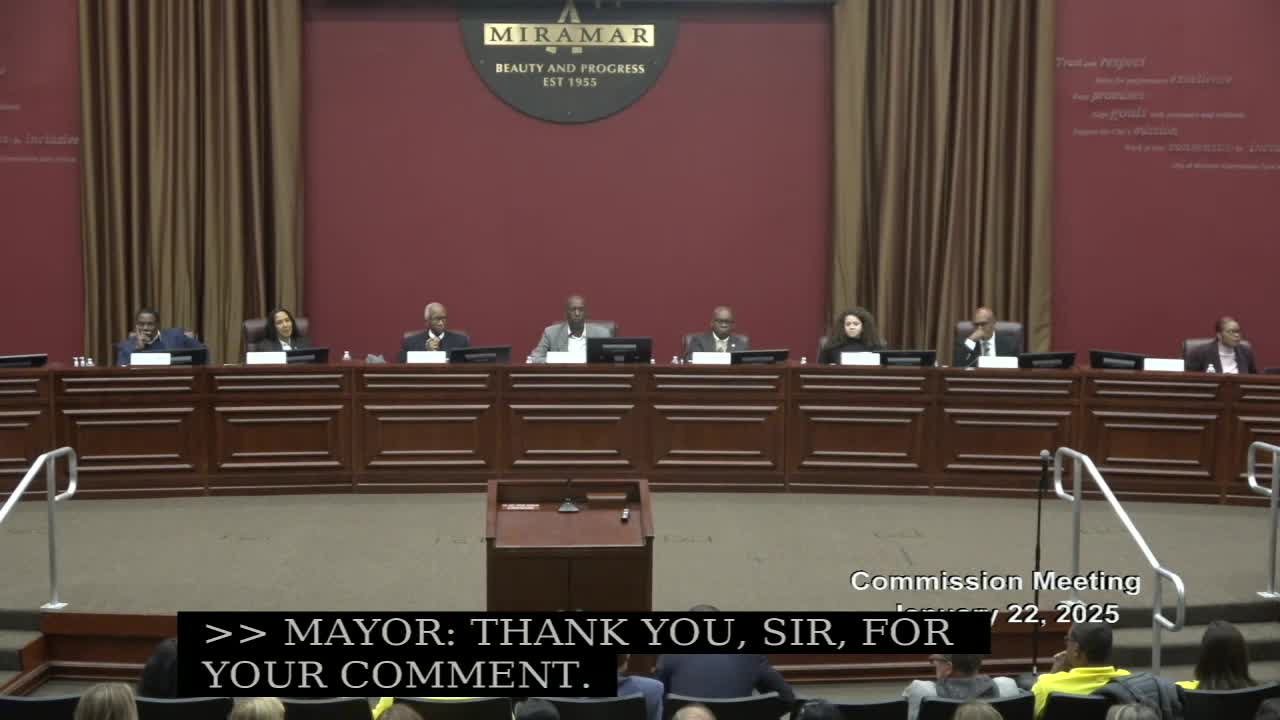
Public speakers and the candidate’s attorney pressed the Miramar City Commission to address a contentious ballot‑qualification dispute on Jan. 22, but the commission deferred to a judicial hearing scheduled for the following day.
Luis Pedraza and his attorney, J.C. Planis, told the commission that Pedraza submitted required qualifying materials and a check and that the city clerk accepted and cashed the check. Planis said an apparent error on a state nomination form — a checked write‑in box combined with a printed name — should be resolved in favor of candidacy and urged the commission to direct the clerk to place Pedraza’s name on the March 11 ballot. "You basically completed the contract formed by what your charter says for the name to appear on the ballot," Planis said, arguing that Florida law and precedent favor resolving ambiguity in favor of candidacy.
City officials explained the matter is the subject of pending litigation and a hearing before Judge Tudor scheduled the next morning. City Attorney office staff and the clerk’s office were named in court filings; the clerk’s office had treated the submission as a write‑in due to the checked box, while the form also contained the candidate’s printed name. Mayor Wayne Messam and the city attorney advised the commission that the clerk performs a ministerial review of qualifying documents and that courts commonly resolve such disputes. The city attorney said he was not prepared to advise the commission to override a ministerial clerk decision without research.
Commissioners and the public urged clarity in the qualifying process in future elections. Several residents and speakers framed the dispute as a broader access and fairness question; some urged the commission to take a corrective vote to avoid litigation costs. Commissioner Barnes said she would not make the clerk a "sacrificial lamb" and recommended allowing the court process to run. Commissioner Chambers and others urged that the city ensure residents understand the qualifying rules going forward.
What happened next: The commission did not take a motion to override the clerk’s determination. The matter remained in court with a hearing scheduled the following day; staff and the commission said the judicial process should resolve the qualification.