Get Full Government Meeting Transcripts, Videos, & Alerts Forever!
Get email alerts on the Land Use Development topic
No spam. Unsubscribe anytime.
Lakeville committee weighs open-space residential plan against 40B proposal for Rocky Woods
Summary
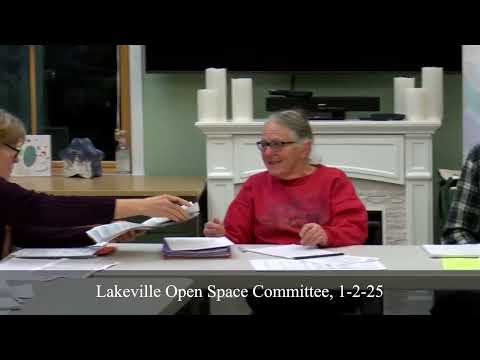
Lakeville’s Open Space Committee on Jan. 2 deliberated whether the town should pursue an Open Space Residential Development agreement for the Simonsville/Rocky Woods parcel or allow a developer’s 40B proposal to proceed, and agreed to ask the Planning Board for more detailed topographic, ecological and cultural data before pursuing an OSRD.
Lakeville’s Open Space Committee on Jan. 2 discussed whether the town should pursue an Open Space Residential Development (OSRD) agreement for the Simonsville/Rocky Woods property or allow the developer’s existing 40B comprehensive-permit proposal to proceed.
The committee and members of the public told the Planning Board that the OSRD concept, as shown to town officials, leaves major technical and conservation questions unanswered and that more information — including topographic overlays and archaeological overlays — is needed before the town pursues a negotiated OSRD agreement. The Planning Board asked town boards for written input and to decide whether to continue negotiating on an OSRD at its Jan. 9 meeting.
The OSRD concept presented to the Planning Board shows roughly 204 units on about 308 acres; the 40B plan referenced in committee materials covered roughly 202 units on about 185–190 acres. Committee members and other town reviewers identified discrepancies in unit counts and bedroom totals between the two concepts and raised concerns that the OSRD plan appears to spread development across the parcel, increasing impacts to wetlands, vernal pools and other resources compared with the more compact 40B layout.
Conservation and public‑health concerns were prominent. The Board of Health recommended restrictions on lot sizes for septic systems, saying lots under 30,000 square feet should not have septic systems because of nitrogen‑loading concerns; the OSRD concept includes duplexes with on‑lot septic in places. The Conservation Commission reported that the OSRD plan shows more wetlands impacted than the 40B plan and noted at least four certified vernal pools and other temporary pools that could be in backyards under the OSRD layout. Committee members urged larger wetland setbacks and continuity of upland habitat rather than fragmented “patches” of open space that cannot serve as meaningful wildlife corridors.
Speakers at the meeting also stressed cultural and geological values on the parcel. The Narragansett tribal representative asked for better topographic overlays to identify and protect Native American sites; a historical-walk summary presented earlier notes house foundations and artifacts dated to the 17th century on portions of the land. Committee members and residents described large exposed ledge outcrops and other geological features that limit buildable areas and can drive blasting, stormwater and well‑head concerns.
Residents voiced strong opposition to either proposal sited where they would add substantial traffic and new sewer or wastewater infrastructure near existing neighborhoods and the high school well. Several public speakers said the developer had not made concessions in prior hearings and urged boards to deny proposals that threaten wetlands, wells and historic resources.
The Conservation Commission reported it will fund continued outside ecological review of the proposals and has retained an ecological consultant who has walked the property and identified additional vernal pools, amphibian and turtle observations, and other resource concerns; the Conservation Commission agreed at its recent meeting to allocate funds to continue that technical work. Committee members said they want overlays combining the developer’s plan(s) with up‑to‑date topography, wetlands, vernal‑pool delineations, cultural‑resource locations and hydrology so boards can evaluate impacts comparably between the OSRD concept and the 40B plan.
The Open Space Committee agreed to draft a memo for the Planning Board listing the committee’s concerns and suggested conditions to make an OSRD worth pursuing, including asking the developer whether it would sell the property for conservation, asking the developer to consider fewer units, requiring the 50% open space to consist of contiguous, usable uplands rather than fragmented wetlands, and requesting a topographic and cultural overlay so the town can assess impacts. The committee explicitly distinguished investigation and negotiation from approval: it will provide recommendations and does not approve any OSRD agreement on behalf of the town.
Planning Board staff and legal counsel are expected to have the committee and other departmental input at their Jan. 9 meeting to decide whether to continue negotiating an OSRD agreement or to let the 40B process continue. If the town pursued an OSRD agreement it would require additional legal and technical work and, if an agreement were reached that required town‑level approvals, it could require Town Meeting consideration.
Documents and plans discussed at the committee’s Jan. 2 meeting are on the Planning Board and Conservation Commission files; committee members asked staff to request updated plan overlays, to seek answers from the developer about buyout willingness or price, and to ask the developer for a clearer phasing and wastewater/water‑supply plan.
The committee will circulate a draft memo to members for revision before sending it to the Planning Board.