Get Full Government Meeting Transcripts, Videos, & Alerts Forever!
Get email alerts on the State Budget Conference topic
No spam. Unsubscribe anytime.
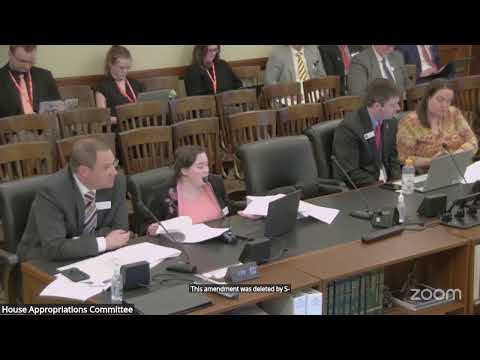
Appropriations committee receives staff summary of Senate File 1; approves one-page report to the floor
Summary
Legislative Service Office staff briefed the House Appropriations Committee on Senate File 1, highlighting differences between House and Senate budget positions (notably LSRA transfers, wildfire grants and local government backfill). The committee approved a standing committee report by roll call, sending the summary to the House floor.
The House Appropriations Committee received a staff presentation on Senate File 1 from the Legislative Service Office and approved a one-page standing committee report to be presented to the House floor, recording the Senate’s amendments and the committee’s review.
Don Richards, budget and fiscal administrator with the Legislative Service Office (LSO), told the committee the staff packet included a high-level summary, the LSO fiscal profile (the “goldenrod”), the committee’s formal report, the full text of Senate amendments and a tabloid-sized summary. “The Senate adopted 28 amendments compared to your house position of 19 amendments,” Richards said, summarizing a primary point of divergence.
Richards and LSO analyst Catherine Camarotti walked the committee through key differences between chamber positions. Richards highlighted net general fund differences—about $3.1 million in identified items—and broader contrasts in major accounts, including an LSRA-to-general-fund transfer the Senate increased by $145,000,000 for a total transfer of $215,000,000 (S 3,029). He also identified a $100,000,000 Senate position for wildfire grants versus $40,000,000 in the House position, and the House’s $72,000,000 contingent appropriation for local government backfill versus a $15,000,000 special-district backfill in the Senate package.
Camaarotti (LSO) explained LSO’s categorization of amendments into identical (mirror), related and unrelated, and noted staff judgment calls where later amendments altered the end positions. She also directed members to contingency language and footnotes, including a Senate amendment that would appropriate $15,000,000 in general funds for special district property-tax grants, contingent on passage of several bills. Committee members asked clarifying questions about differences in scope, funding sources, timing (some House provisions were two-year in effect while Senate provisions were one-year), and which classes of special districts would be included or excluded under particular amendments.
After the briefing, the committee took a roll call vote to approve the standing committee report documenting the Senate amendments and the committee’s review. The clerk recorded seven ayes and no nays; the chair said, “7 aye.” Richards said the report would be transmitted to the floor and that, if the committee wishes, the speaker can appoint five members to a joint conference committee in subsequent floor action.
The committee’s adoption of the report preserves LSO’s summary as the official committee record for floor consideration; no floor votes on the report itself are typical, but the report provides the basis for conference committee appointments and later reconciliation between chambers.