Get Full Government Meeting Transcripts, Videos, & Alerts Forever!
Get email alerts on the Teacher Certification topic
No spam. Unsubscribe anytime.
Committee advances alternative‑certification bill after hours of debate over accreditation and classroom quality
Summary
The House Education Committee on Feb. 21 voted 6–3 to advance Senate File 86, which would let the Professional Teaching Standards Board approve alternative teacher‑certification programs — including non‑accredited providers — so candidates with a bachelor’s degree can seek state certification after completing subject and pedagogy exams.
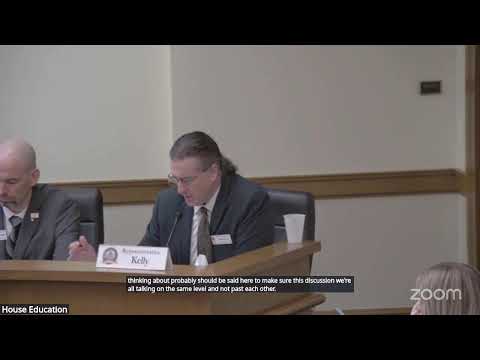
CHEYENNE, Wyo. — After more than an hour of testimony and questions on Feb. 21, the House Education Committee voted to give Senate File 86 a due‑pass recommendation, advancing a proposal to expand pathways into Wyoming classrooms.
Senate File 86, carried in the House by Representative Strauch, would authorize the Professional Teaching Standards Board (PTSB) to approve alternative certification programs — accredited or non‑accredited — that allow an applicant with a baccalaureate degree to pursue teacher certification after successful completion of a subject‑area examination and a pedagogy examination. The bill would also let applicants who complete an approved alternative program apply for district employment without first receiving a superintendent request under the existing exception authorization described as “Option 7.”
Sponsor Senator Dan Larson told the committee he had tried to get a similar measure through previously and that some alternative programs the bill would permit operate online and cost about $1,900, compared with accredited university programs that he said can cost several thousand dollars. “These programs are not connected to colleges or universities, and they would have a very difficult time getting accredited,” Larson said, arguing the state’s teacher shortage warrants more flexible routes into the profession.
Brendan O’Connor, executive director of the Professional Teaching Standards Board, said the board reviewed the specific provider mentioned by the sponsor in 2023 and raised concerns. The PTSB’s current rules include an exception authorization (Option 7) that allows provisional licensure tied to an accredited alternative route and a two‑year mentorship period. “Accreditation … is the coin of the realm,” O’Connor said, summarizing the board’s focus on accredited programs and oversight that includes mentorship and district evaluations.
Representatives of statewide education organizations urged caution. Nick Bellack of the Wyoming School Boards Association said the PTSB had improved its flexibility and that districts want quality candidates. But both Bellack and Tate Mullen of the Wyoming Education Association cautioned against lowering preparation standards; Mullen said the program described by the sponsor could produce teachers who “have never set foot in a classroom.” He warned that quickly produced certifications could leave educators unprepared for classroom management and special‑education responsibilities under IDEA.
Supporters included Patricia McCoy, who testified on behalf of Moms for Liberty — Wyoming, saying the bill would open doors for industry professionals, tradespeople and others with deep subject‑matter expertise who lack traditional teacher‑preparation credentials. Coral Johnson, who holds alternative certification and classroom experience in other states, described difficulty transferring credentials to Wyoming because she did not complete a traditional student‑teaching sequence.
Representatives of the American Board, one of the non‑accredited providers cited by the sponsor, said the organization operates in 14 states, has certified nearly 20,000 teachers and charges roughly $1,900 for its program. Isabella Welch, director of government affairs for American Board, told the committee that a Drexel University study of principals across 12 states found American Board candidates performed “better than or equally to traditionally trained teachers in 95% of observed areas” and had a 97% three‑year retention rate — remarks she made while describing the provider’s experience in Montana and other nearby states.
The committee’s discussion centered on two competing aims: expanding the supply of classroom teachers in rural and specialized areas versus maintaining consistent, accredited preparation that includes clinical hours, observation and mentorship. PTSB officials said existing rule pathways already allow districts to hire nontraditional candidates under controlled, mentored arrangements but that the board had not been willing to endorse non‑accredited programs without safeguards.
After debate, the committee voted 6–3 to advance Senate File 86. The roll call recorded ayes from Representatives Bratton, Guggenmoss, Kelly, Strak and two absentee aye votes for Representative Singh and Chairman Andrew; no votes were recorded from Representatives Erickson, Lolly and Williams.
Supporters said the bill increases local hiring flexibility and may help hard‑to‑fill positions, particularly in career and technical education (CTE). Opponents said the PTSB’s existing exception authorizations and provisional permits provide safer, more accountable ways to bring career changers and paraprofessionals into classrooms while ensuring mentorship and evaluation.
Senate File 86 will go to the House floor with a committee recommendation of due pass; the committee did not adopt any amendments during the hearing. Further floor action and potential amendments could refine accreditation language or add explicit mentorship and evaluation requirements.
— Reporting from the House Education Committee hearing on Feb. 21, 2025.