Get Full Government Meeting Transcripts, Videos, & Alerts Forever!
Get email alerts on the Reproductive Health topic
No spam. Unsubscribe anytime.
San Antonio health committee advances $100,000 for reproductive‑justice downstream services
Summary
The San Antonio Community Health Committee voted to forward a proposal to the full City Council to allocate $100,000 for downstream reproductive‑health services after public comment and a staff presentation on prior grants and a new solicitation process.
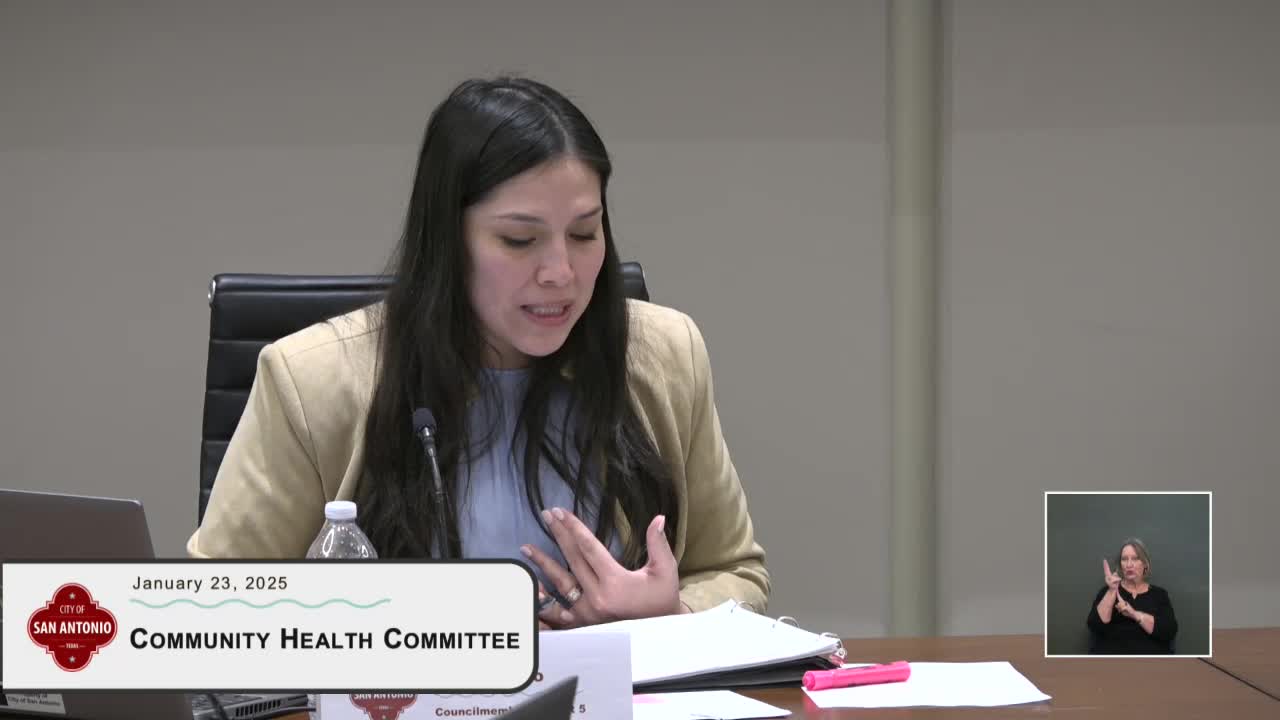
The San Antonio Community Health Committee on Jan. 23 voted to advance to the full City Council a proposal to allocate $100,000 for downstream reproductive‑health services, sending the item for formal council consideration.
The request would fund “downstream” activities tied to a previous round of grants for reproductive‑health providers, including items such as transportation and navigation related to abortion access, staff said. Committee members voted to forward the proposal after receiving public comments urging urgent action and a staff presentation that outlined prior city investments and a new 30‑day solicitation for the additional funds.
The item drew public testimony urging the committee to act. Lara Molina, co‑founder and director of Sueños y Fronteras, said the need was urgent and described barriers clients face when seeking reproductive care: “La urgencia es, no se puede exagerar.” Melissa Cabello Jábrida submitted a letter for the record and urged the city to act to protect reproductive health and privacy, writing that residents “tienen el derecho de tomar las decisiones que ellos decidan sobre su cuerpo.”
A staff presentation summarized work the city has already funded and compared San Antonio’s response to other jurisdictions. The presentation said a panel recommended $499,179 to local providers under earlier awards; those contracts were approved by the City Council and are scheduled to expire Nov. 30, 2025. Staff said the new solicitation for downstream activities would be open for 30 days, restrict eligibility to the ten original applicants, and use the same scoring matrix as the earlier round. Applicants will be allowed to submit amendments to their original proposals.
Public commenters and some committee members raised legal and fiscal concerns. Jack Finger, a public commenter, warned of possible litigation from the state and asked who would pay legal costs if the city were sued: “¿Qué va a pasar cuando el el fiscal general Paxen empiece a presentar demandas contra nosotros?” Councilmember Alderete (commenting) said she supports reproductive rights but suggested that travel to other states for care should be funded by nonprofits rather than general fund dollars.
Committee members asked staff to clarify the source of funds; staff said the money would come from the city’s FY24 operating budget. Staff also reported that the initial RFP was open 36 days, that ten organizations applied and five were interviewed, and that some applicants did not propose transportation or abortion navigation as part of their original bids.
Committee members discussed whether to limit the $100,000 to specific downstream activities or let the original applicants propose how to use the money. Several members said they wanted agencies to identify the highest priorities and possible risks before final action by the full council. The committee’s motion to forward the $100,000 measure passed; meeting comments recorded one opposing vote and one abstention, with the remainder in favor. The full City Council will consider the item at a later date; staff said a date for Council A action has not been set.
The presentation also noted examples from other cities: Austin’s recent allocations, and larger county commitments (the presentation cited Travis County at about $4 million for prevention, education and wraparound services), which staff used to illustrate possible levels of local commitment.
Next steps included issuing the 30‑day solicitation for downstream activities, allowing applicants to amend prior submissions, and returning recommendations to the council for final funding decisions.