Get Full Government Meeting Transcripts, Videos, & Alerts Forever!
Get email alerts on the Water Supply topic
No spam. Unsubscribe anytime.
Cedar City to begin drilling test wells as drinking-water master plan flags aquifer stress
Summary
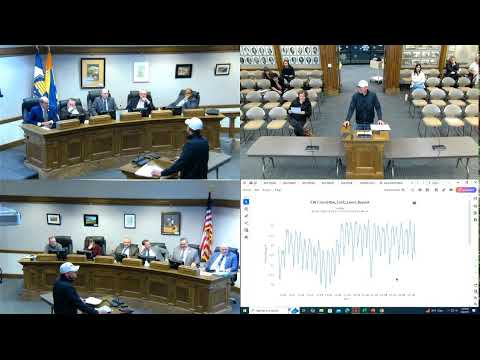
Cedar City council members and staff spent the bulk of a work session reviewing the city's Drinking Water Master Plan and next steps to secure long-term water supplies, agreeing to start a sequence of pilot test wells in the city's northern valley and to pursue additional site work and negotiations on potential water purchases.
Cedar City council members and staff spent the bulk of a work session reviewing the city's Drinking Water Master Plan and next steps to secure long-term water supplies, agreeing to start a sequence of pilot test wells in the city's northern valley and to pursue additional site work and negotiations on potential water purchases.
The master plan warns of stressed groundwater and limited system redundancy: "The plan states, 'Groundwater in the Cedar City Valley has been withdrawn at an unsustainable rate,'" council members read during the presentation. The consultants and city engineers told the council that current sources and pipelines approach peak-day capacity and that additional wells and pipelines will be needed over the next decade.
Why it matters: The report and discussion framed the city's immediate options — drill targeted test wells to learn water quality and quantity at specific sites, and pursue larger projects such as pipeline construction and Pine Valley import water — while emphasizing that groundwater alone is not expected to meet projected growth.
City staff recommended drilling three pilot wells in different parts of the northern watershed so the city can compare water quality and likely yield across a broader cross section. The council and staff discussed preferred sequencing: begin with the site the consultant ranked as the best unexplored option (referred to in the meeting as the new potential well site 1, on BLM-adjacent land), then proceed to a second site in the middle profile and a third farther west if results require it. Staff said the contract with the drilling firm allows drilling wells one at a time and paying only for each well as it is drilled.
Ryan Marshall, public works staff, summarized the near-term trade-offs and funding challenge: "Something we need desperately is just how do we go about doing that and where do we come up with the funding to do it." Marshall and other staff said cost and permitting questions remain, but that they could sequence work to limit risk and that sample-only testing would not require committing to full development until quality and yield were acceptable.
What the tests will show and timing: Staff emphasized the difference between quality testing and production testing. A pilot/test well provides water-quality samples and initial clues to formation characteristics; a separate, later "packer" or production test is needed to measure sustainable yield. The council was told that drilling three test wells and getting results would take months — staff estimated about six months to drill and receive laboratory results for the initial pilot holes.
Technical and cost context: The master plan lists system vulnerabilities including pipeline bottlenecks under I-15, high operating pressures in parts of the distribution network and limited redundancy between major conveyance pipelines. Consultants provided planning-level costs for a broader north wellfield and pipeline construction that run into tens of millions; staff and the mayor characterized the larger buildout cost estimates in the plan as substantial and described the test wells as the next affordable step to reduce uncertainty before major capital commitments.
Site selection debate: Council and staff discussed specific mapped potential well sites (numbered in the consultant materials). Some council members and staff favored a cross-section approach (one well on BLM-adjacent ground near a bluff, one in the center of a drainage with willow/meadow indicators, and one farther west), to avoid drilling multiple closely spaced holes that could produce redundant results. A consultant present said his preferred site was the BLM-adjacent location, which the mayor and several council members supported as the first test.
Rush Lake negotiations and closed-session timing: Separately, council members raised an ongoing negotiation about Rush Lake-area water rights and wells that staff and the mayor said merit a confidential discussion. City legal counsel advised that a counter-offer or negotiation strategy would ordinarily be discussed in closed session to avoid revealing negotiating position; the council placed a closed-session item on next week's agenda to discuss property/negotiation strategy related to Rush Lake water offers.
Next steps and staff directions: The council directed staff to proceed with the recommended sequence of pilot/test wells, beginning with the consultant's preferred new site 1, to obtain quality samples and report back on outcomes and costs. Staff will work with the drilling contractor and property owners (including negotiating access and any change orders if sites change), will sample for arsenic and other parameters flagged in the plan, and will bring negotiation strategy on Rush Lake to a closed session next week.
Votes at a glance: - Motion to close the work meeting and move into closed session for reasonably imminent litigation and related items: motion seconded and approved (voice vote recorded as "Aye").