Get Full Government Meeting Transcripts, Videos, & Alerts Forever!
Get email alerts on the Higher Education Funding topic
No spam. Unsubscribe anytime.
MHEC, independent colleges urge panel to reject proposed cuts to Sellinger funding
Summary
At a House subcommittee hearing, Maryland Higher Education Commission officials and leaders of independent colleges opposed Department of Legislative Services recommendations to cut or convert the Sellinger funding formula, warning reductions would reduce financial aid for Maryland students and strain small private colleges.
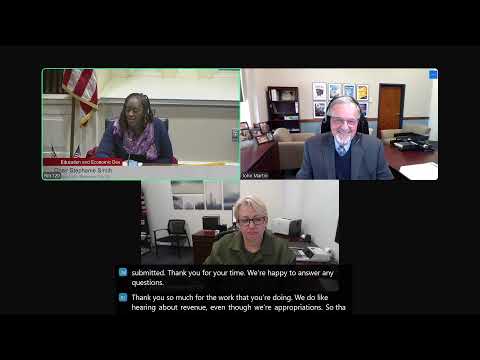
Maryland Higher Education Commission officials and leaders of independent colleges told the Education and Economic Development Subcommittee on Feb. 12 that they oppose Department of Legislative Services (DLS) recommendations to sharply reduce or eliminate the Sellinger funding formula and replace it with a needs‑based grant program.
The DLS analysis presented to the subcommittee recommended cutting Sellinger funding and restricting remaining funds to competitive grants; DLS figures mentioned in the hearing included proposed reductions in the range of tens of millions of dollars (DLS cited figures around $36.7 million and proposed percentage reductions reported in the analysis). Sarah Baker, the DLS analyst who presented the budget review, said the recommendation was intended to align the program with current budget constraints and to target funds by institutional financial need.
The suggestion prompted unified pushback from Maryland Higher Education Commission officials and independent college leaders. Dr. Sanjay Rai, Maryland’s secretary of higher education, asked lawmakers to preserve the Sellinger formula’s per‑FTE allocation method, saying it provides predictable, objective allocations to small independent colleges and helps those institutions plan budgets and provide student aid.
“Keeping the allocation of Sellinger funds through a per‑FTE calculation … is an objective way in decision making,” Rai said, arguing a competitive grant approach would be administratively burdensome and raise questions about evaluation criteria and remedies for institutions denied aid.
Representatives of independent institutions warned of immediate student impacts if the program is cut. Matt Power, president of the independent college association (identified in testimony as representing Maryland independent colleges), said his members already absorbed a 50% reduction last year and that another similar reduction would amount to a 73% decrease over two years for the sector. “A 50% reduction for the second year in a row seems as if the state is truly rooting for our demise,” Power said.
Leaders from specific institutions described how Sellinger funds have been used to support need‑based aid. Maria Tilden, vice president for government, community and economic partnerships at Johns Hopkins Medicine, told the committee Sellinger scholarships helped keep Maryland students in‑state and cited numbers from Hopkins: 335 undergraduates received Sellinger aid this year, including first‑generation and Pell‑eligible students. Several college presidents said Sellinger funds are routinely used to provide institutional scholarships; Notre Dame of Maryland University’s president said Sellinger funding helped the university provide $12 million in institutional aid in 2024, including $1.7 million from Sellinger grants.
MHEC officials also noted other items in the DLS report. Baker’s presentation reviewed a range of MHEC issues including online enrollment trends, student loan debt tax credit program limits proposed in the BRFAA, and an upcoming harm analysis on program approvals and impacts to historically Black colleges and universities; MHEC told the subcommittee it is drafting that harm analysis and expects to present it in late summer.
Why it matters: Sellinger funding is an ongoing state program that provides unrestricted aid to independent nonprofit colleges and universities; institutions often use the money for student scholarships. Independent institutions and MHEC argued cutting the program would reduce aid for Maryland students and could threaten small colleges’ viability. DLS said the proposed changes would better target limited state dollars on institutions showing financial need.
MHEC and most independent college witnesses asked the General Assembly to fund Sellinger at the governor’s allowance level rather than adopt the DLS recommendations. The hearing record shows a clear split between the DLS budget approach and the administration/sector preference to preserve the existing formula.
Ending note: No formal vote or statutory change occurred at the hearing; the subcommittee received testimony and questioned agency and sector representatives. MHEC said it would continue to press for funding at the governor’s allowance and to complete required reports and analyses requested by the legislature.