Get Full Government Meeting Transcripts, Videos, & Alerts Forever!
Get email alerts on the Education Oversight topic
No spam. Unsubscribe anytime.
Guam lawmakers press Department of Education on school repairs, staffing and Sanchez rebuild during oversight hearing
Summary
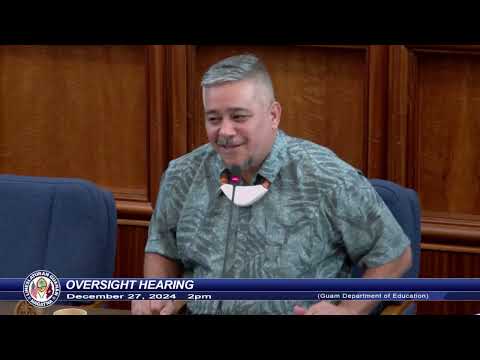
The Guam Legislature’s Committee on Education held an oversight hearing Dec. 19 with the Guam Department of Education to review school refurbishment work funded by ARP dollars, staffing shortages in special education and classroom positions, delays with HVAC and maintenance contracts, textbook inventory and audits, the Smarter Balanced assessment rollout and the ongoing Simon Sanchez High School rebuild.
The Guam Legislature’s Committee on Education held an oversight hearing Dec. 19 with the Guam Department of Education to review school refurbishment work funded by American Rescue Plan (ARP) dollars, staffing shortages in special education and classroom positions, delays with heating, ventilation and air‑conditioning (HVAC) work, interim grass‑cutting measures after a contractor withdrew, the rollout of the Smarter Balanced assessment system and several pending audits and construction projects, including the long‑delayed Simon Sanchez High School rebuild.
Committee chair Senator Telena Cruz Tello opened the hearing saying the session would review roughly 15 agenda items that “will guide the direction of the legislature for the next term,” and asked the Department to update the panel on progress and outstanding needs.
Why it matters: Lawmakers pressed the Department on projects that affect school operations, student learning time and safety — from classrooms without air conditioning to multi‑school refurbishment contracts and the continued double‑session arrangement affecting Simon Sanchez High School students. Several items involve federal ARP funding or legal reviews that limit GDOE’s options without new appropriations or separate procurement steps.
Superintendent Jon Swanson (identified in testimony as superintendent) told the committee that twelve campuses are currently included in an ARP‑funded refurbishment package worth about $125 million and that the work must be completed by late February or early March 2026 to meet the ARP grant liquidation deadline. The scope for the contracted schools covers roof and canopy repairs, restroom restoration, exterior doors and electrical upgrades; quoted contract amounts range from about $5 million to $20 million per campus depending on condition.
The superintendent said two campuses originally planned for the package — Southern High School and Inalihan (sometimes cited in testimony as Interrahan) Middle School — were removed after the Attorney General’s office rejected language in the bid package specific to those schools. “The only way we can service them is go back now and let individual contracts for those segments that we can find the funding to do,” Swanson told the committee. He said the Department is seeking other funding and that some restroom work is being done using in‑house crews where possible.
Special education and teacher staffing shortfalls
Tom Babauta, who identified himself to the committee as overseeing special education, reported an active shortage of staff for students who require adult support. “We have a need for 378 students requiring adult support. Currently, we have 285. So that leaves us a shortage of 93,” Babauta said. He added that the Department recently selected 21 special‑education positions for hire but only 10 had been processed through personnel.
Panelists discussed a paraeducator “boot camp” training program being developed with Guam Community College and the University of Guam School of Education to certify paraeducators and create a pipeline for special‑education staff. Babauta said the Department is “crunching the numbers” on how to fund part of the training and ensure positions are available for trainees, and that a cohort of 10 teachers at UOG is beginning work to be special‑education certified within a year.
The superintendent and deputies described plans to reassign roughly 18–19 centrally based instructional coaches or staff with certificated teacher status to school sites for the spring semester; officials said work authorizations are in process and final staffing decisions will be school‑by‑school.
HVAC, refurbishments and maintenance
Department procurement and facilities staff described progress and supply issues on HVAC work under a vendor contract. The Department reported hundreds of units yet to be installed: an estimated 482 remaining split units and 327 tonnage (ducted) units across regions, with some ductwork delayed while the vendor sources materials. At one school the Department said a cafeteria tonnage installation is slated to begin early January after ducting arrives.
Officials acknowledged acute problems at Okkodo/“Okudu” (transcript spelling varies) and other campuses where dozens of air conditioners remained nonfunctional. The Department said some failures are typhoon‑related and some predate the storms; staff are asking the vendor to accept responsibility for units that should be covered under contract.
When a private grass‑cutting vendor withdrew coverage of roughly 25 campuses, GDOE purchased mowers and other equipment and stood up a six‑person maintenance team led by Mark Crisostomo to provide interim service. Crisostomo described a daily schedule with crews coordinating with principals to perform once‑a‑month cycles; legislators pressed whether the Department intends to re‑bid the service and whether the agency will invest in school‑based maintenance packages. Swanson said the Department is seeking contracts and intends to restore maintenance personnel at schools in packaged assignments once funding and procurement are in place.
Textbooks, audits and inspections
GDOE officials told the committee they have a warehouse of surveyed textbooks, including hardcovers and related consumable workbooks. Department staff said some schools received overages of consumables (workbooks) — in some cases “double” the expected amount — and that the Department is coordinating delivery timing with the vendor so supplies can be used across a five‑year cycle. The Office of Public Auditor is conducting a textbook audit; GDOE staff told the committee they have provided documents they have, while the public auditor said additional records were still being reconciled.
On public‑health sanitary permits, Swanson said the Department has completed initial inspections across campuses and is on a reinspection cycle; the Department and the legislature adopted a staggered permit schedule to avoid simultaneous expirations after the committee and the Legislature passed a change earlier this year.
Smarter Balanced assessment rollout
Joe (identified by GDOE staff as the assessment lead) described GDOE’s switch to the Smarter Balanced consortium for statewide summative assessment and the vendor relationship with Pearson. GDOE completed a first year of Smarter Balanced testing and is piloting interim assessments to align periodic screeners with the end‑of‑year test. Officials said the assessment provides student‑level and teacher‑level reports as well as teaching resources that were not available with prior assessments; one figure cited in committee discussion placed the current license/contract at roughly $2.2 million per year.
Audits, management review and staffing costs
The Department reported the FY2023 audit was late but completed; GDOE said it had turned over requested materials for FY2024 and for other OPA reviews. The Department is preparing a scope for a management audit under recently passed legislation (citation given in testimony as a modification to “section 3103p of article 1, chapter 3 of title 17 of the Wong statutes”); the RFP for that management audit was described as being prepared and the Department expects an award and findings by late February or early March 2025/2026 timeframe.
The committee also discussed a determination from the Department of Administration on auditor pay grades; GDOE said DOA maintained existing assigned pay grades for auditor series positions and did not recommend classification changes in a November determination.
Budget pressures: sports, healthy‑futures funding
Officials said GDOE’s interscholastic sports appropriation (listed at about $614,000) is not sufficient to cover coach stipends and officials. The Department presented quarter‑one figures indicating coach stipends plus association costs create an estimated shortfall that, when annualized, would put the sports program roughly $300,000 over its appropriation. Committee members requested precise prior‑year figures; the Department said it would provide them.
Separately, the Department said the Healthy Futures Fund transfer (a tobacco‑related fund) that previously supported programs was not released in fiscal year 2024, creating a shortfall the Department estimates at roughly $900,000 in funds that had been expected for programming and reimbursement.
Simon Sanchez High School, double sessions and student testimony
The long‑running issue of Simon Sanchez High School and its replacement campus drew sustained scrutiny. Superintendent Swanson and legislators reiterated a goal to end the double‑session arrangement that currently has Simon Sanchez students attending on a shifted schedule at John F. Kennedy High School and elsewhere. Swanson said the rebuild procurement was being readied for advertisement with public works and financing partners and that an RFP/advertisement was intended for the spring with a roughly 90‑day bid window, but that the procurement process and phasing decisions could affect where temporary classrooms are located until construction begins.
Students and student‑government representatives testified about the effect of double sessions on extracurriculars, homework time, travel costs and event planning. Andrea Eliana, an Islandwide Board of Governing Students representative and Simon Sanchez senior, told the committee: “We don’t want to move farther away than what we already are at JFK … it makes it so hard to plan events. We don’t even have enough time — 30 to 60 minutes isn’t enough time to plan islandwide events.” Isaiah Trespona, a Southern High School senior and IBOGS representative, asked how schools were prioritized for the ARP refurbishment package and why many campuses remained outside the award.
What the Department said: Swanson said some temporary campus options considered (including a commercial mall space) were rejected by FEMA for the type or duration of occupancy FEMA would back; he said the Department continues to explore temporary modular solutions and nearby school sharing that minimize travel time for students. Swanson gave a conservative estimate that, if everything proceeds, the rebuilt Simon Sanchez campus could open in the 2027–28 school year.
Committee action and next steps
Senators pressed GDOE for more detailed timelines, more precise funding estimates and clearer procurement status updates. Swanson committed to providing school‑by‑school timelines for the Core Tech refurbishment package and to working with student leaders on any temporary campus decisions that affect student activities. The Department agreed to follow up on outstanding audit document requests and to provide more explicit breakdowns of ARP allocations and unresolved funding needs for schools not included in the current refurbishment contract.
Discussion points, directions and decisions from the hearing
- Discussion points: shortages in special‑education adult support (93‑person shortfall reported); HVAC installation delays due to ducting and vendor materials; grass‑cutting contractor withdrawal and interim maintenance solution; ARP refurbishment package scope and why some high‑need campuses (Southern High, Inalihan Middle) are not in the current contract; Smarter Balanced assessment implementation and teacher tools; textbook inventory and the OPA textbook audit; FY2023 audit closure and FY2024 audit materials; Simon Sanchez rebuild procurement and temporary campus options. - Directions: Superintendent to provide school‑by‑school timelines for the Core Tech refurbishment work, to follow up with the public auditor on outstanding textbook audit documentation, to pursue funding options for schools removed from the ARP package and to continue discussions with student leaders about temporary campus options for Simon Sanchez students. - Decisions: No formal committee votes or legislative actions were taken during the hearing. Several items were left for follow‑up reporting to the committee and for continued procurement or funding work by GDOE and partner agencies.
Ending: The committee accepted written statements for three business days after the hearing and closed the public session after students and community representatives offered testimony.