Get Full Government Meeting Transcripts, Videos, & Alerts Forever!
Get email alerts on the Open Streets topic
No spam. Unsubscribe anytime.
CB2 traffic committee hears DOT update on Open Streets, flags signage, barriers and safety concerns
Summary
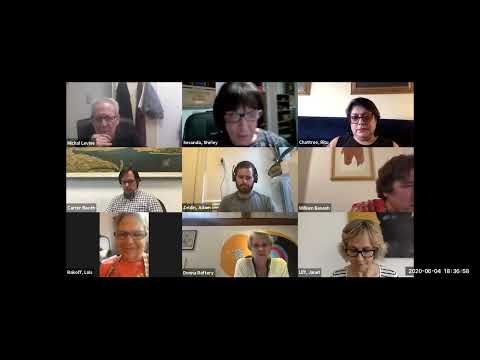
Manhattan Community Board 2’s Traffic and Transportation Committee heard an update Wednesday on New York City’s Open Streets program from the Department of Transportation and representatives of the Meatpacking District and Hudson Square.
Manhattan Community Board 2’s Traffic and Transportation Committee heard an update Wednesday on New York City’s Open Streets program from the Department of Transportation and operators from the Meatpacking District and Hudson Square.
The Department of Transportation said it is continuing to accept and review Open Streets applications and is coordinating reviews with sister agencies including the Fire Department and the police. Jennifer Young, of DOT’s Manhattan branch office, said the program is being made “less restrictive” to encourage more streets to open and that DOT provides a template and guidelines for signage but does not currently mass-produce signs.
The discussion focused on operational details that DOT and neighborhood partners say are slowing or complicating implementation: the weight and mobility of barricades, inadequate city signage, uncertainty over who may serve as partners to run streets, how to handle emergency access and the effects of recent unrest on open-street infrastructure.
“Right now, we are continuing to receive applications for OpenStreet. We are reviewing them internally, and we are reviewing each request individually with our sister agencies, sanitation, fire department, and PD,” Jennifer Young said. She added that while DOT prefers that an applicant include a partner to help manage an open street, “the absence of one does not mean that it won't be considered.”
Participants from two business improvement districts described on-the-ground problems. Jeffrey LeBrantsauff, representing the Meatpacking District, said city-provided French barricades have been moved by drivers and left open, and that the district has begun producing larger 2-by-3-foot signs to make the closures clearer. “I want to put a planter in the middle of the road. I don't want a driver to be able to move a police barricade just because,” LeBrantsauff said.
Ellen Baer, representing Hudson Square, said her group submitted three Open Streets applications and received approval for one (Greenwich Street between Canal and Spring). Baer supported a City Council proposal discussed earlier the same day to allow temporary “self‑certification” for outdoor dining and suggested a similar approach for Open Streets to speed approvals.
Committee members and attendees raised additional operational and safety questions: whether DOT will supply improved visibility signage, how partner organizations are vetted, how the city monitors open streets and how to prevent barricades and other temporary materials from being removed, damaged or weaponized during unrest. Jennifer Young said DOT will follow up with its staff about monitoring frequency and other operational details.
Specific locations and hours described at the meeting include: University Place between 13th and 4th Streets (Sundays, 8:30 a.m.–1:30 p.m.), McDougall Street between 4th and 8th Streets (Sundays, 8:30 a.m.–1:30 p.m.), Greenwich Street between Canal and Spring (daily, 10 a.m.–4 p.m.), Jones Street between Bleecker and West 4th (daily, 8 a.m.–8 p.m.), West 13th Street between 9th Avenue and Washington Street (daily, 8 a.m.–8 p.m.) and Little West 12th Street between 9th Avenue and Washington Street (daily, 8 a.m.–8 p.m.). Young said there are 14 Open Streets locations south of 14th Street and six of those are within Community Board 2.
Committee members, DOT and BID representatives discussed alternatives to the current portable barricade model: planters or other fixed elements, lighter but lockable gates, and volunteer or BID staffing to set and re-set barricades. Several speakers asked DOT to pursue clearer, interagency guidance so applicants and partners know what will be acceptable. Baer and LeBrantsauff asked DOT to consider more durable physical treatments and clearer, simpler rules for partners.
Speakers also described how unrest across the city affected open-street operations. LeBrantsauff and other participants recounted storefront damage and trash/objects placed in streets; one participant said dozens of storefronts were damaged in recent nights and that large-scale traffic restrictions enacted by the mayor helped reduce repeat incidents. Panelists recommended ways to secure barriers, including locked storage or anchored fixtures when feasible.
No formal action or vote was taken. Chair Shirley Secunda said she would prepare a report compiling the committee’s suggestions and circulate it to members for possible resolution at a future meeting.
“The idea is to make this work for people walking and biking, and to keep it as simple and safe as possible while we learn as we go,” Secunda said near the close of the discussion.
The committee asked DOT to follow up with written clarifications on monitoring, partner vetting, signage options and whether DOT could supply or approve more permanent or lockable closure hardware. DOT said it would provide contact email information and follow up with agency colleagues on FDNY and NYPD coordination and on outstanding site reviews such as the Gansevoort Street application, which attendees said was delayed after FDNY raised emergency-access concerns.
Committee members concluded the session by asking DOT and neighborhood partners to consider a coordinated “network” approach to link individual Open Streets into safer corridors, and they signaled willingness to revisit a formal resolution after they receive DOT’s follow-ups and the committee chair’s written summary.