Get Full Government Meeting Transcripts, Videos, & Alerts Forever!
Get email alerts on the Small Business Accessibility topic
No spam. Unsubscribe anytime.
Committee sunsets local front-door accessibility enforcement, adopts "Beyond the Front Door" reporting and assistance approach
Summary
The committee voted 3-0 to sunset the local Accessible Business Entrance (ABE) enforcement deadlines and require a new collaborative reporting and assistance initiative called "Beyond the Front Door," while reaffirming property owners must still comply with federal and state accessibility laws.
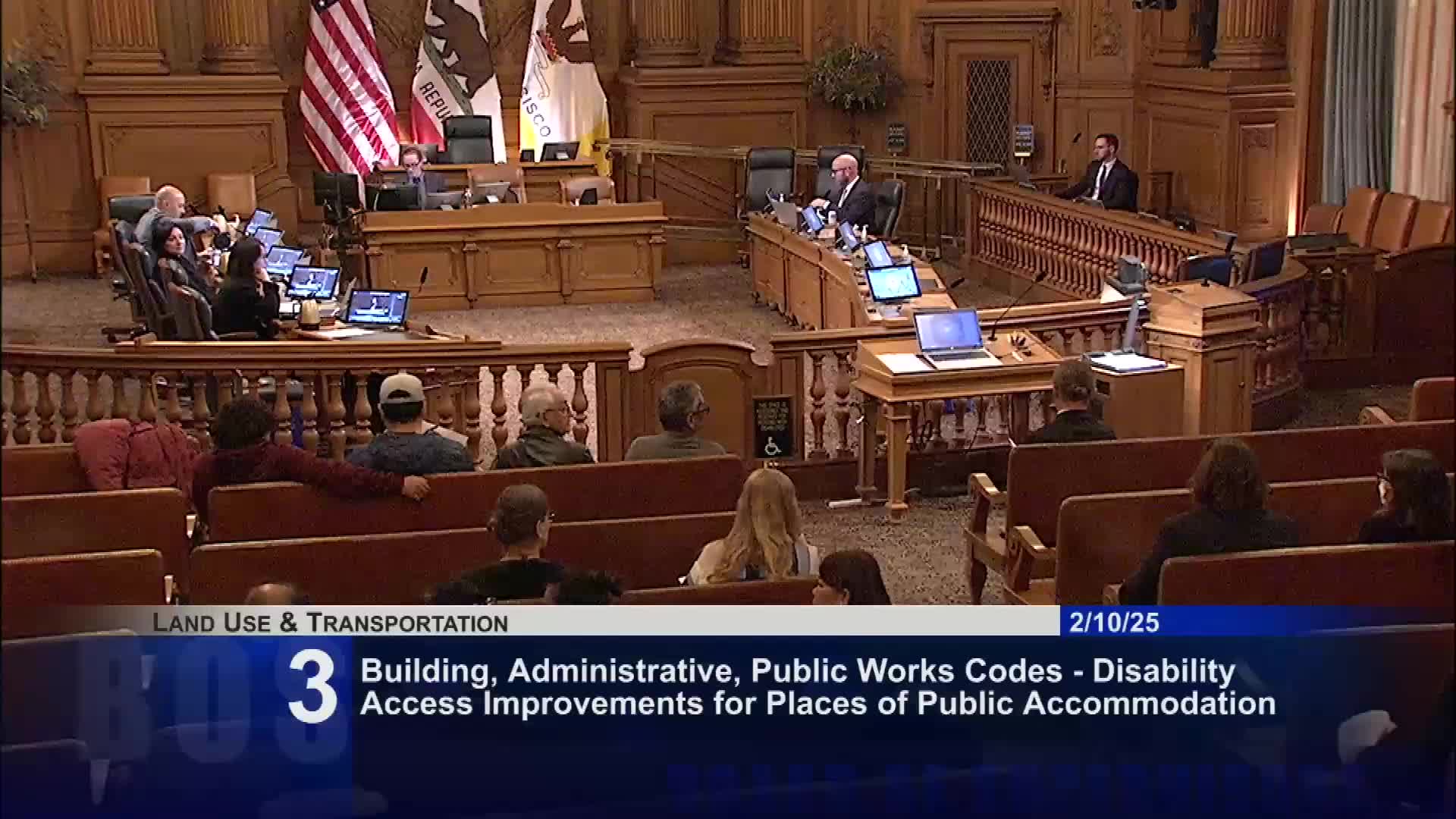
The Land Use and Transportation Committee voted 3-0 on Feb. 10 to recommend an ordinance that sunsets the local enforcement deadlines for the Accessible Business Entrance (ABE) program and implements the early steps of a collaborative initiative described in a concept paper called "Partnership to Drive Accessibility and Inclusivity Best Practices in Local Businesses" (Oct. 2024). The ordinance directs reporting and coordination among the Office of Small Business (OSB), the Mayor's Office on Disability (MOD), and the Department of Building Inspection (DBI).
Sponsor and staff framing: Board President Rafael Mandelmann, who introduced the ordinance, said the ABE program produced substantial compliance—"more than 16,000 businesses have come into compliance" and roughly 2,800 submitted required checklists—but that about 4,100 businesses remained unresponsive. Mandelmann said further extensions of mandatory local deadlines would require DBI to allocate significant enforcement resources at a time of budget pressure and competing priorities. He described "Beyond the Front Door" as a collaborative approach that retains the city's obligation to follow federal and state accessibility laws while shifting local efforts toward technical assistance, coordinated inspections and outreach.
Key provisions and clarifications: The ordinance would (1) sunset the local ABE enforcement requirements; (2) require OSB, MOD and DBI to report on implementation of Beyond the Front Door; (3) direct DBI to hire a certified access specialist inspector to perform higher-level accessibility inspections; and (4) waive annual public-right-of-way encroachment fees for ADA-related accessibility improvements. Sponsors and staff emphasized that property owners and businesses remain obligated to comply with federal and state accessibility requirements; the local change removes an additional local enforcement layer that had generated compliance burdens.
Public comment: Dozens of small-business owners and merchant associations from Chinatown, the Mission, North Beach, the Tenderloin and other corridors urged sunsetting the ABE enforcement deadlines, describing language barriers, cost burdens and complex department routing as reasons the program should shift to technical support. Representatives of the disability community acknowledged the need for accessibility and urged strong implementation of assistance and inspection capacity; Walter Park (longtime disability advocate) urged continued technical assistance and said the unreasonable-hardship standard is in the building code and ADA. Merchant associations including the Valencia Corridor Merchants and Golden Gate Restaurant Association spoke in favor of the ordinance; Chinatown community leaders asked for more time and support for outreach and translation.
Committee action: Vice Chair Cheyenne Chen moved the ordinance to the Board of Supervisors; the motion carried 3-0 (Chen, Mahmood, Melgar all voting aye). Committee members requested continued interdepartmental coordination between DBI and Public Works to resolve sidewalk and public-right-of-way grading issues that hamper some accessibility solutions.
What's next: The ordinance was recommended to the full Board. Departments were asked to implement the reporting requirements and to expand outreach, translation and technical support for small and immigrant-owned businesses as part of the Beyond the Front Door program.