Get Full Government Meeting Transcripts, Videos, & Alerts Forever!
Get email alerts on the Office To Residential Conversions topic
No spam. Unsubscribe anytime.
Committee advances downtown conversion waiver after contentious public comment; recommendation passes 2-1
Summary
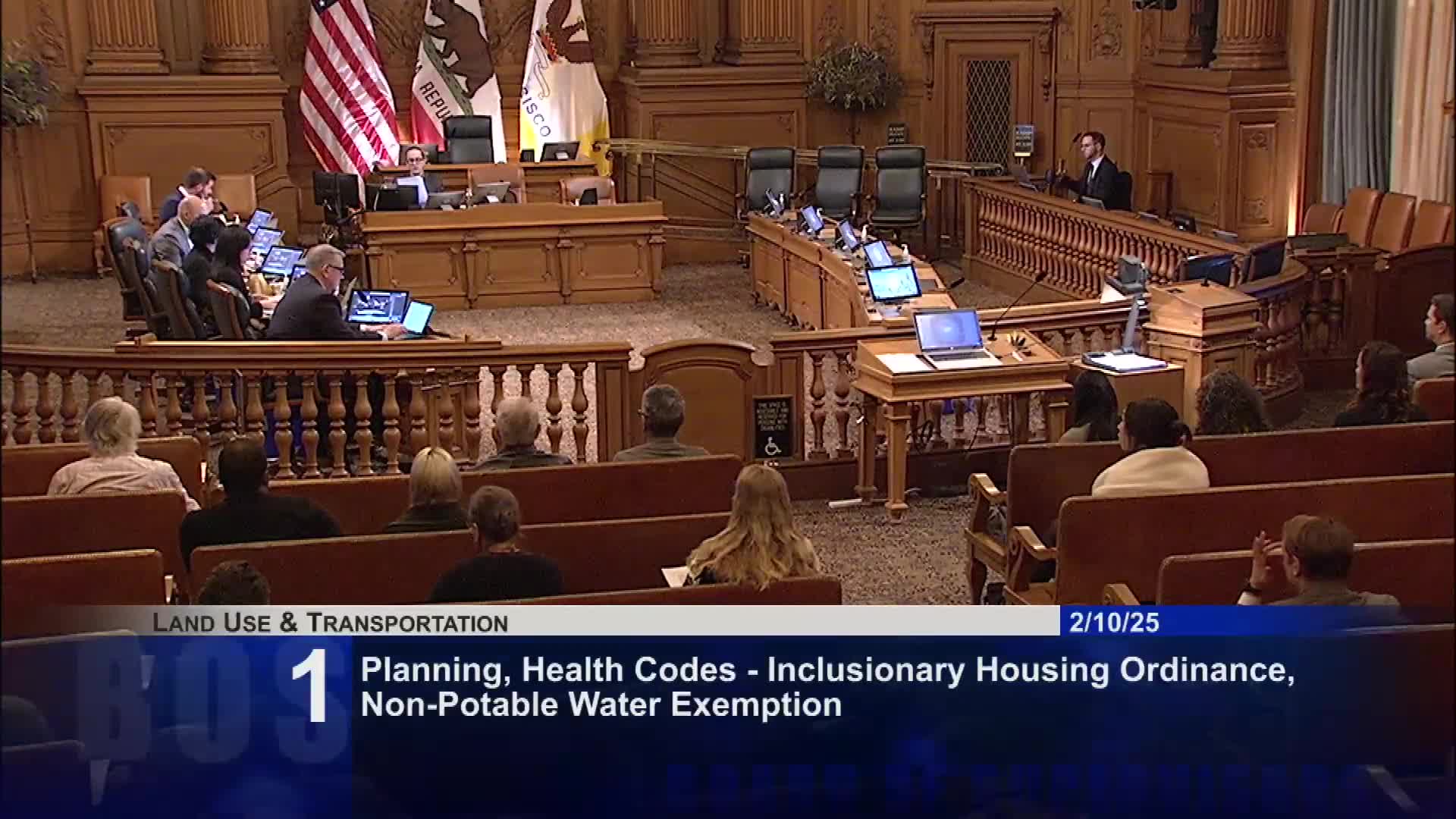
A contentious ordinance to waive impact fees and inclusionary housing requirements for certain downtown office-to-residential conversions was advanced out of the Land Use and Transportation Committee Feb. 10 after amendments and a divided vote.
The Land Use and Transportation Committee on Feb. 10 considered an ordinance that would (1) exempt specified downtown commercial-to-residential conversion projects from Planning Department impact fees, including the inclusionary housing requirement; (2) create a process for previously approved projects to request fee modifications; and (3) remove the application deadline from the commercial-to-residential adaptive reuse program. Planning staff affirmed consistency findings and recommended limited changes.
Why it matters: Sponsors argued the downtown core faces unprecedented vacancy and that waiving certain fees would unlock conversions that create housing, bring residents back downtown and support the citytax and retail base. Opponents, particularly community and cultural-district groups, said removing impact fees would strip funding for parks, childcare, schools and affordable housing and argued priority equity geographies and cultural districts should be carved out.
Key points from sponsors and staff: Supervisor Matt Dorsey, a sponsor, said San Francisco had a roughly 37% office vacancy rate—about 32,000,000 square feet—and cited the regional housing needs allocation (RHNA) target of 82,000 units by 2031. He described three major cost levers that keep conversions from pencil-ing: the real estate transfer tax (which Prop C waived), property-tax tools (AB 2488 referenced), and the city's inclusionary and impact-fee requirements. Planning staff Lily Langlois summarized Planning Commission recommendations to align gross floor area definitions, extend the pipeline date and add the Inclusionary Housing TAC to the work program.
Public comment and stakeholder positions: The hearing drew extensive testimony.
- Supporters included the San Francisco Chamber of Commerce, SPUR, the Bay Area Council, construction unions (Carpenters Local 22), general contractors and multiple developers and architects. Arguments in favor said conversions "activate" dormant downtown blocks, could generate seismic and safety upgrades, reduce greenhouse gas when compared with new construction, and are needed to revive retail and hospitality jobs.
- Opponents or cautious commenters included neighborhood groups and cultural-district representatives (SomCan, Soma Filipinas, South of Market Community Action Network), Parent Voices and other community advocates. Their central objections were that the ordinance would: remove funding for parks, childcare, schools and affordable housing; apply to priority equity geographies and cultural districts; and in some readings could allow demolition-and-rebuild projects to bypass fees. Several speakers said they opposed the measure unless the cultural-district boundaries and priority equity geographies were removed from the waiver.
Clarifications from staff: Planning staff and Supervisor Dorsey clarified that the waiver applies only to square footage that converts from nonresidential to residential (including adaptive reuse or demolition/rebuild that preserves converted square footage). Any additional new residential square footage beyond converted area would remain subject to existing fees and inclusionary requirements. Planning also proposed amendments to refine gross floor area definitions, pipeline deadlines and reporting to the Inclusionary Housing TAC.
Committee action and votes: Vice Chair Cheyenne Chen moved to continue the item to Feb. 24; that motion failed on a 1-2 vote (Chen aye; Bilal Mahmood and Chair Mirna Melgar recorded in dissent). Member Bilal Mahmood offered a motion to adopt the sponsor and planning amendments; the committee approved the amendments on a 3-0 vote. A subsequent motion to recommend the ordinance as amended to the Board of Supervisors passed 2-1 (Mirna Melgar and Bilal Mahmood in favor; Cheyenne Chen opposed).
What's next: The ordinance, as amended, was sent to the full Board of Supervisors with a positive recommendation. The committee directed planning and OEWD to continue analysis and work with community stakeholders; the amendments include a reporting requirement to the Inclusionary Housing TAC.