Get Full Government Meeting Transcripts, Videos, & Alerts Forever!
Get email alerts on the Career Technical Education topic
No spam. Unsubscribe anytime.
Education Committee moves to earmark CTE equipment and supplies funding
Summary
The Education Committee voted to advance House Bill 235, which would convert the portion of high-school CTE block grant funding meant for materials, supplies and equipment into a separate categorical grant; the measure passed the committee as amended after debate about impacts on middle‑school programs and budget mechanics.
The Wyoming Education Committee advanced House Bill 235 to separate the portion of career and technical education (CTE) block grant funding intended for materials, supplies and equipment into a categorical grant that would be appropriated separately and tracked for its intended use.
Representative Andrew, House education chair, told the committee the bill is intended to make sure money generated by enrollment in grades 9–12 CTE courses is spent on those programs. “Right now ... the block grant funds generated directly by enrollment in high school CTE programs are not always being spent on those programs,” he said, adding that only 55.1% of those funds were reported spent on the intended supplies and equipment in the latest reporting period.
Supporters said the change is aimed at workforce needs. Wanda Maloney of the Wyoming Department of Education said the superintendent supports the bill and the House amendments because the measure would allow the funds to “flow through so that the districts would have access without having to apply for it,” and the department already collects the CTE spending reports required by the bill. Jeff Stone, a former CTE educator and Laramie County staffer, told the committee that in his experience the lack of a dedicated category left programs chronically underfunded for equipment and technology.
Opponents, led by a witness from the Wyoming School Boards Association, urged more study before making the change permanent. That witness said the block grant is a resource allocation and warned the committee the money might currently be used to subsidize middle‑school CTE, college partnerships or student competition travel; making the funding categorical, the witness argued, could reduce that flexibility and unintentionally curtail those uses.
Committee members pressed for detail on budget mechanics. Department witnesses and lawmakers said the appropriation is needed because the categorical grant would be outside the current block‑grant model; staff identified an amendment to correct an apparent date mismatch in the bill that committee members also adopted. Committee members discussed recapture and the school foundation funding model; the fiscal note cited a roughly $3.8 million offset to the model and a $4.6 million appropriation effect that the department said reflects recapture dynamics and the addition of House Bill 18 into 235, producing an $800,000 net change in the fiscal projection. The committee was told the House amendment that folded House Bill 18 into 235 increases costs modestly (the HB18 component was described in testimony as roughly $284,000 per year on its own).
The committee adopted two substantive amendments before voting. One corrected the effective school‑year dates in the bill language. A second amendment added the phrase "at any grade level," so the statutory wording reads that amounts distributed "shall only be expended on supplies, materials and equipment for career and technical education programs at any grade level," a change intended to preserve use for middle‑school or other grade‑level CTE where districts currently rely on those funds. After debate the committee voted to pass House Bill 235 as amended.
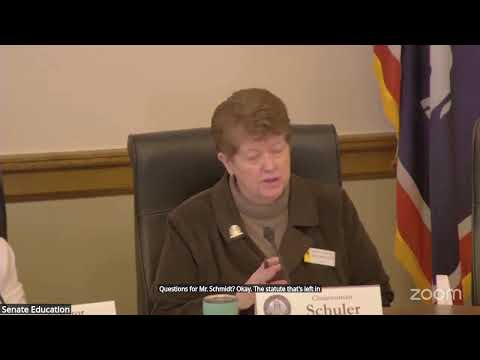
Votes at committee: House Bill 235, as amended — passed in committee (three ayes, one no, one excused). Recorded ayes during roll call were Senator Bridal, Senator Scott and Chairwoman Schueller; Senator Rothfuss recorded a no; Senator Olson was excused. Representative Andrew volunteered to carry the bill on the floor.
What the bill would change and next steps: If enacted as drafted, the 29% portion of CTE funding now calculated within the school foundation/block grant model would be pulled into a separately appropriated categorical grant intended to be spent on materials, supplies and equipment. The Department of Education would continue to receive district CTE expenditure reports required by the bill, and witnesses said districts would receive the funds as a flow‑through without a new application process. The bill now moves from committee toward consideration on the Senate floor.