Get Full Government Meeting Transcripts, Videos, & Alerts Forever!
Get email alerts on the Budget Fiscal Policy topic
No spam. Unsubscribe anytime.
Roy council weighs property tax increase, cuts to close $750,000 FY26 budget gap for employee pay
Summary
At a Feb. 18, 2025 special work session the Roy City Council discussed options to cover a projected $750,000 shortfall in the general fund to pay employee cost-of-living and merit increases, including property tax increases, using fund balance, and targeted cuts.
Roy City held a special work session on Feb. 18, 2025 to discuss fiscal year 2026 budget preparation, focusing on a projected $750,000 shortfall in the general fund to cover employee cost-of-living adjustments (COLA) and merit increases.
The council heard staff estimates that paying COLA and merit increases across all city employees would total about $1,100,000, and that the utility enterprise fund can cover its assigned employees while the general fund faces a roughly $750,000 gap. Mayor said the city’s sales and use tax revenue has stabilized and that the difference must be addressed either by generating new revenue, cutting expenses, or a combination.
Why it matters: Council members and staff said the shortfall could affect employee morale and retention if not addressed. Councilors discussed revenue steps (property tax increases, using one-time proceeds) and expense reductions (program cuts, frozen hires, benefit adjustments) as ways to close the gap.
Council member Sophie, who reviewed figures provided by staff, told colleagues that the scale of a property tax increase discussed is larger than earlier estimates. “After I got totals from Amber, I really it's not a matter of 9, 10 percent. You're looking at 15% just to get the 750,000,” Sophie said.
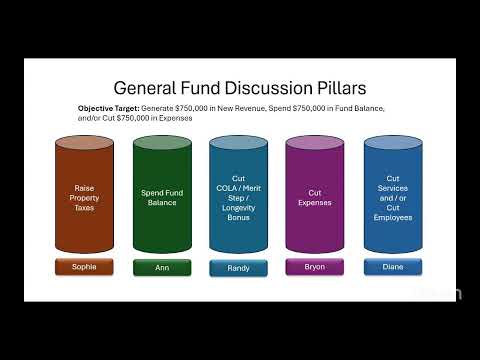
City staff and councilors outlined several options the council could combine to reach the $750,000 target: modest property tax increases, targeted spending cuts, reallocating existing budget allocations (for example, part-time positions that remain unfilled), or a one-time use of excess fund balance from a recent property sale. Sophie and others noted that using fund balance or sale proceeds would be a one-time measure rather than a sustainable revenue source.
On the cost side, Council member Diane gave a review of idea pillars staff had been asked to study: reducing hours at the recreation complex, charging employees for facility rentals, removing some memberships (for example, the Utah League of Cities and Towns membership), re-evaluating volunteer or auxiliary programs for police, changing starting pay steps for new hires, cutting selected full-time positions, imposing a hiring freeze, and trimming part-time/temporary staff. Diane said some line items show minimal savings or risk reducing service levels. “I feel that we should never take it out of our rainy day fund. We need to keep that for something catastrophic,” Diane said when discussing use of fund balance.
Council members and staff repeatedly emphasized the limited pool of discretionary savings; staff said line-by-line cuts identified so far total roughly $476,000, still short of the $750,000 goal. Council member Randy explained the scale of the pay issue: “As far as from a percentage perspective, 1% COLA roughly equates over the next 2 to 3 years, roughly about $180,000 per 1%,” he said, arguing the council needs to weigh property tax increases against the human and service impacts of cuts.
Several councilors said they would prefer to avoid cutting front-line staff because public-facing services are already “to the bone.” Several speakers said a moderate property tax increase to stabilize pay and retain staff would be less burdensome to a typical household than relying solely on volatile sales tax growth; council discussion included examples of household impacts versus retail spending required to generate equivalent sales-tax revenue.
Next steps: Council members agreed they need department budget submittals in March/April to finalize numbers. The mayor and multiple councilors asked staff to prepare for a truth-in-taxation process if the council chooses to pursue property-tax revenue. No formal decision was made; the council recessed to await detailed budgets and will revisit policy choices before the final appropriation vote.
The work session formally ended with a motion to adjourn that carried by voice vote.