Get Full Government Meeting Transcripts, Videos, & Alerts Forever!
Get email alerts on the Agriculture Meat Regulation topic
No spam. Unsubscribe anytime.
Senate committee advances Wyoming Prime Act allowing custom-slaughter sales if federal law changes
Summary
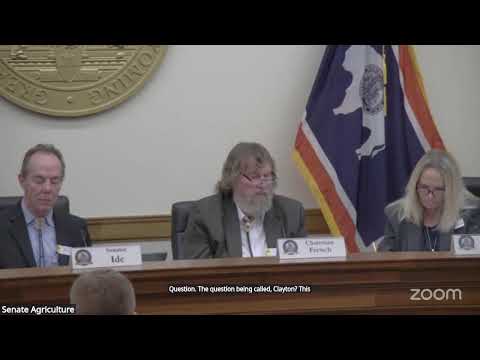
Senators on the Senate Agriculture, State & Public Lands & Water Resources Committee voted to advance Senate File 120, the Wyoming Prime Act, a trigger bill that would allow sale of meat from custom slaughter facilities within Wyoming only if Congress first amends federal law.
Senators on the Senate Agriculture, State & Public Lands & Water Resources Committee voted to advance Senate File 120, the Wyoming Prime Act, a measure that would allow the direct sale of meat from custom slaughter facilities to consumers and retailers in Wyoming if and only if Congress first amends federal law to permit such sales.
The bill would amend state law to opt in to a future federal Prime Act: meat would have to be raised, slaughtered, processed and sold inside Wyoming, sold directly to an "informed end consumer," and the product packaging would require a prominent written warning that it "was not inspected by the USDA," sponsors said. The proposal, a committee sponsor said, is a trigger bill and would become effective in Wyoming only after the federal change takes effect.
Supporters, including the bill sponsor and cosponsors, said the measure would help small-scale farmers and ranchers access local markets, keep dollars in Wyoming communities and could reduce retail prices. "The Wyoming Prime Act is a bill that would allow small scale farmers and ranchers to sell homemade meat products," Senator Salazar told the committee. Representative Tyler Lindholm, who testified as a bill backer, said the legislation "costs nothing" to the state and argued the measure would give producers more direct market access.
The Wyoming Department of Agriculture gave cautious testimony describing how the state's meat inspection program currently operates under an agreement with the U.S. Department of Agriculture and explaining why passage at the federal level is central to how the state could implement in-state resale. "We as the Wyoming Department of Agriculture have an agreement with USDA to carry out the provisions of the federal meat inspection act within the state of Wyoming," Doug Miyamoto told the committee, explaining that custom-exempt processing historically was intended for personal use and that interstate and international trade standards depend on parity with federal inspection regimes.
Committee members asked whether small grocers or retail outlets could be included; both sponsors and WDA staff said the current federal Prime Act language would not automatically cover retail grocers and that adding retail-sale language could create conflicts with federal standards unless the federal law included such language. Several committee members said the bill is a pragmatic, incremental step: "This bill gives us 90%. I'd rather have 90 than nothing," one sponsor said during debate.
Public and industry witnesses including the Powder River Basin Resource Council, the Wyoming Farm Bureau Federation and the Rocky Mountain Farmers Union testified in support, citing local economic benefits and producer control over markets.
The committee approved the bill on a roll-call vote in committee; the chair announced the measure will advance to the next legislative stage for further consideration.
Votes at committee: The committee recorded a roll-call approval for Senate File 120; the chair reported five ayes and no recorded nays. The transcript did not provide a full, named roll-call list in the excerpt reviewed.
Next steps: Because the bill is a trigger tied to prospective federal legislation, its practical effects hinge on congressional action. If Congress enacts the federal Prime Act, sponsors and WDA staff said the department would begin rule changes to allow in-state resale as allowed by federal law.