Get Full Government Meeting Transcripts, Videos, & Alerts Forever!
Get email alerts on the Proposition M topic
No spam. Unsubscribe anytime.
Treasurers office outlines Proposition M changes and effects on homelessness gross‑receipts tax
Summary
A representative from the Office of the Treasurer & Tax Collector explained how Proposition M reorganizes San Francisco business taxes, expands the base for the homelessness gross receipts tax ("Big C") and aims to reduce volatility from remote work.
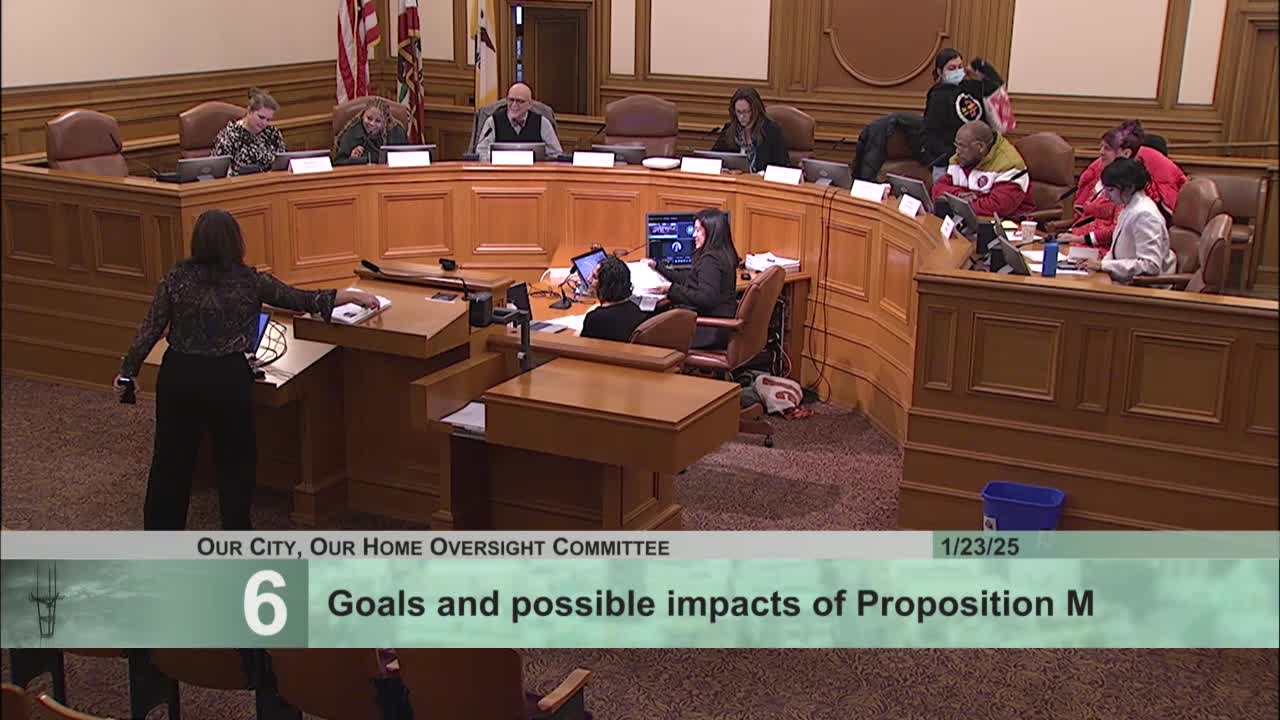
Amanda Freed of the San Francisco Office of the Treasurer & Tax Collector briefed the committee on Jan. 23 about Proposition M, a November 2024 ballot measure that overhauled the city's business tax code and took effect Jan. 1, 2025.
Freed told the committee the measure’s goals included reducing the risk of tax loss due to remote work, lowering revenue volatility tied to a small number of large taxpayers, simplifying tax categories and increasing equity for small businesses. "The general goals of Prop M were to reform the business tax system to better reflect a post COVID economy in San Francisco," she said.
She said the measure simplified multiple industry categories into seven, changed the apportionment formula so 75% of the tax calculation is based on sales into San Francisco and 25% on payroll, and lowered the threshold for businesses subject to the homelessness gross‑receipts tax from $50 million to $25 million in San Francisco gross receipts. Freed said the measure is designed to be revenue neutral over time, with modest reductions in the near term and scheduled increases of 4% in 2027 and 3% in 2028 as the new structure phases in.
Freed summarized background data from the controller's office that motivated the change: the city saw a rapid increase in concentration of business‑tax revenue among the largest taxpayers (the top five taxpayers' share grew from about $30 million, 7%, in 2012 to about $339 million, 24%, in 2022) and that transition to remote work produced an estimated opportunity cost of roughly $485 million in three top sectors in 2021 if employees had remained in person.
Committee questions focused on projections and uncertainty. Member Haddix asked what would happen if the economy did not recover as projected; Freed deferred to the controller for specific revenue forecasting and said the controller's office had made conservative projections that incorporate differing views. Member Sheffrin asked how the code was simpler in practice; Freed said simplification came from fewer industry categories, clearer apportionment and exemptions for very small businesses (those with under $5 million in San Francisco receipts are largely exempt).
Freed cautioned that some midsize businesses will be surprised to see the homelessness gross‑receipts tax on their first filings because Prop M reallocates existing business tax liabilities rather than adding a wholly new net charge. "Their overall taxes to San Francisco aren't changing. It's not like we've added this new tax in addition to what they were paying before," she said, but added the city will increase outreach to explain how liabilities were reallocated.
Freed recommended the committee consult the controller's office for detailed scenario modeling. The committee requested follow‑up materials on OCO fund projections and asked staff to share more detailed revenue forecasts at the next meeting.