Get Full Government Meeting Transcripts, Videos, & Alerts Forever!
Get email alerts on the Workforce topic
No spam. Unsubscribe anytime.
Business groups propose WorkLearn Ohio to retain graduates and expand employer‑led co‑op placements
Summary
The Ohio Chamber and business groups proposed a WorkLearn Ohio public‑private partnership to connect college students with local employers through paid work‑based learning, and discussed aligning it with a budget provision that tasks higher‑education institutions to connect students with Ohio employers.
At the House Children and Human Services Committee hearing on House Bill 96, the Ohio Chamber and business stakeholders urged a statewide employer‑led program called WorkLearn Ohio to retain college graduates and tie students to local employers through internships, apprenticeships and co‑ops.
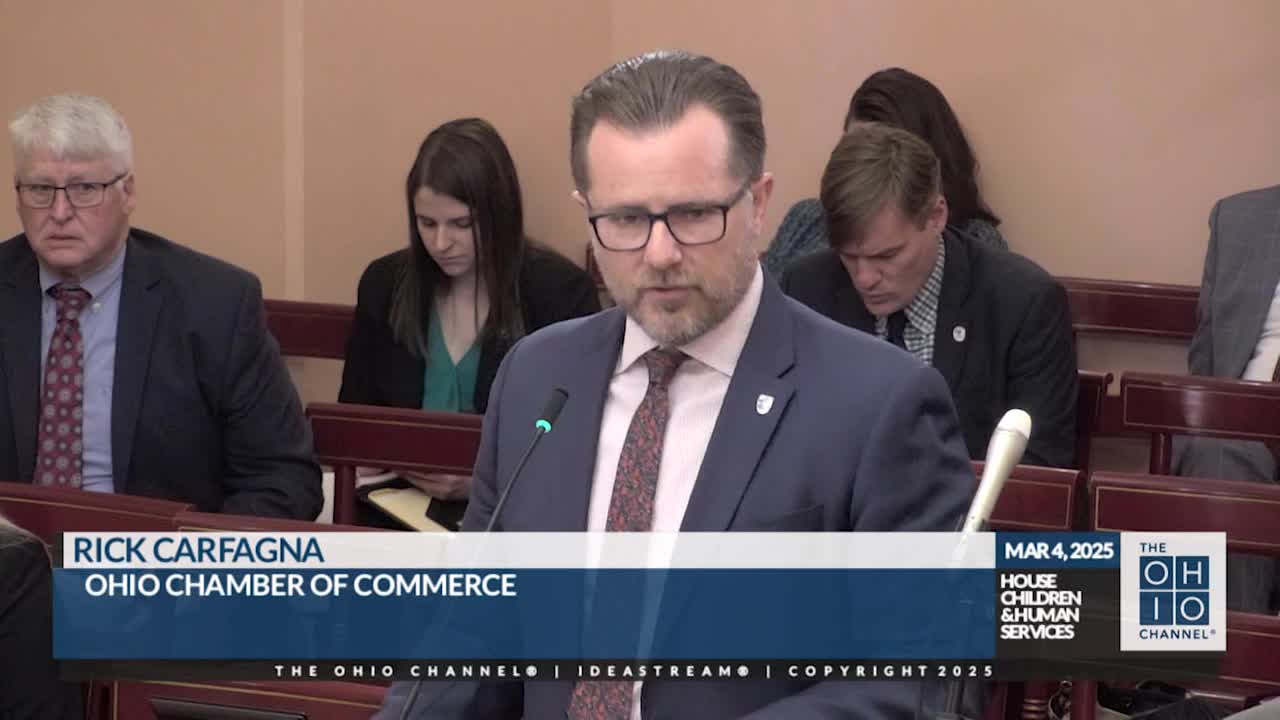
Rick Carfagna of the Ohio Chamber testified that Ohio loses a net share of college graduates and that early employment ties can keep graduates in the state. He described WorkLearn Ohio as a public‑private partnership in which a 501(c)(3) would serve as the platform, a one‑time competitive state grant would be used to stand it up, students would be paid a minimum of $15 per hour and employers would pay an administrative fee to sustain operations.
Carfagna said the governor’s executive budget already tasks state institutions of higher education with connecting students to Ohio employers for internships and co‑ops. He proposed the WorkLearn model as a way to coordinate and scale those efforts across institutions and sectors, not to replace existing campus programs. He and committee members discussed existing models at some Ohio universities, and a nonprofit in Dayton (SOTI) that he said currently serves about 1,500 students and could be scaled to serve more.
Representative Pickle Antonio asked whether employers would pay student salaries; Carfagna replied that the employer would pay salaries and also an administrative fee. Carfagna estimated the state startup grant would be one‑time funding spread over several years to stand up the nonprofit or scale an existing model and said the chamber envisions scaling from pilot sizes toward a capacity that could serve thousands of students.
Committee members pressed for more detail on metrics and funding mechanics; Carfagna offered to provide a more detailed briefing and numbers to interested members. No formal legislative action occurred at the hearing.