Get Full Government Meeting Transcripts, Videos, & Alerts Forever!
Get email alerts on the Childcare topic
No spam. Unsubscribe anytime.
Lawmakers, business groups urge expanded childcare funding, capacity and workforce supports in House Bill 96
Summary
Witnesses at a House Children and Human Services Committee hearing urged that House Bill 96 expand childcare eligibility, boost provider payments, cap family copayments, fund facility retrofits and invest in the early childhood workforce to remove barriers to employment and improve kindergarten readiness.
Chair White convened an informal hearing on House Bill 96 on budget provisions tied to childcare and early education, where business and nonprofit witnesses and county job and family services officials urged the legislature to expand eligibility and funding for childcare, increase provider payments and invest in the early childhood workforce.
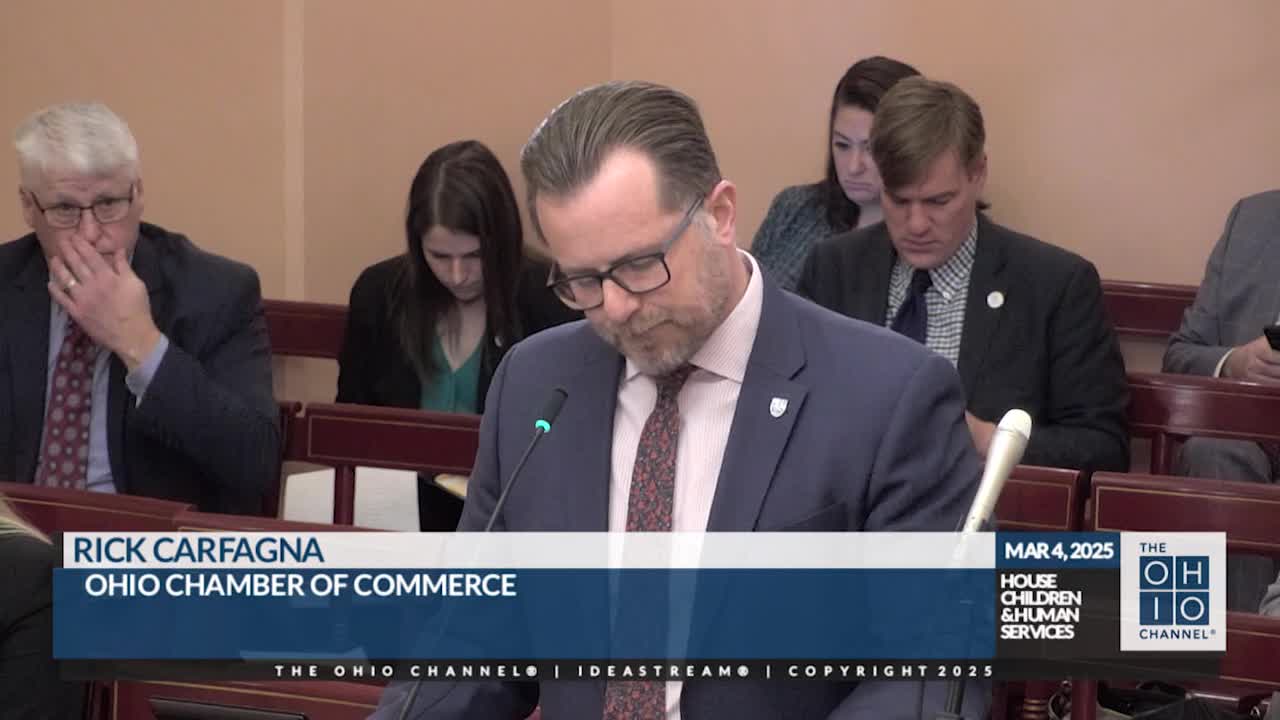
Those who testified said expanding publicly funded childcare and reducing family costs are necessary to return more Ohioans to the workforce and to improve kindergarten readiness. Ohio Chamber of Commerce senior vice president Rick Carfagna told the committee the cost and scarcity of childcare “is robbing our labor force” and urged multi-pronged approaches to affordability, supply and workforce retention.
The hearing included testimony from Nikki Cooper of the Ohio Business Roundtable and Lisa Gray of Ohio Excels, both of whom supported the governor’s proposed increases to childcare eligibility and additional measures in the budget. County Job and Family Services director Roxanne Summerlot described local efforts to stabilize families and connect them with employment, while business leaders described how child care constraints affect hiring and retention.
Carfagna, representing the Ohio Chamber, recommended keeping the governor’s proposal to expand eligibility to 160% of the federal poverty level and urged continuation of a voucher mechanism that would extend eligibility up to 200% FPL for certain working parents. He also outlined a tri-share model being proposed in other legislation in which the state, employer and family would each pay roughly one-third of childcare costs; he said a $10 million pilot was an appropriate start. Carfagna also urged funding for retrofitting underused facilities into childcare classrooms and said incentives should be available to expand both center-based and in-home capacity in childcare deserts.
Lisa Gray of Ohio Excels emphasized the long-term educational and economic returns of early learning investments, citing state data showing 64% of Ohio kindergarten students are not ready for kindergarten. Gray described several budget provisions she supports: moving provider payments to the 50th percentile of the 2024 market rate survey, converting some part‑time public preschool grants to full‑time, instituting a family copayment cap so families pay no more than 7% of income for childcare, and a refundable child tax credit worth up to $1,000 per child age 6 or under. Gray said the budget’s changes to eligibility and payments would both improve access and stabilize provider finances.
Multiple witnesses urged stronger supports for the early childhood workforce. Carfagna and Gray recommended expanding scholarships and state matches for early childhood educator training, covering Child Development Associate credential costs (listed at $425 for new credentials and about $125–$150 for renewals), and offering childcare scholarships to workers’ own children as an incentive to remain in the field. Carfagna pointed to Kentucky’s program as an example and proposed funding for either up to 5,000 scholarship slots for children of childcare workers or making those workers eligible under the governor’s Child Care Choice Voucher Program.
County testimony from Marion County director Roxanne Summerlot highlighted how county programs source and use TANF/PRC funds to stabilize families and noted the state pilot programs and local partnerships that help with basic needs and employer retention supports. Summerlot described contracts with local nonprofits for financial literacy and employer‑sponsored success coaches who help new hires address barriers such as transportation or childcare to reduce turnover.
Witnesses also referenced existing and proposed legislation tied to expansion and innovation in childcare, including House Bill 41 (retrofits/learning lab grants), House Bill 2 and Senate Bill 32 (tri‑share models), and the governor’s Child Care Choice Voucher program.
The hearing provided committee members with data and local examples as they consider budget language. Several representatives asked for follow-up details about program eligibility and pilot results; county officials said they would provide participation counts and implementation details to the committee.
Ending: Committee discussion moved on after the panel’s testimony; no formal legislative vote occurred during the hearing. Committee members signaled interest in follow‑up information from the Department of Job and Family Services and county partners on pilot participation and outcomes.