Get Full Government Meeting Transcripts, Videos, & Alerts Forever!
Get email alerts on the Zoning Setback Variance topic
No spam. Unsubscribe anytime.
Idaho Falls board approves variance allowing homes to be set back beyond 20-foot maximum near Highway 20
Summary
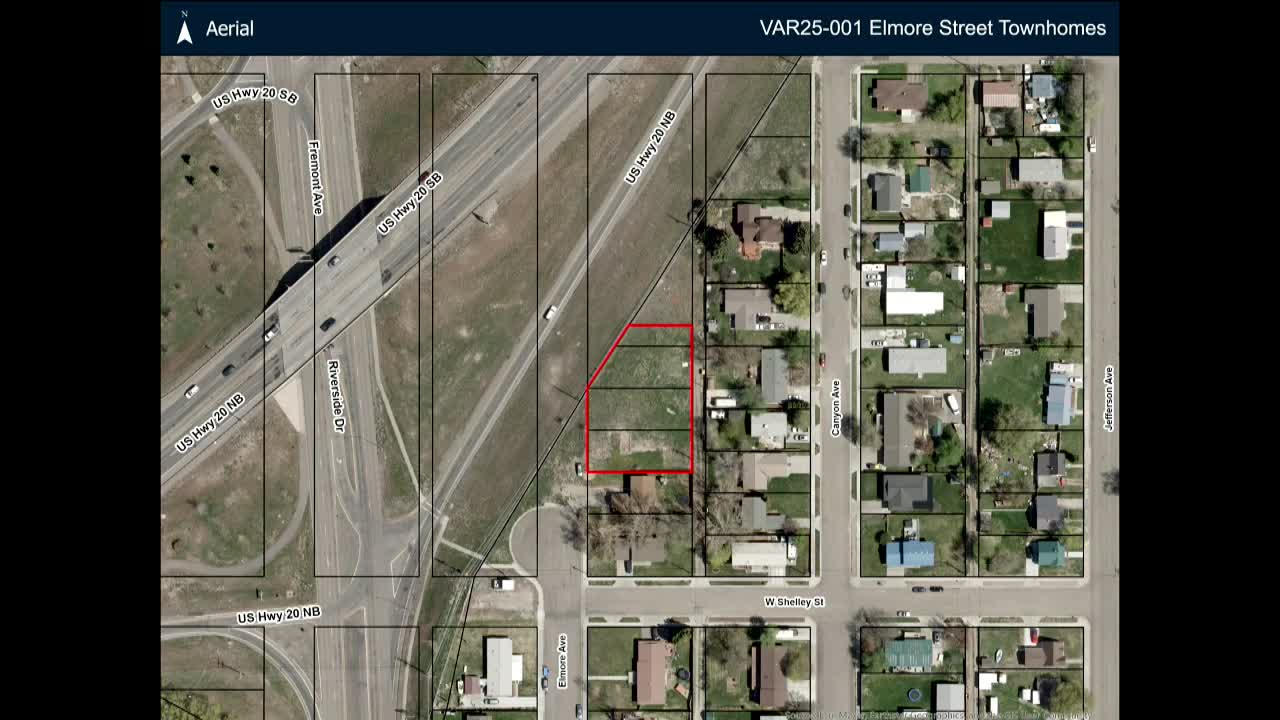
The City of Idaho Falls Board of Adjustments voted Feb. 25, 2025, to approve a variance allowing residential dwelling units to be constructed beyond the traditional neighborhood (TN) zone's 20-foot maximum front setback on a lot southeast of Highway 20 and west of Canyon Avenue.
The City of Idaho Falls Board of Adjustments voted Feb. 25, 2025, to approve a variance allowing residential dwelling units to be constructed beyond the traditional neighborhood (TN) zone's 20-foot maximum front setback on a lot southeast of Highway 20 and west of Canyon Avenue.
The variance affects an irregular infill lot in the city's original town site; staff recommended approval under the zoning ordinance citing a physical hardship created by the lot shape after Highway 20 construction. The developer's representative said the layout requires the increased setback to meet fire access rules while preserving rear garages and some front yard space.
Barry Laing, an engineer with Connect Engineering, described the lot as "a very unique shaped and and unique location property," and said the developer cannot meet the TN zone's maximum 20-foot front setback because the alley is too narrow to meet fire requirements and the lot is unusually shaped by Highway 20. "One of the requirements in the traditional neighborhood zone is a maximum front yard setback of 20 feet. And that's the variance that we're looking for to increase, that maximum setback from 20 feet to more than 20 feet," Laing said during the public hearing.
A city staff speaker (Greg) told the board the property was annexed in 1906, was rezoned to TN in 2018, and that the TN zone includes both a 15-foot minimum and a 20-foot maximum front setback. The staff report referenced section 11-6-5(g) of the zoning ordinance as authorizing a variance where an "undue hardship exists due to a physical limitation" unique to the lot, and concluded the requested variance would not conflict with the public interest. "Staff recommends approval of the variance allowing a front setback beyond the maximum 20 feet," the staff speaker said.
Four nearby residents spoke during the public hearing and raised concerns about safety, utilities, stormwater and access. Annette Harvey, of 1123 Canyon Avenue, said she is concerned about the unmaintained city-owned triangular parcel adjacent to the site and past fires there: "I'm kind of concerned on what's gonna happen with that whole area there, for our safety and everyone else's safety." Marissa Veil, of 1112 Elmore, told the board the site contains substantial lava rock and queried whether rock removal or blasting could damage nearby foundations or utilities: "...there is a lot of lava rock. So I guess when they do construction, if they have to use explosives or anything, that that's gonna mess with our foundation, obviously." Other speakers cited narrow alley geometry that makes backing trailers difficult and the potential for runoff and sewer impacts.
The applicant's representative and city staff responded to several concerns: the developer said joint use of the small, city-owned triangular parcel is under discussion and could be used as a storm pond maintained by the homeowner association; the applicant said city code requires on-site stormwater control and that utilities and site layout would be finalized during site-plan and public-works review. On telephone poles, the applicant said poles would likely remain or be relocated into an easement if available. The applicant noted the team would need to coordinate with public works for water and sewer connections and that the alley's width prevents primary fire access from the alley, which drives the proposed orientation.
Board members deliberated after closing the public hearing. Members acknowledged resident concerns about alley width, rock, and winter access but said those issues were largely related to the larger development process rather than the narrow question of whether allowing a setback beyond 20 feet would create a neighborhood detriment. One member observed that nearby redevelopment had previously removed an unmaintained parcel and provided neighborhood benefits.
A motion to approve the variance beyond the TN zone's 20-foot maximum was made and seconded; the board approved the motion by voice vote with ayes recorded. The board also voted to approve the relevant criteria and standards read into the record.
The variance approval does not authorize building permits or final site layout. The applicant must still complete platting, site-plan review, and public-works approvals and meet fire and utility requirements before construction. The staff report noted the lots must meet city stormwater standards and other development regulations during subsequent reviews.
Votes at a glance: The board approved the variance allowing front setbacks beyond 20 feet by voice vote (ayes recorded), and later approved the motion adopting the relevant criteria and standards as read.