Get Full Government Meeting Transcripts, Videos, & Alerts Forever!
Get email alerts on the Property Assessments topic
No spam. Unsubscribe anytime.
Board upholds assessor value for Fort Apache townhomes after debate over income vs. rent-multiplier approaches
Summary
The Board of Equalization on Feb. 20 declined to adopt an income‑capitalization valuation for a 79‑unit Fort Apache townhome development, instead accepting the assessor’s parcel‑by‑parcel comparable/GRM approach with a modest land‑value adjustment.
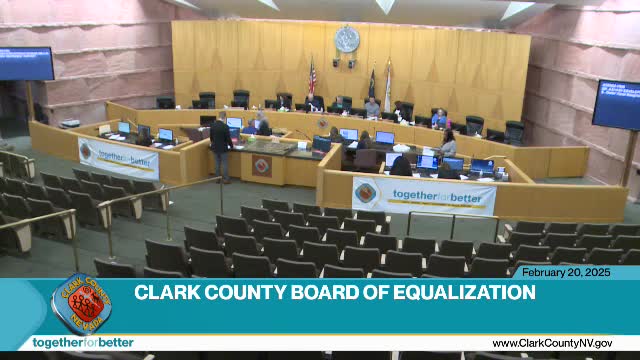
The Clark County Board of Equalization heard competing valuation approaches on Feb. 20 in an appeal by Fort Apache Townhomes LLC over the taxable value of a 79‑unit townhome development near Fort Apache and Serene streets.
Developer and owner representatives argued the project should be valued as a single income‑producing unit rather than as 79 separate taxable townhome parcels. Counsel and developer witness Vincent Schetler described the property as an operating rental project (build‑to‑rent) with a single construction loan and a unified revenue stream; they provided a rent roll and several months of operating statements that showed the project reaching near‑full occupancy in December 2024. Using the December net operating income (NOI) that the owner provided (about $112,700 for the month, equivalent to roughly $1.35 million annualized), the petitioner proposed capitalizing the income at a 6.0–6.5% rate to estimate market value in the low‑to‑mid‑$20 million range.
Assessor staff countered that the subdivision had been platted as individually parceled units and that county practice and the available market data supported using a residential gross‑rent‑multiplier (GRM) or per‑unit comparable sales approach for individually parceled townhomes. Assessor witnesses presented a GRM analysis using nearby for‑lease townhome data and a set of portfolio sales of rental communities; they argued those indicators supported the assessor’s recommended taxable values and a modest reduction in base lot value (from $100,000 to $90,000 per lot) that the assessor had already applied during review.
Board members discussed the legal test in NRS 361.227 (unit of appraisal) and NAC 361.1295 for subdivision discounts and whether the facts of the Fort Apache ownership and financing made it appropriate to value the property as a collective economic unit. The petitioner emphasized lender proposals to take out construction financing in the $17–18 million range, and the developer contended that lenders underwrite on income and residual analyses rather than per‑unit retail comparisons.
After deliberation, the board voted to accept the assessor’s recommended taxable values for the park of cases (the motion recorded at the hearing). The board noted the developer’s right to appeal to the Nevada State Board of Equalization.
Why it matters: The case captures a recurring tension in modern housing markets: whether build‑to‑rent developments that are platted as individual units should be assessed using parcel‑level residential comparables or treated as consolidated income assets. The board’s decision to rely on the assessor’s GRM/comparable framework leaves the assessor’s current approach intact, but owners and lenders may renew the argument on appeal or in subsequent similar projects.