Get Full Government Meeting Transcripts, Videos, & Alerts Forever!
Get email alerts on the Economic Development topic
No spam. Unsubscribe anytime.
Bountiful council reviews economic development element of general plan; adds zoning, downtown action items
Summary
Bountiful City Council held a work session Tuesday, Nov. 26, 2024, to review the economic development element of the draft general plan and to identify action items for zoning, downtown vitality and transportation.
Bountiful City Council held a work session Tuesday, Nov. 26, 2024, to review the economic development element of the draft general plan and to identify action items for zoning, downtown vitality and transportation. Staff and consultants presented a Zions Public Finance “leakage” analysis showing that sales tax is the city’s primary general-fund revenue source, that many resident jobs are located outside city limits, and that opportunities exist to capture retail and entertainment spending now leaving the city.
The study’s findings matter because, as Gary Hill, presenter for the Zions Bank analysis, put it, “for purposes of Bountiful in this study, economic development means generating and protecting sufficient revenue to provide desired services.” He told the council that the study therefore focused on revenue production rather than job creation.
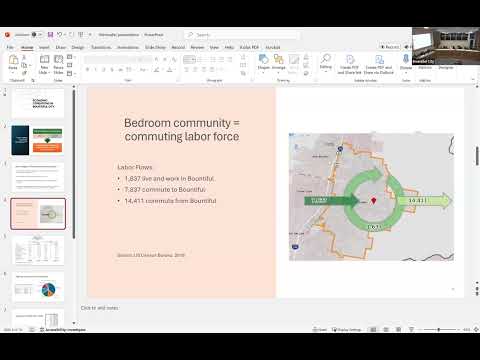
Councilmembers and staff discussed the implications of a city that the study identified as a bedroom community. The presentation said roughly 22,000–23,000 jobs are held by Bountiful residents, about 14,000 of which are outside city limits; roughly 1,600 of the jobs held by residents are located in Bountiful, and about 7,800 jobs in Bountiful are held by commuters. The consultants and staff noted the consequence: because sales tax is the city’s dominant revenue source, protecting commercial land and encouraging sales-generating uses are priorities for sustaining services.
Francisco Astorga, staff member, described recent development pressures and administrative approvals that produced uses yielding little or no sales tax. “We’re receiving more applications for uses that do not generate taxes,” he said, and he urged the council to consider policies that would limit non–sales-generating office and storage uses along key commercial corridors. City staff and the council agreed to add an action item in the general plan to review mixed-use and commercial zoning and to consider guardrails that preserve high-value tax-producing parcels.
Council members emphasized downtown vitality and foot-traffic-producing uses as objectives distinct from simply filling storefronts. One councilmember said Main Street should prioritize businesses that invite pedestrians over storage or warehouse-style internet retailers. Staff recommended adding a discrete action item to review downtown zoning to ensure the code aligns with the council’s vibrancy goals.
Other action items the council supported for inclusion in the economic element of the general plan were: continue use of RDA funds for downtown infrastructure; analyze development-review procedures and parking requirements to support retail and restaurants without oversupplying parking; study an arts-and-entertainment overlay or district; explore façade rehabilitation and tree-canopy preservation; analyze utility capacity in target infill areas; and identify pedestrian and active-transportation improvements, including bike parking, along Main Street.
The Zions presentation included a sector analysis identifying strengths and leakage. Motor-vehicle sales and electronics/appliances generated more sales tax than expected; groceries and health/personal care were near expected levels. Leakage categories where residents spend outside the city included accommodations (hotels), spectator sports and performing arts, building materials, and general merchandise. Presenters and councilmembers noted nearby competitors — including a Costco and large home-improvement stores just outside city limits — would limit the feasibility of attracting some national retailers.
Staff cautioned that zoning and ordinance changes are legislative decisions and that the council’s willingness to refuse rezoning requests that reduce commercial acreage will be critical to protecting the tax base. Gary Hill and staff recounted a past example from another city in which council members refused a residential rezoning request on a large commercial parcel to preserve long-term commercial capacity.
No formal votes were recorded during the work session; councilmembers signaled support during the discussion and directed staff to incorporate the agreed action items into the draft general plan and prepare subsequent zoning and code revisions for future council consideration. Staff said the zoning and ordinance work would follow the general-plan adoption schedule and that detailed zoning discussions would occur when the land-use map and code amendments are prepared.
The council paused at the end of the item and planned to continue with the regular city council meeting after a brief break.