Get Full Government Meeting Transcripts, Videos, & Alerts Forever!
Get email alerts on the Housing Rent Stabilization topic
No spam. Unsubscribe anytime.
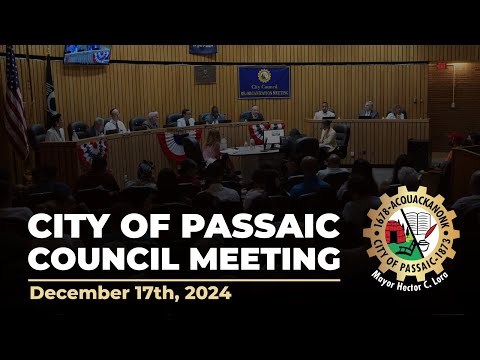
Passaic council introduces rent-stabilization ordinance for first reading, schedules Jan. 7 vote
Summary
The Passaic City Council voted unanimously on Dec. 6 to introduce for first reading an ordinance that would establish a six-year rent stabilization regime, create or clarify a rent-leveling board, and set limits and exceptions for rent increases; second reading is scheduled for Jan. 7, 2025.
The Passaic City Council on Dec. 6 introduced Ordinance 44, a rent-stabilization measure that would limit certain rent increases and create a process for tenant-landlord disputes, voting unanimously to carry the ordinance to a second reading on Jan. 7, 2025.
City leaders said the ordinance aims to balance protections for long-term renters with mechanisms that allow property owners to seek higher rents when justified. Mayor Hector Laura told council members the proposal was a “pragmatic and responsible approach” intended to protect residents while leaving options for landlords who can justify higher rents.
Under provisions explained to the council during the meeting, the proposed ordinance would: - Apply to existing rental units (new construction would be exempt under state law for the life of the mortgage), - Include a six-year sunset so the council must revisit the ordinance after that period, - Allow annual increases within a capped percentage (the ordinance text discussed an annual cap used for planning and comparison), and - Provide specific pathways for landlords to seek larger increases when a unit rents well below HUD regional low-income rent levels (staff cited the Passaic–Bergen–Sussex HUD rent table and noted the example low-income two-bedroom threshold of 14.58 on that chart), and for hardship or capital-improvement requests to be reviewed by the rent-leveling process.
Rent-leveling attorney Christopher Rodriguez explained administrative details during the meeting, saying the ordinance’s low-market provision permits a property owner renting substantially below HUD regional low limits to apply for staged increases (staff described a 20% step-up mechanism in those circumstances). Rodriguez also described how existing city code sections tied to pre-1999 protections would remain in effect for tenants covered by that code, while units not covered would fall under the new ordinance.
Council members debated the measure at length. Supporters, including the mayor and several councilmembers, said the city is receiving daily complaints from residents whose rents doubled or rose sharply after the pandemic and that the ordinance provides an expedited local forum and clearer standards for resolving disputes. Opponents voiced concern that any rent-limiting measure could reduce investment or lead to larger numbers of tax appeals by property owners, which in turn could shift the municipal property-tax burden to homeowners.
Councilman Schwartz urged caution about unintended consequences for development and tax appeals, and asked for more time; other councilmembers and the mayor countered that staff and outside advisers had vetted the proposal and that the ordinance includes exemptions (notably for new construction) and a limited duration.
Councilman Love moved to introduce the ordinance for first reading; Councilman Mello seconded. A roll-call vote recorded unanimous support (Councilmembers Munk, Love, Mello, Schwartz, Garcia, Colombo Tanez and Council President Schaer recorded “yes”), advancing Ordinance 44 to a Jan. 7, 2025 public hearing and second reading.
The council also discussed how the rent-leveling board would operate, including the board’s composition (a landlord representative, a tenant representative and an “expert” slot). Several council members and staff debated whether to explicitly add a homeowner category in the ordinance amendment; staff noted some municipalities permit homeowners on comparable boards and that the ordinance as drafted leaves certain qualifications (for example, “expert” definitions) to council discretion.
Discussion at the meeting emphasized that decisions of a local rent-leveling board could be appealed to court, and that the board’s role is to evaluate individual cases (for example, whether a capital improvement justifies a higher rent). The council’s rent-leveling attorney said the board’s recommendations and decisions would be governed by the ordinance and existing law and that affected parties retain the right to seek relief in landlord–tenant court.
Ending: The council’s vote advanced the ordinance to a second reading and public hearing on Jan. 7, 2025. Council members and staff said they expect additional public comment and technical questions between meetings; council records show the mayor and administration will provide additional materials to members to address concerns raised during the debate.