Get Full Government Meeting Transcripts, Videos, & Alerts Forever!
Get email alerts on the Water Supply topic
No spam. Unsubscribe anytime.
Ivins mayor: county modeling spares one proposed reservoir; city presses water-conservation measures
Summary
Mayor Chris Hart of Ivins City said county modeling by Stantec Engineering has reduced the number of west-side reservoirs proposed in the Washington County Water Conservancy District's 20-year plan from two to one, easing immediate pressure to build a planned reservoir in the Dry Wash area.
Mayor Chris Hart of Ivins City said county modeling by Stantec Engineering has reduced the number of west-side reservoirs proposed in the Washington County Water Conservancy District's 20-year plan from two to one, easing immediate pressure to build a planned reservoir in the Dry Wash area.
The finding "was kind of manna from heaven for many of us," Hart said, adding that only the Graveyard Wash reservoir on the west side will be required under the Stantec analysis. He credited Ivins residents' low water use and local infrastructure plans for the change.
Why it matters: water supply and distribution shape growth and development in Ivins and the surrounding county. The Dry Wash site is in an area residents and local open-space advocates value for trails and rock features; removing it from near-term plans reduces a contentious land-use pressure point while leaving other countywide water challenges unresolved.
Hart said two factors led Stantec to conclude the second reservoir is not presently required: Ivins' unusually low per-capita water use and the city's planned secondary irrigation infrastructure. "Ivins City has the lowest per-capita water use in the entire state of Utah," Hart said, noting the district's new allocation standard of 0.59 acre-feet per new connection had fallen from a prior 0.89 figure; he quoted Ivins figures of about 0.49 and 0.43 acre-feet in recent measures.
Hart described additional local measures the city is moving forward with to reduce demand. The City Council has authorized development of residential irrigation standards with assistance from Utah State University Extension Services, and the city plans to implement automated metering infrastructure (AMI) to give residents near-real-time usage data through a phone app. Hart also cited "transparent billing" that would let customers compare their use to nearby properties and to their own past usage.
Hart and staff emphasized the city will continue conservation work rather than rely solely on supply-side projects. "Our goal is another 10% [reduction] this coming year," Hart said. He also noted that roughly 10% of statewide water is lost to poorly designed or installed residential irrigation systems and said Ivins will promote better design and installation through voluntary standards and an inspection/assurance program; the mayor said the city cannot withhold certificates of occupancy based on the new voluntary irrigation standard.
What remains open: Hart described the Stantec modeling and district decisions as county-level actions; the mayor did not claim final county approval or construction timelines for Graveyard Wash. He also said construction of any citywide secondary irrigation system had been estimated at roughly $30 million if carried out citywide, and that the council and staff were weighing the costs and practicalities.
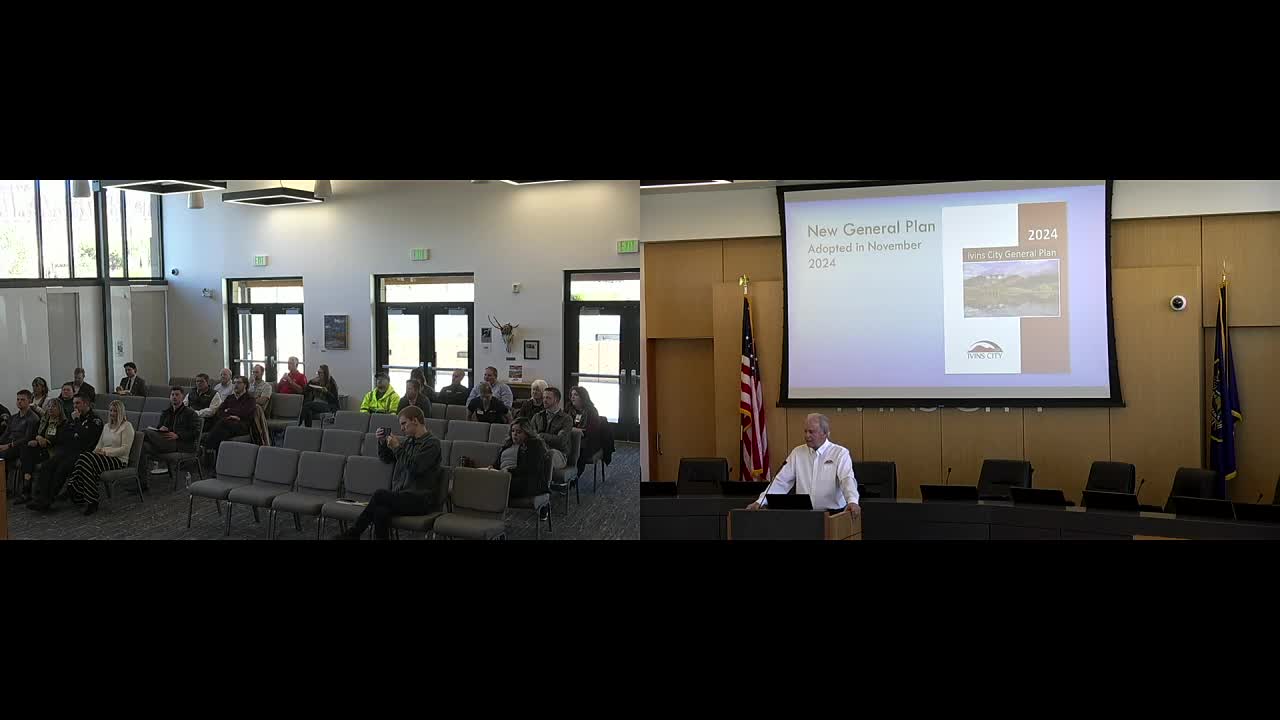
Evidence: Mayor Chris Hart described the Stantec modeling and the district's allocation standard during the Ivins State of the City presentation.