Get Full Government Meeting Transcripts, Videos, & Alerts Forever!
Get email alerts on the Homelessness Services topic
No spam. Unsubscribe anytime.
HSH unveils weapons policy for site-based supportive housing, highlights new dashboard and Restore pilot
Summary
San FranciscoDepartment of Homelessness and Supportive Housing Director Shereen McSpadden presented systemwide data, announced a new anti-violence and weapons lease addendum for site-based permanent supportive housing, described the expansion of the Restore bridge program with DPH, and previewed new shelter openings and closures.
Shereen McSpadden, executive director of the San Francisco Department of Homelessness and Supportive Housing, told the Homelessness Oversight Commission on Feb. 14 that the department will require city-funded site-based permanent supportive housing providers to adopt a site-specific weapons policy and incorporate it into tenant leases through a lease addendum.
McSpadden said the template lease addendum will specify that possessing a weapon in violation of California law, failing to securely store a weapon ("especially in the presence of minors"), threatening someone with a weapon, selling weapons on site, or failing to report stolen weapons or ammunition can constitute a lease breach. She said HSH and the City Attorney worked on the policy and that the rollout will focus on site-based supportive housing where tenants hold leases; shelter weapons policies will remain in place for congregate shelter programs.
The new policy is one of several items McSpadden highlighted in a comprehensive directors report. The department on Tuesday also announced a new homelessness trends dashboard that tracks inflow, outflow and the population homeless at the start of a reporting period. McSpadden said the dashboard went live on the HSH website the morning of the meeting and is intended to help staff and the public understand movements into and out of the homelessness response system.
Why it matters: HSH officials said stronger site-level weapons policies are intended to improve safety for residents, staff and visitors while remaining constrained by state and federal law. The dashboard is meant to make system trends more transparent and to help the city slow inflow into homelessness while increasing exits to stable housing.
Key program updates and data - Outreach and placements: In December, the San Francisco Homeless Outreach Team (HOT) recorded 3,659 engagements and distributed 9,365 items (food, water, hygiene supplies). HOT activated inclement-weather protocols 15 days during December and January, with four level-1 and 11 level-2 activations, McSpadden said. HOT also conducted 223 in-field housing assessments in December, connected 14 households to long-term housing and placed 213 people into shelter.
- Coordinated entry and prevention: Coordinated entry assessments in December numbered 1,036, up from the same time last year; 75% were adults, 15% families, 10% young adults, McSpadden said. The San Francisco Emergency Rental Assistance Program (ERAP), administered by HSH in partnership with the Mayors Office of Housing and Community Development, served 316 households in the past month with an average assistance of $4,565 per household. McSpadden noted there is no new problem-solving funding identified for the rest of the fiscal year.
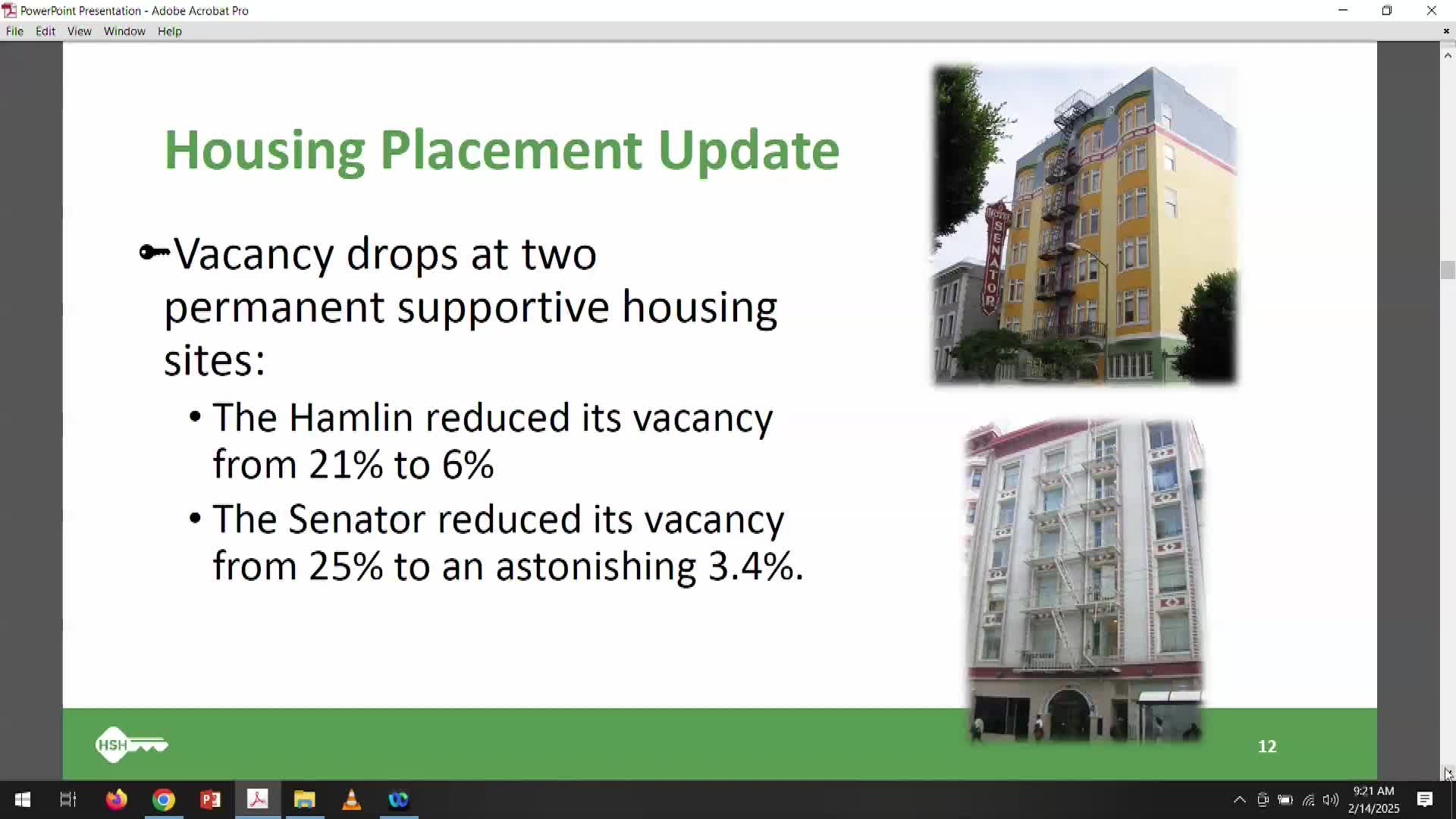
- Housing inventory and vacancies: HSH funds more than 13,000 units across site-based supportive housing, scattered-site supportive housing, rapid rehousing and other programs, McSpadden said. In December the department moved 158 people into permanent housing (125 adults, 22 families with children, 11 young adults). HSH reported an overall 8.5% vacancy rate in site-based supportive housing as of Jan. 20, 2025, and noted a reduction in units offline for maintenance compared with last fall. Two buildings were highlighted for vacancy-reduction progress: the Hamlin Hotel (operated by Chinatown Community Development Corporation) and the Senator (operated by HomeRise), which reduced vacancies from peak rates to 6% and 3.4% respectively through active leasing strategies.
- Restore pilot and health partnerships: McSpadden described an expanded Restore program, a collaboration between HSH and the Department of Public Health (DPH) co-located at the Adante non-congregate shelter. The program offers short-term (typical seven-day) bridge stays to stabilize adults using substances, pair residents with telehealth and substance-use treatment services, and connect them to residential treatment or housing. Restore has expanded from a 9-room pilot to 26 rooms and has served 379 clients; HSH reported 84% of Restore clients initiated medication during their stay and 49% exited to a stable location (shelter, medication-assisted treatment, residential treatment, housing or relocation services).
- Shelter capacity and transitions: As of Feb. 4, HSH reported 3,848 shelter units with a 92% occupancy rate. The adult shelter wait list increased to 390 people as of Jan. 28 (up from 248 the prior month). McSpadden listed new shelter capacity coming online: a Trans Hotel Voucher Program operated by San Francisco Community Health Center (serving 8—10 people) launching this month, and the Gerald Commons program (operated by We Hope) expected in early April 2025, which will prioritize people identified by HOT who are unsheltered or living in vehicles in the Bayview neighborhood. She also announced upcoming closures: the Episcopal Community Services COVID non-congregate shelter will close Feb. 28, 2025, and the Bayview Vehicle Triage Center will close March 3, 2025; HSH said most guests at those sites were offered housing, subsidies, alternative shelter or relocation assistance.
What commissioners and providers asked: Commissioners pressed HSH on the data presentation, including the methodology behind changes in family shelter wait-list counts and the need for demographic segmentation of exits from the wait list (for example, transitional-age youth vs. seniors). They also emphasized the importance of cross-department collaboration with DPH on shelter health services and on design options for higher-acuity shelter beds.
WhatHSH directed staff to do: McSpadden said HSH will provide template lease addendums and begin provider rollouts this month. HSH also said it will continue work with DPH on the Restore expansion, continue tracking site vacancies and rehab timelines, and make the new dashboard publicly available.
Ending: McSpadden closed by noting HSH is advancing procurement pre-development for scattered-site and transitional housing contracts, pursuing targeted convenings for youth and other vulnerable subpopulations, and coordinating with the mayor's office and Board of Supervisors around pending lease extensions and grant agreements.